Poker Bankroll Calculator: Size Your Roll
A poker bankroll calculator turns buy-ins into a dollar target. Here's the formula, a fill-in worksheet, and multipliers for cash and online play.
On this page · 10 sections
A poker bankroll calculator does one simple thing: it turns a buy-in and a buy-in count into a dollar target. The formula is bankroll = buy-in x required buy-ins. Pick the right multiplier for your format, plug in your stake, and you get the exact roll you should have before you sit down. Everything below is that calculator, unpacked so you can run it by hand for any game.
Bankroll calculator
Enter your buy-in and format above for an instant target. Each format is preloaded with a sensible buy-in count from the ranges below; the sections that follow show how to run the same math by hand and tune the count to your own situation.
The core formula
Every bankroll calculator, online or otherwise, reduces to this:
Required bankroll = buy-in × buy-in count
The buy-in is fixed by your stake. The buy-in count comes from format variance — softer, lower-variance games need fewer; wild, high-variance games need many more. That single multiplier is where all the judgment lives.
Buy-in multipliers by format
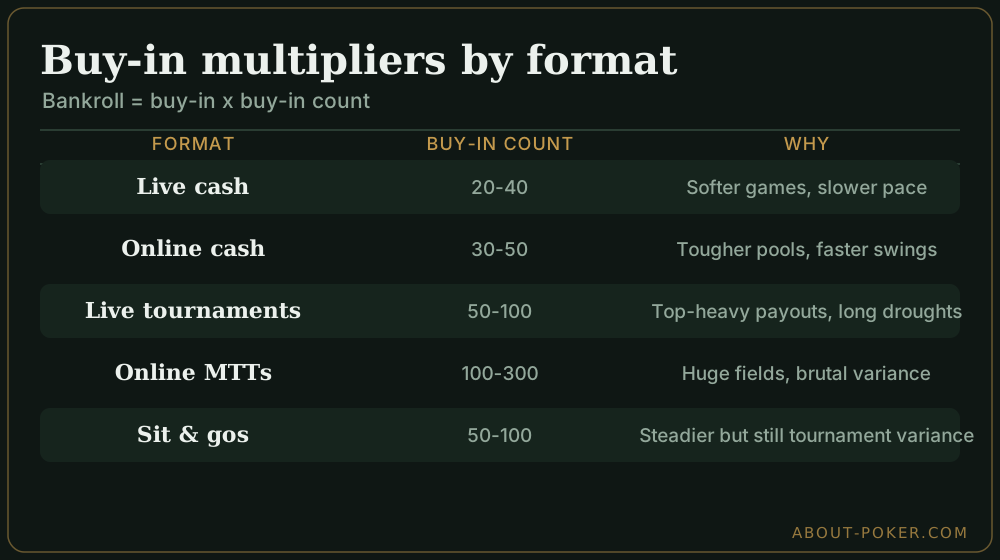
Use these ranges as the multiplier in the formula. They reflect variance and how tough the pool typically is:
| Format | Buy-in count | Why |
|---|---|---|
| Live cash | 20–40 | Softer games, slower pace, easy to move down |
| Online cash | 30–50 | Tougher pools, higher volume, faster swings |
| Live tournaments | 50–100 | Top-heavy payouts, long droughts between cashes |
| Online MTTs | 100–300 | Huge fields, brutal variance, rare big scores |
| Sit & gos | 50–100 | Steadier than MTTs but still tournament variance |
For online play specifically, lean toward the higher end of each range — the games are tougher and you play far more hands, so downswings arrive faster and deeper.
Ready-to-use targets for common stakes
If you don’t want to do any arithmetic, these are the numbers the calculator returns for the most-played stakes, using the buy-in count noted in each row:
| Stake | Buy-in | Buy-in count | Target bankroll | Move-down line |
|---|---|---|---|---|
| $0.25/$0.50 online cash | $50 | 40 | $2,000 | $1,750 |
| $0.50/$1 online cash | $100 | 40 | $4,000 | $3,500 |
| $1/$2 live cash | $200 | 30 | $6,000 | $5,000 |
| $1/$3 live cash | $300 | 30 | $9,000 | $7,500 |
| $2/$5 live cash | $500 | 30 | $15,000 | $12,500 |
| $11 online MTTs | $11 | 150 | $1,650 | $1,595 |
| $55 online MTTs | $55 | 150 | $8,250 | $7,975 |
Target = buy-in × count; move-down line = (count − 5) × buy-in. Nudge the count up if you can’t easily reload or play for income, down if you drop stakes the moment you dip.
Fill-in worksheet
Run your own numbers in four lines:
- My buy-in: $______ (one full stack at my stake)
- My format’s buy-in count: ______ (from the table above)
- Multiply them: buy-in × count = $______
- Move-down line: the buy-in count minus 5, × buy-in = $______
Line 3 is your target roll. Line 4 is the number that, if your bankroll drops below it, means you drop to a smaller stake until you rebuild.
Worked example: online cash
You want to grind $0.50/$1 online no-limit. A full 100 big-blind stack is $100.
- Buy-in: $100
- Buy-in count: online cash is tough and high-volume, so use 40.
- Required bankroll: $100 × 40 = $4,000.
- Move-down line: (40 − 5) × $100 = $3,500. Drop to $0.25/$0.50 if your roll falls below it.
So $4,000 is the number to have before sitting in that game full-time, and $3,500 is the tripwire that protects it. The same arithmetic scales to any stake — double the buy-in, double the target.
Worked example: online MTTs
Tournaments are the same formula with a far bigger count, because you can run bad for hundreds of games between real scores. Say your staple is the $22 online MTT (a $22 total buy-in).
- Buy-in: $22
- Buy-in count: big online fields swing hard, so use 150 (mid-range for online MTTs).
- Required bankroll: $22 × 150 = $3,300.
- Move-down line: (150 − 5) × $22 = $3,190. Drop to $11s if your roll falls below it.
Notice the count is roughly four times the cash number: a $22 tournament needs a bigger roll than a $50 cash buy-in even though the seat costs less than half as much. That gap is variance, not fussiness — a 100-buy-in downswing is routine in tournaments and would be alarming in cash. If you play a mix of buy-ins, size the count off your average entry, and treat any single bullet bigger than ~2% of your roll as a shot you take deliberately, not a regular game.
Adjusting the multiplier to you
The calculator gives a range, not a single answer, because your own situation shifts the count:
- Push higher if you can’t easily reload your roll, play a loose high-variance style, or rely on poker for income.
- Pull lower only if you move down instantly and treat the money as pure recreation.
If you’d rather anchor the count to your actual downswing risk instead of a rule of thumb, size it against your risk of ruin — the odds a normal losing stretch busts you at a given roll size.
Why the online multiplier runs higher
New online players often copy live buy-in counts and end up short. Online play compresses variance into far less calendar time: you might play 2,000 hands in an evening versus 200 live. More hands per session means downswings hit harder and faster, and the pools are tougher, so a thinner edge produces wider swings. That’s why an online poker bankroll calculator should default to 30–50 buy-ins for cash rather than the 20–30 that live grinders sometimes get away with.
From calculator to a full plan
The formula gives you a number; a plan gives you a system around it. Once you’ve calculated your target, map it against every stake you might play using the bankroll management chart, confirm the total against the broader how much bankroll you need guidance, and remember the multiplier only holds if your edge is real — which is ultimately a question of making +EV decisions the math rewards.
Bottom line
A poker bankroll calculator is just buy-in × buy-in count, with the count set by your format: 20–40 for live cash, 30–50 for online cash, 100-plus for tournaments. Run the four-line worksheet, keep a move-down line five buy-ins below your target, and recalculate every time you change games. The full system lives in the bankroll management hub.
Frequently asked
How does a poker bankroll calculator work?
It multiplies your buy-in by the number of buy-ins appropriate for your format. Bankroll = buy-in x required buy-ins. For a $50 online cash buy-in at 40 buy-ins, that's $2,000. Formats with higher variance use a larger multiplier.
What multiplier should an online poker bankroll calculator use?
Online cash games are tougher and higher-volume, so use 30 to 50 buy-ins. Online tournaments swing far harder and call for 100 or more buy-ins. Live cash can drop to 20 to 40 because the games are typically softer.
Can I use one calculator for cash and tournaments?
The formula is the same, but the multiplier changes drastically. Cash games use 20 to 50 buy-ins; multi-table tournaments need 100-plus. Never apply a cash multiplier to tournaments — you'll be badly under-rolled.
How often should I recalculate my bankroll target?
Recalculate whenever you change stakes, formats, or risk tolerance. Your target is a moving line: as your roll grows past the next stake's threshold, the calculator tells you the new number to clear before you move up.