How to Play Poker
Learn how to play poker from scratch: the deal, betting rounds, hand rankings, and a beginner's first hand. Your starting point for every poker game.
On this page · 9 sections
Poker is a family of card games where players bet on the strength of their hands, and the best hand — or the last player who hasn’t folded — wins the pot. The rules of any single variant take minutes to learn; the skill is in the betting. This hub is your starting point.
The shape of every poker game
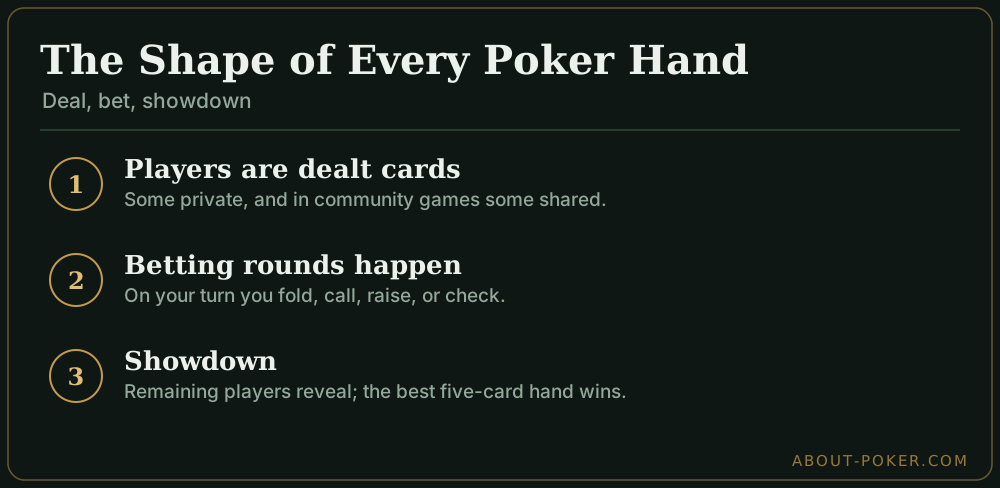
Whatever the variant, the pattern is the same:
- Players are dealt cards — some private, and in community games some shared.
- Betting rounds happen — on your turn you fold, call, raise, or check.
- Showdown — remaining players reveal, and the best five-card hand wins.
You win two ways: by having the best hand at showdown, or by betting so that everyone else folds before it. That second path — winning without the best hand — is what makes poker a game of skill, not just cards.
The betting actions
| Action | When | What it does |
|---|---|---|
| Check | No bet to face | Pass without wagering |
| Bet | No bet yet this round | Put chips in; others must call, raise, or fold |
| Call | Facing a bet | Match it to stay in |
| Raise | Facing a bet | Increase it |
| Fold | Any turn | Give up the hand |
A round ends when everyone still in has wagered equally (or folded). Then the next cards come and a new round begins.
Hand rankings: memorize these first
Every variant is decided by the same ladder, strongest to weakest: royal flush, straight flush, four of a kind, full house, flush, straight, three of a kind, two pair, one pair, high card. You use it every single hand, so learn it cold — the full guide is in poker hand rankings.
Which game should a beginner learn?
Texas Hold’em. It has the simplest structure (two private cards, five shared), the most available games online and live, and the deepest learning resources. Almost every other variant builds on concepts you’ll learn here. Omaha, stud, and the rest come later.
Blinds: how the betting gets started
Before any cards are dealt, two players are forced to put chips in so there’s something to fight over. The player to the left of the dealer button posts the small blind, and the next player left posts the big blind (usually double the small blind). In a $1/$2 game, that’s a $1 small blind and a $2 big blind. The button moves one seat clockwise each hand, so everyone pays the blinds in turn. Some games (often stud, or later tournament stages) also use an ante — a small forced bet from every player — but in Hold’em the blinds do the job. Without them, everyone could simply fold free hands forever; the blinds put money in the pot and give the action a reason to start.
The big blind also sets the minimum bet for that first round, and it defines the minimum raise: any raise must be at least the size of the previous bet or raise. So facing the $2 big blind, the smallest legal raise is to $4 (raising by another $2).
A beginner’s first hand, step by step
Here’s a full Texas Hold’em hand at a $1/$2 table, so you can see exactly how the deal and betting flow together. You’re in the big blind holding A♠ K♣.
- Blinds posted. The player to your right posts the $1 small blind; you post the $2 big blind. The pot is $3 before a card is dealt.
- Hole cards dealt. Everyone gets two private cards (your hole cards) face down. Yours are A♠ K♣.
- Pre-flop betting. Action starts left of the big blind. One player calls $2, everyone else folds to the small blind, who folds. As the big blind you already have $2 in, so you can check (take no further action) since no one raised. Pot: $5.
- The flop. The dealer burns one card and turns three community cards face up — the flop: K♦ 9♥ 4♠. You now have top pair with the best kicker (a pair of kings, ace alongside). You bet $3; your opponent calls. Pot: $11.
- The turn. A fourth community card, the turn, is dealt: 2♣. It doesn’t help your opponent. You bet $6, they call. Pot: $23.
- The river. The fifth and final community card, the river, comes: J♠. You bet $12; your opponent calls. Pot: $47.
- Showdown. Both players reveal. Your opponent turns over Q♠ J♦ — a pair of jacks. You make your best five cards from your two hole cards plus the five on the board: your K♣ pairs the K♦ on the board, giving you a pair of kings with A-J-9 as kickers. That beats their pair of jacks, and you win the $47 pot.
That’s a complete hand: forced blinds start it, hole cards and four betting rounds shape it, and the best five-card hand wins at showdown. The complete beginner’s guide drills deeper, and Texas Hold’em is where you start playing.
The main poker variants
Once you know Hold’em, the other games are easy to pick up — they share the same hand rankings and betting logic:
| Variant | Key difference |
|---|---|
| Texas Hold’em | 2 hole cards, 5 shared; the standard |
| Omaha | 4 hole cards, must use exactly 2 |
| Seven-card stud | No community cards; some cards face-up |
| Razz | Lowball stud — the worst hand wins |
| Short deck | 2–5 removed; flushes beat full houses |
Start with Hold’em and branch out only once it feels natural. Each variant rewards the same core skills: position, hand selection, and reading opponents.
Etiquette and table basics
A few unwritten rules keep games running smoothly: act in turn (don’t fold or bet out of order), keep your cards and chips visible, don’t discuss a hand you’re not in while it’s live, and be clear when you bet or raise (announce the amount). Live or online, acting in turn and betting clearly are the two habits that mark a player who knows what they’re doing.
Start here
New to everything? Read the beginner’s guide, memorize the hand rankings, then learn Texas Hold’em.
Frequently asked
How does poker work?
Players are dealt cards and bet over one or more rounds. You win either by having the best five-card hand at showdown, or by betting enough that everyone else folds.
What are the basic rules of poker?
Learn the hand rankings, the betting actions (fold, call, raise, check), and the flow of a hand. In community-card games like Hold'em you combine private cards with shared cards to make your best five.
Is poker hard to learn?
The rules of any one variant take minutes. The skill — betting, position, and reading opponents — is what takes time. Start with Texas Hold'em.