Can You Call a Raise and Then Raise
Can you call a raise and then raise in the same turn? Why calling ends your action, the string-bet rule, and how to legally re-raise when action comes back to you.
On this page · 5 sections
Short answer: no — you cannot call a raise and then raise on the same turn. Once you call, your action is done and your turn is over. This trips up a lot of newer players who reach out with a call, see a reaction, and then try to bump it up. That is not allowed, and understanding why comes down to two core rules: one action per turn, and the string-bet rule. But there is a legal path to re-raising, and it is worth knowing exactly when it opens up.
Calling closes your turn
In poker, each turn you get one action: fold, check, call, bet, or raise. When you choose to call, you are matching the current bet and declaring that your decision is made. The moment your call is complete, the action passes to the next player. You do not get to change your mind and add a raise on top — the call is binding and your turn is finished.
So the sequence “call, then raise” in a single turn is impossible. You either call (and stop) or you raise (as one motion). If you want to put in more money, you must decide that before you commit the call. Our guide to how raising works covers the mechanics of a legal raise.
Why the rule exists: string bets
The specific reason you cannot call and then raise is the string-bet rule. A string bet is any bet or raise made in multiple motions or with a hesitation, rather than in one clear declaration. The rule exists to stop players from putting out chips, watching how opponents react, and then adding more.
If calling and then raising were legal, a player could slide out a flat call, study everyone’s faces and body language, and only then decide to raise once they saw who looked weak. That is a huge unfair edge. So the rule is strict: announce your full action first, or make it in one motion. If you say “call” or push out a calling amount, that is your action. Any chips you then try to add for a raise are pulled back and the call stands. Read string bets rules and etiquette for the exact motions that count.
The clean way to raise is to declare it verbally first — “raise” — before touching a chip. A verbal declaration is binding and removes all ambiguity. If you stay silent, you must move all your raise chips in one single forward motion.
When you CAN raise after calling
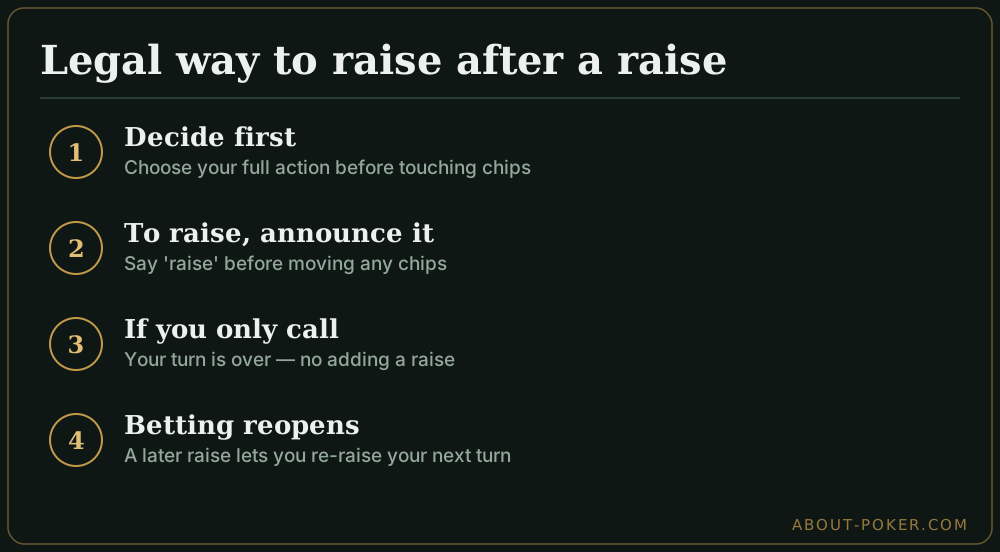
Here is the important nuance. You cannot call and raise on the same turn — but you can absolutely raise on a later turn in the same betting round.
Betting rounds go around the table, and they reopen whenever someone makes a full raise. So if you call a raise, and then a player behind you re-raises, the action eventually comes back to you. On this new turn, you have a fresh set of options: fold, call the new raise, or re-raise. Your earlier call only closed your earlier turn; it does not lock you out of the round.
A worked example
You are on the button in a $1/$2 game holding K♠ K♣.
- A player in middle position raises to $8.
- You call $8. Your turn is now over — you cannot suddenly make it $25. If you tried to add chips now, the dealer would stop you and your call would stand.
- The big blind, however, re-raises to $30.
- The action travels back to you. This is a brand-new turn. Now you are perfectly entitled to re-raise — say, to $90 — because the betting reopened.
So with your pocket kings you did not get “trapped” by calling. You simply had to wait for the round to come back to you. The only thing you could never do was call the $8 and then, in the same breath, bump it to $25.
Common mistakes and a checklist
- Reaching back for more chips after a call. The call is final. Decide your full action first.
- Silent multi-motion raises. Two trips to your stack without announcing “raise” is a string bet; the extra chips get pulled back.
- Thinking a call locks you out for the whole round. It does not — a later raise reopens your options.
- Assuming a verbal call can be upgraded. Once you say “call,” it stands. You cannot say “call… actually, raise.”
Quick checklist for acting cleanly:
- Decide your full action before you touch chips.
- To raise, say “raise” first, then move your chips.
- If you are only calling, put out the exact amount in one motion.
- Want to raise but action already passed? Wait — if someone re-raises, you get another turn.
The rule is simple once it clicks: one action per turn, declared cleanly. You can never call and raise together, but a re-raise is always available the next time the betting swings back to you. For more on the mechanics of matching a bet, see poker rules on calling a bet.
Frequently asked
Can you call a raise and then raise in the same turn?
No. Once you call, your action is complete for that betting round and your turn is over. You cannot call and then raise on the same turn. You can only raise if you do it as a single action, or when the betting comes back around to you after another player raises.
Why is calling and then raising not allowed?
It is a form of the string-bet rule. A player must declare or push their full action at once so opponents are not misled. Putting out a call and then reaching back to add a raise gives an unfair read on reactions, so it is prohibited. The call stands and the raise is disallowed.
Can you raise after you have already called earlier in the hand?
Yes, if a later player raises and the action returns to you in the same betting round, you may then re-raise. Your earlier call only closed that turn. A new raise reopens the betting and gives you a fresh chance to raise, call, or fold.