Poker Odds & Math
Poker odds and math made simple: pot odds, outs, equity, and the rule of 4 and 2 — the numbers that turn guesses into profitable decisions.
On this page · 7 sections
Poker isn’t pure math, but the math is the floor under every good decision. You don’t need to be a statistician — a handful of simple tools (pot odds, outs, equity, and the rule of 4 and 2) cover the vast majority of spots you’ll ever face. This hub ties them together.
The three numbers that matter
Almost all in-game math reduces to three quantities you can estimate in seconds:
| Concept | What it tells you | Covered in |
|---|---|---|
| Outs | How many cards improve your hand | Counting outs |
| Equity | Your % chance to win the pot | Rule of 4 and 2 |
| Pot odds | The price you’re being offered | Pot odds |
Put them together: count your outs, convert to equity with the rule of 4 and 2, and compare that to your pot odds. If your equity beats the price, calling is profitable. That single loop is the engine of winning play.
A 20-second example
You have a flush draw on the flop — 9 outs. Rule of 4: 9 × 4 ≈ 36% to hit by the river. Your opponent bets $25 into a $75 pot, so you call $25 to win a final pot of $125 — that’s 20%. Your 36% beats the 20% price, so it’s a clear, profitable call. No spreadsheet required.
If you think in ratios instead of percentages, the same call reads as 4:1: you’re risking $25 to win the $100 already in the pot. Convert a ratio to a percentage by adding the two sides and dividing — 25 ÷ (100 + 25) = 20%. Your 9-out draw hits about 1.8:1 against on the flop, comfortably better than the 4:1 you’re being laid.
Outs-to-equity reference chart
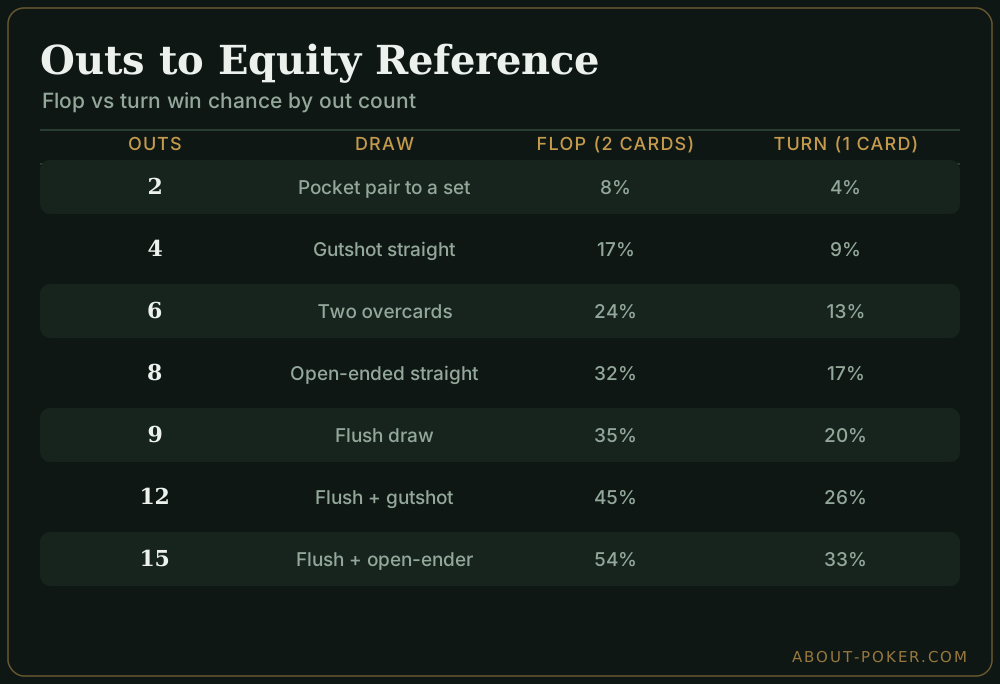
Count your outs, then read across. The flop column assumes you’ll see both the turn and river (i.e. you’re all-in on the flop); the turn column is a single card to come. The rule-of-4-and-2 estimate is in parentheses so you can see how close the shortcut lands.
| Outs | Draw example | Flop (2 cards) | Turn (1 card) |
|---|---|---|---|
| 2 | Pocket pair to a set | 8% (8%) | 4% (4%) |
| 4 | Gutshot straight | 17% (16%) | 9% (8%) |
| 6 | Two overcards | 24% (24%) | 13% (12%) |
| 8 | Open-ended straight | 32% (32%) | 17% (16%) |
| 9 | Flush draw | 35% (36%) | 20% (18%) |
| 12 | Flush + gutshot | 45% (48%) | 26% (24%) |
| 15 | Flush + open-ender | 54% (60%) | 33% (30%) |
Notice the rule of 4 starts to overstate equity once you get past about 8 outs — at 15 outs it says 60% but the real number is 54%. A quick fix: for big draws, multiply by 4 and subtract 1 for every out above 8 (15 outs → 60 − 7 ≈ 53%). The rule of 2 for the turn stays accurate throughout.
Beyond the basics
Once the core loop is automatic, a few more ideas sharpen it:
- Implied odds — the extra chips you’ll win on later streets when your draw hits, which can justify a call raw pot odds don’t.
- Reverse implied odds — the times you make your hand but still lose to a bigger one; discount draws that often finish second-best.
- Expected value (EV) — the long-run average profit of a decision, the concept all the shortcuts approximate.
Here’s the same idea in dollars. It’s the turn, you hold that flush draw (9 outs ≈ 20%), and your opponent bets $50 into a $100 pot. You call $50 to win a final pot of $200 — a price of 25%. On raw pot odds this is a fold, and the EV proves it:
- Call, no implied odds: (0.20 × $150) − (0.80 × $50) = $30 − $40 = −$10.
- Call, with implied odds: if you expect to win an extra $100 from a stacked-off opponent when your flush lands, the win side becomes 0.20 × $250 = $50, so EV = $50 − $40 = +$10. The implied odds flip a losing call into a winning one.
- Reverse implied odds: if a third player could hold a bigger flush, some of your “wins” actually lose a big pot. Shade that expected extra from $100 down to $50, and the win side is 0.20 × $200 = $40, so EV = $40 − $40 = $0 — right back to break-even. That’s why you discount draws that can finish second-best.
Why the math only pays off over time
Any single hand is noisy — you can make the mathematically correct call and still lose. The math wins over thousands of hands, which is why it pairs with bankroll management: you need to survive the swings for your good decisions to average out in your favor.
Start here
Begin with the single most useful concept — what are pot odds — then learn to count outs cleanly. Put both to work in Texas Hold’em, the format where you’ll use them most.
Common math mistakes to avoid
- Counting tainted outs as clean — a card that completes your draw but gives an opponent a better hand isn’t a full out.
- Ignoring position — being in position lets you realize your equity more often by taking free cards.
- Chasing on the flop without a turn plan — check whether you’ll still get the right price on the next street.
- Forgetting reverse implied odds — the times you hit your draw and still lose to a bigger one. Discount draws that often finish second-best.
Avoid these four and your in-game math will be sound far more often than not.
Frequently asked
Do you need to be good at math to play poker?
No. Poker uses simple arithmetic — counting outs, comparing a bet to the pot, and a couple of shortcuts like the rule of 4 and 2. If you can multiply small numbers, you have enough math to win.
What is the most important poker math concept?
Pot odds — comparing the price of a call to how often your hand wins. Almost every profitable call or fold traces back to it.
What is the rule of 4 and 2?
Multiply your outs by 4 on the flop and by 2 on the turn to estimate your chance of hitting. Nine flush outs ≈ 36% on the flop.