How to Use Pot Odds at the Table
Use pot odds in real hands with one routine: read the price from the bet size, estimate your equity, compare, then adjust for later streets.
On this page · 3 sections
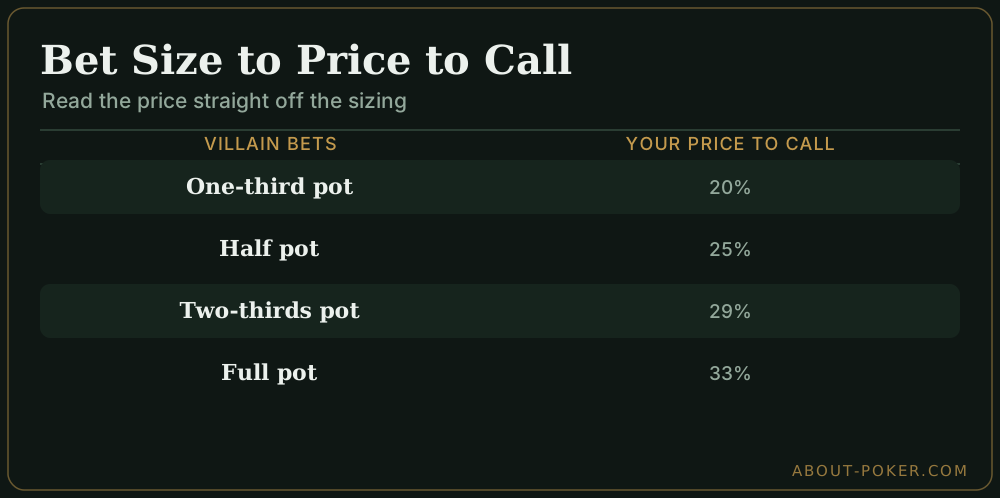
Most of using pot odds is reading a price off the bet size without doing arithmetic. Since bets are usually a fraction of the pot, the price is fixed by the fraction:
| Villain bets | Your price to call |
|---|---|
| One-third pot | 20% |
| Half pot | 25% |
| Two-thirds pot | 29% |
| Full pot | 33% |
Memorize those four rows and the “read the price” step becomes instant recognition. Then it’s just a three-part routine on top: price, equity, decide — with a fourth check for the money still to come.
Get your equity
The other side of the scale is how often you win. Count outs and apply the rule of 4 and 2: outs × 4 on the flop, outs × 2 on the turn.
- Flush draw, 9 outs → about 19.1% on one card.
- Open-ended straight, 8 outs → about 17.0% on one card.
- Combo draw, 15 outs → about 31.9% on one card.
For spots that aren’t clean draws, count the cards that actually give you the best hand and read off the same one-card ballpark (outs ÷ 47):
| Spot | Outs | One card |
|---|---|---|
| Gutshot straight | 4 | ~8.5% |
| One pair → trips/two pair | 5 | ~10.6% |
| Two overcards | 6 | ~12.8% |
| Flush draw + gutshot | 12 | ~25.5% |
When you’re unsure, count conservatively — discard outs that could make an opponent a bigger hand (a flush card that pairs the board, an overcard that gifts them two pair) rather than counting them at full value.
Compare, then adjust
Equity above the price is a call; equity below it is a fold — unless later streets rescue it. A flush draw (19.1% for one card) facing a half-pot bet (25%) is under the price, a fold on immediate odds. The same draw against a third-pot bet (20%) is basically break-even, and against anything smaller it’s a comfortable call. Same hand, different price, opposite decision — that’s the whole discipline.
The adjustment is implied odds: the chips you’ll win after you hit. When equity falls just short, ask whether your draw is disguised, whether your opponent will pay off a big hand, and whether stacks are deep enough for real money to remain. If all three are yes, a slightly bad immediate price becomes a good overall call.
When there’s no fourth step: all-ins and the river
The adjustment vanishes when no more money can go in. Facing an all-in, or any river bet, implied odds are zero — there is no later street to pay you off — so the price is the whole decision. Your equity must clear the price on its own, full stop.
Two things change with it. First, an all-in with cards to come buys you both remaining cards for one price, so use the flop-to-river number (rule of 4), not the one-card figure: a bare flush draw is about 35% to get there over two cards, enough to call a half-pot shove (25%). Second, on the river you have no outs, so “equity” becomes how often your hand is already best — a bluff-catch. If a villain shoves $50 into a $100 pot, you’re getting 50 ÷ 200 = 25%, so you only need to be good one time in four to call.
Multiway pots: the price holds, the bar rises
The price you read off a bet size doesn’t change with more players — it’s still call ÷ (pot after your call). What changes is the equity you need. Heads-up you only have to beat one hand; against two or three callers your draw has to hold up against the whole field, and even a made hand you’d bet for value shrinks in a crowd. Tighten up: fold marginal draws you’d take heads-up, and lean on clean, nut-making outs (the nut flush, the top-end straight) whose value survives being shown down against several opponents. The offset is dead money — when several players have already called the same bet, the pot is laying you a better immediate price, which is why nut draws multiway are often a snap-call while weak ones become clear folds.
One hand, all the way through
You hold 7♥ 6♥ on K♥ 9♥ 2♣ — a flush draw. Pot is $80, opponent bets $40 (half pot).
- Price. Half-pot, so 25% (or
40 ÷ 160). - Equity. Nine hearts, one card to come, about 19.1%.
- Compare. 19.1% is below 25% — immediate odds say fold.
- Adjust. Deep stacks, a well-hidden flush, and a bet that smells like a strong king that’ll pay a river bet. Those implied odds cover the five-point gap, so it’s a call.
Drop the fourth step and you fold a profitable hand; keep it and you don’t. That gap is the difference between knowing pot odds and using them.
Your betting is the same tool pointed outward — size up to charge draws, size down to let them chase cheaply. Building that into a plan is postflop work, and the concept itself lives in what are pot odds.
Frequently asked
How do you use pot odds in a real hand?
Read the price the bet gives you, estimate your equity from your outs, and continue only when your equity beats the price. Then check whether later-street money changes the call.
When should you use pot odds?
Any time you face a bet with a draw or a marginal made hand. They matter most on the flop and turn with drawing hands, where the price-versus-equity question is sharpest.
Which bet sizes should I memorize the price for?
The four common ones: a third-pot bet prices you at 20%, half-pot at 25%, two-thirds at 29%, and a full-pot bet at 33%. Those cover most of what you'll face.
Do pot odds apply when you are the one betting?
Yes, in reverse. Your bet sets the price your opponent gets, so sizing up denies draws a good price and sizing down offers a cheap call. Your sizing is a pot-odds decision too.
How do pot odds work with implied odds?
Start with the immediate price. If your equity falls a little short, add the chips you expect to win on later streets — your implied odds — and call if the total makes the play profitable.