Implied Odds Explained
Implied odds are the extra chips you win on later streets when a draw hits. Here's the break-even test, a gutshot example, and when to trust them.
On this page · 5 sections
Implied odds are the extra chips you expect to win on later streets when your draw hits. They let you profitably call a bet the immediate pot odds say is too expensive, because the pot you can eventually win is bigger than the one sitting there now.
The reason this matters is that pot odds only see the chips in front of you. When you complete a hidden draw, opponents routinely pay you off with a strong-but-losing hand on the turn or river. That future money is real profit, and a raw pot-odds calculation ignores every chip of it. Implied odds are how you put it back into the decision.
The break-even test
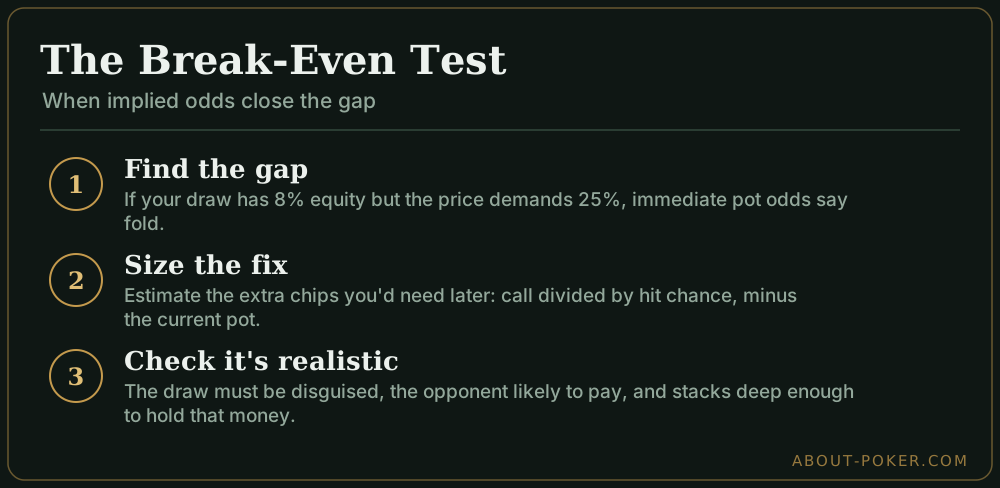
You don’t need a formula for the concept, just a two-step check.
- Find the gap. If your draw has 8% equity but the price demands 25%, immediate pot odds say fold.
- Size the fix. Work out how many extra chips you’d need to win later to close that gap. If extracting that amount from your opponent is realistic, the fold becomes a call.
To get your equity fast, use the rule of 2 and 4: multiply your outs by 2 for one card to come, or by 4 when you’ll see both the turn and river. Then compare it to the price the pot is laying:
| Pot odds offered | Equity you need | Outs (one card) |
|---|---|---|
| 4:1 (call 20% of the final pot) | 20% | ~10 |
| 3:1 (25%) | 25% | ~12 |
| 2:1 (33%) | 33% | ~16 |
| 1:1 (50%) | 50% | — |
If your outs fall short of that column, you have a gap — and implied odds are the only thing that can close it.
The shortcut most players use for step two:
Extra chips needed ≈ (call ÷ chance to hit) − current pot
If that number is comfortably below what your opponent might pay you when you get there, the implied odds carry the call.
A gutshot with a deep stack
You hold J♦ 10♦ on Q♠ 8♥ 3♣. That’s a gutshot to the nut straight — a 9 fills it, 4 outs, about 8% on the turn. Your opponent bets $20 into a $40 pot, so you call $20 to win $60: a price of 25%.
Immediate odds are hopeless. 8% is nowhere near 25%, and on pot odds alone you fold instantly. (If you were guaranteed to see both cards for that one $20 call — say you’re all-in — the gutshot climbs to about 16%, but a single bet on the turn only buys you one card, so 8% is the honest number here.)
Now add the future. You both started with $500 behind. Run the shortcut:
$20 ÷ 0.08 = $250 needed to win at showdown → minus the $60 already there = about $190 more you’d have to extract when you hit.
With roughly $480 still behind and a straight nobody sees coming, winning $190 more across the turn and river is very realistic against someone glued to top pair. The call flips from clear fold to justifiable — entirely because of the money still to come. Position sharpens this: acting last, you extract more when you hit and lose less when you miss.
Put a number on the threshold: that $190 you need to win is about 3× the current $60 pot. As a rule of thumb, a bare gutshot wants roughly 10–15× the call left in the stacks to be worth chasing on implied odds alone — here, $190 needed against $480 behind clears that bar comfortably. Flush and open-ended draws hit more often, so they need far less; a gutshot is near the bottom of what’s ever worth peeling.
Now change one input. Give both players just $60 behind instead of $480, and the math collapses — there aren’t $190 left to win, so the same gutshot on the same board is an easy fold. Stack depth alone decides it.
One more input matters: use the effective stack, not your own. If you have $480 but the bettor covers only $90, then $90 is the most you can ever win from them — well short of the $190 you need — and the call fails. Implied odds are capped by whoever has the shorter stack.
Multiway changes the calculus
Add players and the picture shifts both ways. The upside: with two or three opponents behind, the pot you win when your straight hits is bigger, and someone is more likely to have the strong-but-losing hand that pays you off — genuine implied odds. The downside is reverse implied odds climb too: the more players in the pot, the more likely one of them already has, or is drawing to, a hand that beats your completed draw. In multiway pots, discount dominated draws (low flushes, the dumb end of a straight) hard, and lean on the disguised nut draws that get paid and win.
Reverse implied odds: the twin trap
Implied odds have an evil twin. Reverse implied odds are the chips you lose when you complete your draw and still finish second-best — making the low end of a straight, or a small flush into a bigger one. These are the “I hit and lost anyway” hands, and they’re where a lot of stacks go.
The practical rule: a king-high flush draw has excellent implied odds, but a five-high flush draw can cost you everything when someone turns up with the ace. When your draw can be dominated, shade your implied-odds estimate downward — sometimes all the way back to a fold.
The three conditions
Implied odds are strongest when all three of these hold:
- The draw is disguised. A gutshot or a set is far harder to read than an obvious four-flush board, so opponents keep firing into you.
- The opponent will pay. Implied odds need a payer. A calling station or someone married to top pair is ideal; a nit who folds to any turn card gives you nothing to win.
- Stacks are deep. With a pot-sized bet left behind, there’s little to collect later and implied odds shrink toward zero. The deeper the money, the more they matter.
Miss any one of them and the extra chips you’re counting on may never arrive. When they line up, implied odds turn “the price is wrong” into “the price is wrong for now” — count the pot with pot odds, tally your outs, and put it to work at the Texas Hold’em table.
Frequently asked
What are reverse implied odds?
The chips you lose when your draw completes but still finishes second-best — like making a small flush against a bigger one. They make some draws worth less than their pot odds suggest.
When should you rely on implied odds?
When your draw is disguised, your opponent is likely to pay off a big hand, and stacks are deep enough that real money is still left to win on later streets.