Texas Hold'em
How to play Texas Hold'em: the rules, the betting rounds, starting-hand basics, and the strategy that turns a beginner into a winning player.
On this page · 9 sections
Texas Hold’em is the world’s most popular poker game: two private cards each, five shared community cards, and the best five-card hand wins. If you learn one poker game, learn this one — almost everything else builds on it.
The table setup
- Players. A table seats 2 to 10. Nine- or ten-handed is a “full ring” game; six-handed (“6-max”) is faster and more aggressive; two players is “heads-up.”
- The dealer button. A small disc marks the nominal dealer. After every hand it moves one seat clockwise, so the blinds and the order of action rotate — everyone pays the blinds equally over time.
- The blinds. The player left of the button posts the small blind, the next player the big blind (usually double the small). These forced bets start the pot.
- Limit vs no-limit. In No-Limit Hold’em — by far the most common — you can bet any amount up to your entire stack at any time. In Limit Hold’em, bets and raises come in fixed increments. Most cash games and tournaments you’ll see are No-Limit.
The four betting rounds
A hand of Hold’em plays out across four streets. The two players left of the dealer post the small and big blinds to seed the pot.
- Pre-flop — everyone gets two hole cards; first betting round.
- The flop — three community cards dealt face-up; second round.
- The turn — a fourth community card; third round.
- The river — the fifth and final card; last round, then showdown.
You build your best five-card hand from your two hole cards and the five on the board, in any combination.
The betting actions
When it’s your turn, you have a small, fixed set of options. Which ones are available depends on whether anyone has bet ahead of you.
- Check — pass the action to the next player without putting in money. Only allowed if no one has bet yet this round.
- Bet — put chips in when no one else has this round. Everyone after you must at least match it to stay in.
- Call — match the current bet to stay in the hand.
- Raise — increase the current bet. Opponents must then call the new, larger amount, re-raise, or fold.
- Fold — give up your cards (and any chips already in the pot) and sit out the rest of the hand.
A round of betting ends when everyone still in has put in the same amount — or when everyone but one player has folded, which ends the whole hand right there.
The hand rankings
Your goal is the best five-card hand. From strongest to weakest:
- Royal flush — A-K-Q-J-10, all one suit.
- Straight flush — five in sequence, all one suit (e.g. 9-8-7-6-5 of hearts).
- Four of a kind — four cards of the same rank.
- Full house — three of a kind plus a pair.
- Flush — five cards of one suit, not in sequence.
- Straight — five in sequence, mixed suits.
- Three of a kind — three cards of the same rank.
- Two pair — two different pairs.
- One pair — two cards of the same rank.
- High card — none of the above; your highest card plays.
Ties are broken by the next-highest card (the “kicker”). For the full detail and examples, see the hand rankings guide.
Starting hands: the first real skill
Most beginners lose by playing too many hands. A simple, disciplined starting range beats loose play immediately.
| Tier | Examples | Play from |
|---|---|---|
| Premium | AA, KK, QQ, AK | Any position |
| Strong | JJ, TT, AQ, AJs, KQs | Most positions |
| Speculative | small pairs, suited connectors | Late position, cheaply |
| Trash | offsuit junk (J4o, 9-2) | Fold |
The same hand is worth more in late position, because acting after your opponents is a lasting edge — see why position matters.
A quick worked hand
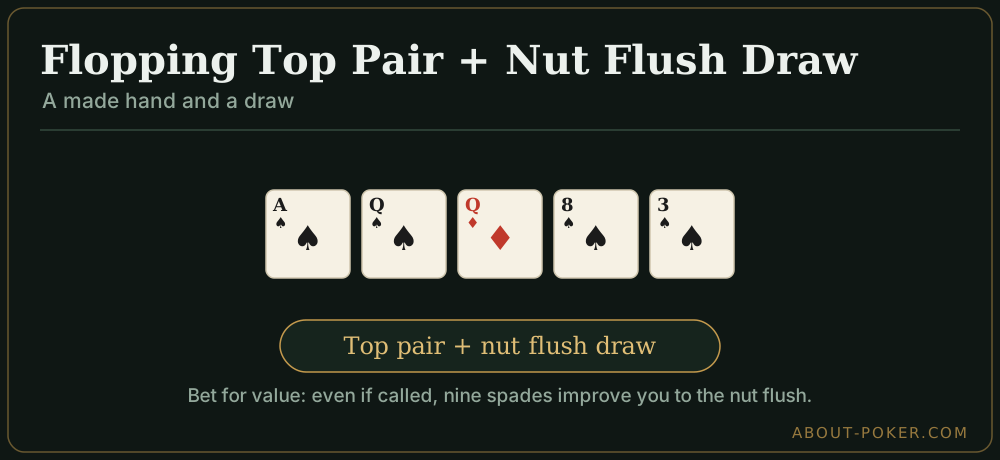
You hold A♠ Q♠ on the button. The flop is Q♦ 8♠ 3♠.
- You’ve flopped top pair (queens) with a strong kicker, plus the nut flush draw (any spade makes the best flush).
- That’s a powerful combination — a made hand and a draw. You can bet for value and to build the pot, knowing even if called you have many cards that improve you.
Say you bet, one opponent calls, and the streets play out to showdown:
- Flop
Q♦ 8♠ 3♠. You bet; your opponent calls. You hold top pair with the nut flush draw — 9 spades are still live to complete your flush. - Turn
7♥. No spade, but you’re still ahead with top pair. You bet again; opponent calls. - River
2♠. A spade lands. Your A♠ Q♠ now makes the nut (ace-high) flush — the best possible hand on this board. You bet for value; opponent calls and shows Q♥ J♦ (a pair of queens). You win.
Counting how often that flush completes is where the math comes in — learn pot odds to know when a call is profitable.
How to actually improve
- Play tight-aggressive. Enter fewer pots, but bet and raise when you do.
- Use position. Play more hands in late position, fewer up front.
- Think in ranges, not single hands — what could your opponent have, and how does your hand do against all of it?
- Mind the board. A pair is great until the board shows an obvious straight or flush.
Master the streets and starting hands first; the rest is repetition and review.
Common beginner mistakes
Most losing beginners lose the same handful of ways. Avoid these and you’re ahead of the field:
- Playing too many hands. The number-one leak. Fold more, especially from early position — see starting hands.
- Ignoring position. Calling and raising the same hands from every seat throws away a real edge — why position matters.
- Chasing draws at the wrong price. Calling any bet to hit a flush without checking the pot odds.
- Not folding to obvious danger. A pair of aces is great until the board shows four to a straight or flush and your opponent shoves.
- Playing scared money. Poor bankroll management makes you play timidly and jump stakes when stuck.
Your learning path
A sensible order to build real skill:
- Learn the rules and the hand rankings until they’re automatic.
- Tighten your starting hands and lean on position.
- Add the math — pot odds and counting outs.
- Protect it all with sound bankroll management.
Work through those in order and you’ll go from knowing the rules to actually beating the games.
Frequently asked
What are the rules of Texas Hold'em?
Each player gets two private cards and shares five community cards. You make your best five-card hand and bet across four rounds — pre-flop, flop, turn, and river. Best hand at showdown wins.
Is Texas Hold'em hard to learn?
The rules take minutes. Hold'em is famously 'a minute to learn, a lifetime to master' — the depth is in the betting and the reads, not the rules.
What's a good starting hand in Texas Hold'em?
Big pairs (AA, KK, QQ) and big suited connectors (AK, AQ suited) are premium. Most other hands should be folded, especially from early position.