Why Is Position Important in Poker?
Position in poker means acting after your opponents — one of the biggest edges in the game. Here's why, the seats ranked, and how to use it to win more.
On this page · 5 sections
Position is where you sit in the betting order — specifically, when you act relative to your opponents on each street. Position matters because the player who acts last has the most information — they’ve already seen what everyone else did. In poker, information is money, so acting last is one of the largest and most permanent edges in the game. The proof is in the win rates: for a solid winning player the button is typically the most profitable seat by far (often several big blinds per 100 hands), while the same player loses money from the blinds (the small blind commonly runs at roughly -10 to -30 bb/100). Same cards, different seat, and the expected result flips from profit to loss.
The positions, best to worst
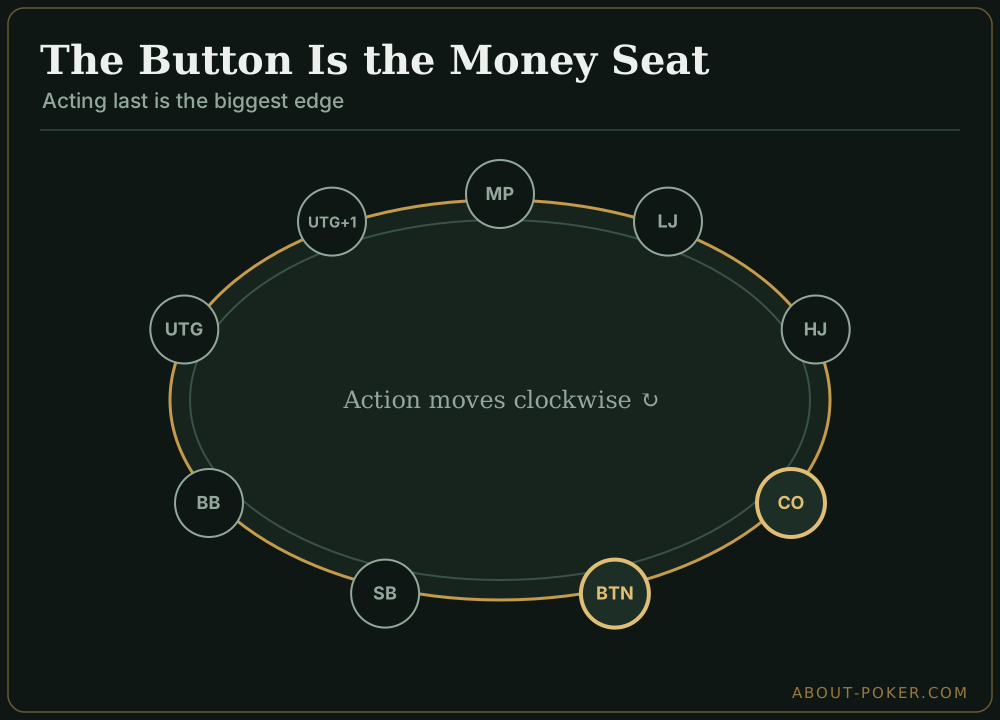
Acting later is better. From strongest to weakest post-flop:
| Position | Where | Why |
|---|---|---|
| Button (BTN) | Last to act post-flop | Best seat — full information every street |
| Cutoff (CO) | One right of the button | Near-best; can steal the button’s edge |
| Middle (MP) | Center of the table | Average; some players still to act |
| Under the gun (UTG) | First to act pre-flop | Worst — everyone acts after you |
| Blinds (SB/BB) | Forced bets, act first post-flop | Out of position all hand; play tighter |
A useful shorthand: the button and cutoff are your money seats — you’ll play the most hands and win the most from them. The blinds are your leak — you’re forced to put money in, then act first all hand, so you lose the least by playing them tightly.
Why acting last wins money
When you’re in position you can:
- See before you decide — check behind for a free card on a draw, or bet when your opponent has shown weakness.
- Control the pot — keep it small with a marginal hand, or build it with a strong one. Out of position you can’t reliably do either.
- Bluff more credibly — their check signals weakness before you commit a single chip, so your bluffs work more often and cost less.
- Realize your equity — with a draw, you can take a free card instead of facing a bet, so you see more rivers cheaply. This directly interacts with your pot odds.
Out of position you’re guessing; in position you’re reacting to real information. Over thousands of hands, that gap is the difference between a small winner and a big one.
A worked example
You hold A♦ 5♦ and it folds to you.
- On the button: you raise to steal the blinds. If called, you act last on every street — you can fire again when they check, or take a free card if your flush draw misses. The hand is profitable.
- Same hand under the gun: you fold. Six players still to act behind you, and you’d be out of position for the rest of the hand if called. The information disadvantage makes a marginal hand unplayable.
The cards are identical. The button makes the hand a profitable raise; UTG makes it a routine fold. That is the entire concept in one example.
Out of position: damage control
You can’t always be in position — at a full 9-handed table you’re in the blinds about two hands in nine, and you’ll be out of position in plenty of other spots too. When you are out of position:
- Tighten your range. Play fewer, stronger hands so you’re not guessing with junk.
- Lean on check-raising to put pressure back on the in-position player.
- Keep pots smaller with medium-strength hands; don’t bloat a pot you’ll have to play blind.
How to use position, in practice
- Play more hands in late position, fewer up front. This single adjustment beats most beginners outright.
- Attack the blinds from the button and cutoff when it folds to you — they have to defend out of position, which is hard.
- Defend your own blinds selectively — don’t call wide just because you’ve “already put money in.”
- Re-evaluate every hand by seat. Before asking “is this hand good?” ask “where am I sitting?”
Position is the scaffolding the rest of strategy hangs on. Pair it with starting-hand discipline and the math, and you have the core of winning play — put it all together in Texas Hold’em, or explore more in the poker positions hub.
Frequently asked
What does position mean in poker?
Position is when you act in the betting order. 'In position' means you act after your opponent; 'out of position' means you act first. Acting last is a lasting advantage because you have more information.
What is the best position in poker?
The button (dealer) is the best seat — you act last on every post-flop street, so you always have the most information when deciding.
Why is the button so valuable?
On the button you see what everyone does before you act on the flop, turn, and river. That information lets you bluff more, value-bet more precisely, and control the size of the pot.
What does it mean to be out of position?
You act before your opponent on later streets — usually from the blinds. You have to commit chips without knowing what they'll do, so you should play tighter and more cautiously.