Cash vs Spin & Go
Cash games vs Spin & Go: how the two formats differ in stack depth, variance, and skill edge, and which one fits your bankroll and goals.
On this page · 7 sections
Cash games and Spin & Gos sit at opposite ends of the poker spectrum. One is a deep, patient, chip-equals-money grind; the other is a short, explosive, lottery-flavored sprint. Understanding the difference tells you which one matches your bankroll and temperament.
| Feature | Cash game | Spin & Go |
|---|---|---|
| Players | 6–9 (or heads-up) | 3-handed |
| Starting stack | 100+ BB | ~25 BB |
| Pace | Untimed, blinds fixed | Turbo, fast blinds |
| Prize | Chips = money | Randomized multiplier |
| Variance | Lower | Very high |
The core structural difference
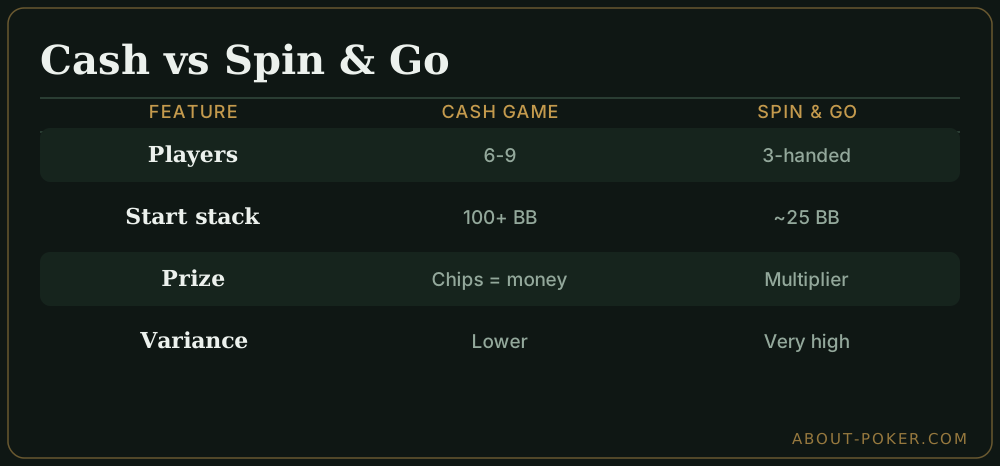
In a cash game, chips equal money and you can reload to a full stack any time. That means your edge — better position play, sharper bet sizing, more accurate reads — gets to work over deep stacks and long sessions. Small advantages compound.
A Spin & Go flips this. Three players start with roughly 25 big blinds, the blinds rise fast, and a multiplier drawn before the hand sets the entire prize pool. Most spins pay a modest 2x, but a rare spin can pay hundreds or thousands of times the buy-in. The result is a format where your skill edge is real but small per game, and the swings are driven by whether you happen to hit big multipliers.
Skills each format rewards
Because Spins are short-stacked and three-handed, they lean heavily on push-fold accuracy, heads-up play once one player busts, and simple ICM-aware decisions. There is very little deep postflop poker. Cash games reward the opposite: multi-street planning, thin value betting, and exploiting deep-stacked opponents over hundreds of hands.
If you enjoy the technical, grind-it-out side of the game, cash suits you. If you want fast games, quick sessions, and the thrill of jackpot upside, Spins fit better — but only with the right bankroll.
A worked example
You are heads-up in a Spin & Go, 12 big blinds effective, on the button with K7 offsuit. Open-shoving is standard: your hand dominates a big chunk of your opponent’s calling range, you have significant fold equity, and folding surrenders too much at this depth. Even when called by a hand like A5, you are only a modest underdog (K7o vs A5o is roughly 39% to 61%), and the frequent folds plus the times you flip or dominate make the jam clearly profitable. In a cash game with the same two cards and 100 big blinds, you would simply fold K7 offsuit in most spots — the deep stack changes the entire decision.
Bankroll and variance
Spin & Gos demand a much larger bankroll relative to buy-in than cash. Standard cash guidance might be 20–30 buy-ins for a stake; serious Spin players often want 100 buy-ins or more because a multiplier drought can last for hundreds of games even while playing well. Cash swings are gentler and more predictable, so your bankroll can be smaller and your emotional experience calmer.
Common mistakes
The classic error is playing a Spin like a cash game — trying to outplay opponents postflop with 20 big blinds instead of committing to clean push-fold and reshove ranges. The mirror mistake is treating cash like a Spin, jamming light and abandoning the deep-stack patience that makes cash profitable. Each format has its own gears; borrowing the wrong one leaks money fast. For the short-stacked adjustments that carry over to Spins, see the short-handed strategy guide.
Which should you play?
Pick cash if you want a steadier win rate, deeper strategy, and lower variance, and you have the patience for long sessions. Pick Spin & Gos if you want fast, short games, jackpot upside, and you can tolerate — and bankroll — the swings. Many players do both: cash to build a stable win rate, Spins for volume and variety.
Quick checklist
- Cash: chips equal money, deep stacks, edge compounds over time.
- Spin & Go: 3-handed turbo, ~25 BB start, randomized multiplier drives variance.
- Spins reward push-fold and heads-up skill; cash rewards deep postflop play.
- Bankroll Spins far more conservatively than cash — 100+ buy-ins is common.
- Do not import cash-game postflop habits into a short-stacked Spin.
Frequently asked
What is a Spin & Go?
A Spin & Go is a three-handed, fast turbo sit-and-go where a randomized multiplier decides the prize pool before cards are dealt. Most spin at the base amount, but a small chance of a huge multiplier is what draws players. Stacks are short and the game usually ends within minutes.
Is cash or Spin & Go more profitable?
Cash games have a higher and more stable win rate for skilled players because deeper stacks let your edge compound over many streets. Spin & Gos have enormous variance from the jackpot multipliers, so even winning players endure long swings and need a large bankroll relative to buy-in.
Do Spin & Gos require different skills than cash?
Yes. Spins are short-stacked, three-handed, and turbo, so they emphasize push-fold ranges, heads-up play, and ICM-lite adjustments. Cash rewards deep-stack postflop skill, bet sizing across streets, and position exploitation.