How to Count a Pot
Learn how to count a pot fast and accurately in Texas Hold'em, from preflop blinds through the river, so your pot-odds and bet-sizing decisions are always right.
On this page · 6 sections
Counting the pot is the single most useful mechanical skill in Texas Hold’em. Almost every good decision — whether a call is profitable, how large to bet, whether you are being priced in on a draw — depends on knowing the pot size at that instant. Yet most beginners either guess or freeze up when it is their turn. The good news: pot counting is arithmetic you can learn to do in a couple of seconds with a little structure.
Why the Pot Size Drives Every Decision
The pot is the reward you are playing for on any given street. When you know it, you can immediately work out your pot odds — the price you are being offered to continue. It also anchors your own bets, since good sizing is expressed as a fraction of the pot (half pot, two-thirds, full pot). If you do not know the pot, you are sizing blind and calling blind. Everything downstream of the pot count is guesswork.
Dealers in a casino will not count for you mid-hand, and online the number is on screen — but you still want the skill so you can plan ahead and read live games. Train the habit and it becomes automatic.
Start With the Blinds, Then Track Preflop
The pot is never empty when a hand begins. In a 1/2 no-limit game, the small blind posts 1 and the big blind posts 2, so the starting pot is 3. Add any antes or a straddle if the table uses them. From there, add money as each player acts.
Say a player opens to 6. The pot is now 3 + 6 = 9. One caller adds 6, making 15. If the big blind folds, the small blind’s 1 stays. Now three players see the flop with 15 in the middle (roughly — the exact figure depends on who folded their blind). The trick is to keep a running total rather than recounting the whole street each time. Update the number as chips go in, like a mental odometer.
Count Each Street Fresh, Then Carry Forward
Postflop, start from the pot you carried to the flop, then add the current street’s action. Suppose 15 went to the flop. Player A bets 10, Player B calls 10. The pot on the turn is 15 + 10 + 10 = 35. Now A bets 25 and B calls: 35 + 25 + 25 = 85 going to the river.
The structure that keeps you accurate is: carried pot + all bets and calls this street = new pot. You never need to remember individual preflop bets once you have the flop total. Collapse the history into one number and move on.
A Worked Example, Hand to River
Let’s count a full hand in a 2/5 game. Preflop: blinds are 2 and 5, so the pot starts at 7. The cutoff opens to 15. You call on the button with 15, and the big blind calls the extra 10. Pot = 7 + 15 + 15 + 10 = 47. (The big blind’s 5 was already in.)
Flop: the big blind checks, the cutoff bets 25, you call 25, the big blind folds. Pot = 47 + 25 + 25 = 97.
Turn: the cutoff bets 60, you call 60. Pot = 97 + 60 + 60 = 217.
River: the cutoff shoves 150 into a 217 pot. To call 150 to win 217 + 150 = 367, you are getting 367-to-150, or about 2.45-to-1, meaning you need roughly 29% equity to break even. That single ratio is only available because you counted every street. This is exactly the input that feeds your bet-sizing decisions too — you cannot size to two-thirds pot if you do not know the pot.
Common Mistakes When Counting the Pot
The most frequent error is forgetting to include your opponent’s most recent bet before computing your call. When someone bets 50 into 100, the pot you are getting is 150, not 100. Count their bet in.
Second, players lose track when there are multiple callers. Add each caller’s contribution separately; do not assume everyone put in the same amount, because a short stack may be all-in for less, creating a side pot. Third, people recount from the blinds every street, which is slow and error-prone. Carry one number forward instead. Finally, watch for uncalled bets that get returned — if you bet 80 and everyone folds, that 80 comes back to you and is not part of any pot.
A Simple Pot-Counting Checklist
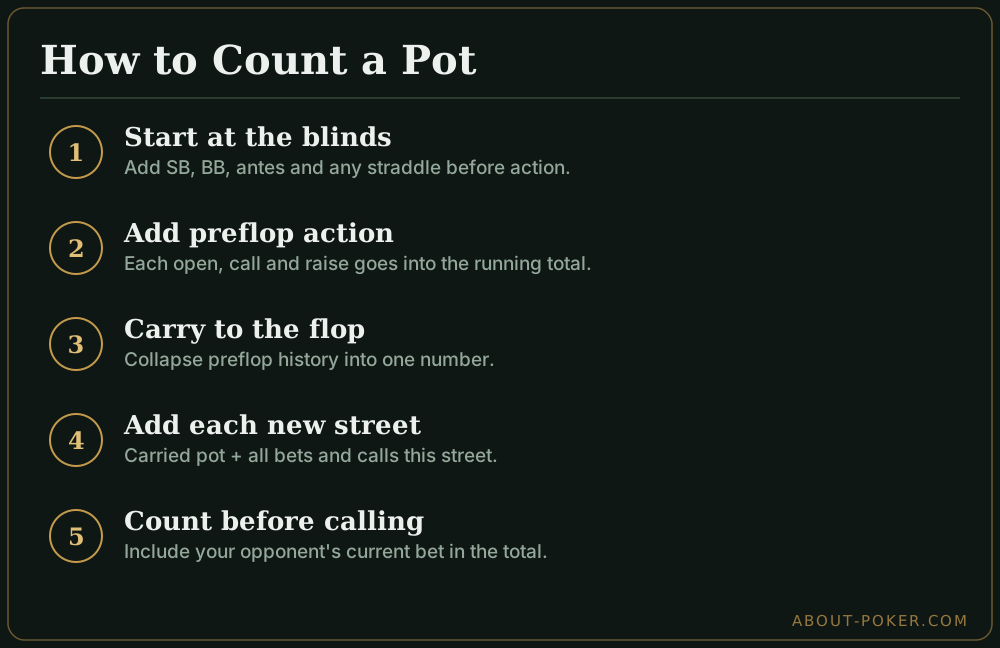
Use this routine until it is automatic:
- Note the starting pot (blinds + antes + straddle).
- Add each preflop bet and call to get your flop pot.
- On every later street, take the carried pot and add this street’s action.
- Before you call, include your opponent’s current bet in the total.
- Watch for all-ins that create side pots and for uncalled bets that return.
Do this for a few sessions and you will find the number is simply there when you need it. Accurate pot counting turns fuzzy “feel” decisions into clean math, and clean math is what separates break-even players from winners. If you want to drill the follow-on skill, practice converting a counted pot into a call/fold decision until pot odds are second nature.
Frequently asked
Do I count the blinds as part of the pot?
Yes. The small blind and big blind are live money in the pot before any action. In a 1/2 game, the pot starts at 3 before anyone acts, and that grows as players call or raise.
Should I count my own bet when working out pot odds?
When you compute pot odds to call, use the pot after your opponent's bet but before your call. You are comparing the amount you must put in against the total you can win, which already includes their bet.
How do I count a pot with multiple callers?
Add each player's contribution as it happens. If three players call a raise to 10, that is 30 from callers plus the raiser's 10 plus the blinds. Track a running total street by street rather than recounting from scratch.