How to Read the Board
Learn how to read the board in Texas Hold'em: spot the nuts, recognize flush and straight threats, gauge board texture, and know exactly what your hand is worth.
On this page · 6 sections
Reading the board is the skill of looking at the five community cards and instantly understanding what is possible. A player who reads the board well knows the nuts on every street, spots the flush and straight threats before they act, and never misvalues their own hand. If you have ever announced two pair only to be beaten by a flush that was staring you in the face, this is the fix.
What “Reading the Board” Means
There are two questions you answer every time cards hit the felt. First: what is the best hand possible right now given these community cards — the nuts? Second: where does my hand rank against that? Everything else in Hold’em strategy flows from those two answers. You cannot value bet correctly, call correctly, or bluff correctly without them.
Start by combining your two hole cards with the board to name your own made hand precisely — not “I have a pair,” but “I have top pair with an ace kicker.” Then scan the board for what beats you. The order matters: know your hand, then know the threats.
Scanning for Flush and Straight Threats
Two threats change hands the fastest, so check them first. For flushes, count suits. Three cards of one suit on the board means a flush is live for anyone holding two of that suit. Four of one suit is dangerous: now a single matching card in someone’s hand completes a flush, and even a lone high card of that suit can play.
For straights, look for connected or gapped cards. A board of 8-9-T means anyone with a jack-queen, six-seven, or queen-jack has a straight, and many one-card straight draws loom. Widely spaced boards like K-8-3 offer almost no straight potential. Learn to see “connectedness” at a glance — the more the ranks cluster, the more straights exist.
Paired Boards and Full Houses
A pair on the board unlocks a whole tier of hands. If the board shows K-K-7, then anyone with a king has trips, anyone with 7-7 or K-7 has a full house, and pocket kings would be quads. Once the board pairs, straights and flushes are no longer the top of the range — full houses and quads are.
This is where many players go wrong. They flop a flush, feel invincible, and forget that a turn or river that pairs the board suddenly lets a set become a full house that beats them. When the board pairs, mentally demote every straight and flush and ask whether a full house is now possible.
A Worked Example on a Full Board
You hold Ah Qc. The final board reads Ks Qs Js 8s 3d. Walk through it in order.
Your hand: you have a pair of queens with an ace kicker — a mediocre made hand. Now the threats. There are four spades on the board, so anyone holding a single spade has a flush, and the nut flush is the ace of spades. You do not have it. Straights are also live: anyone with a ten has a K-Q-J-T straight, or better, a ten of spades makes a straight flush (the true nuts here). Your pair of queens is nearly worthless on this board despite the two big cards. Reading the board tells you to check and fold to serious aggression rather than pay off a flush that is almost certainly out there.
Contrast that with the same Ah Qc on a board of Qd 8c 3h 2s 7d. Now you have top pair, top kicker, no flush is possible (all different suits, only two of anything), and no straight completes cleanly. Here your hand is strong and you should bet for value. Same two cards, opposite conclusions — because the board reads differently.
Reading Board Texture
Beyond the exact nuts, categorize the whole board as “wet” or “dry.” A wet board (connected, two-tone or monotone, like 9h Th 6h) hits many drawing hands and shifts equity around fast. A dry board (disconnected, rainbow, like Ks 7d 2c) connects with very few hands and lets top pair hold up. Texture tells you how often opponents have improved and how much protection your value hands need. On wet boards, bet larger to charge draws; on dry boards you can bet smaller or check back thin value.
A Board-Reading Checklist
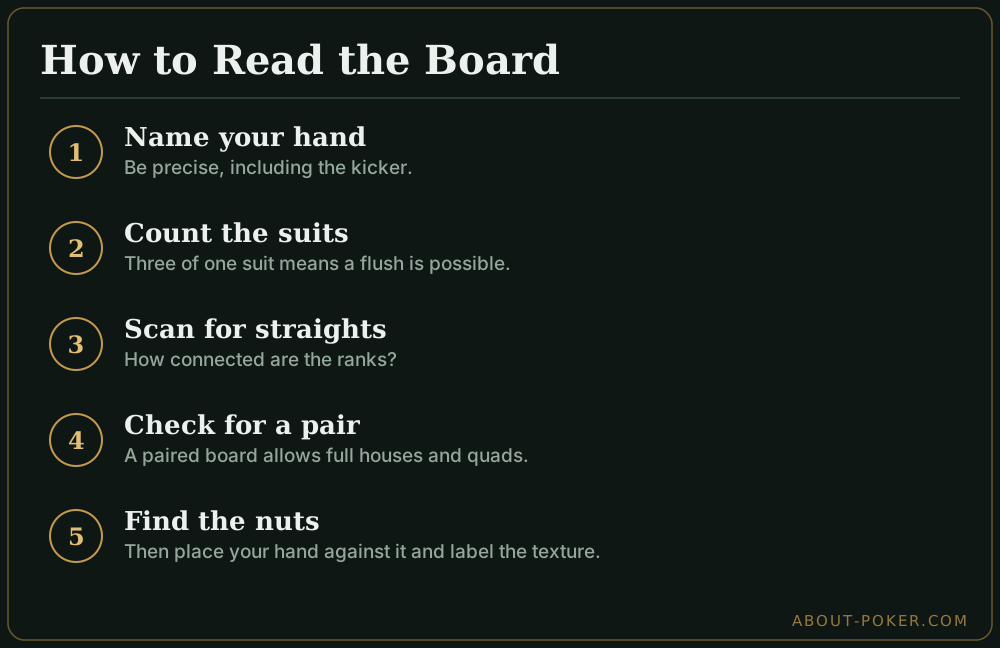
Run this sequence every street, in order:
- Name your own hand precisely, including the kicker.
- Count suits — is a flush possible or already made?
- Scan for straights — how connected are the ranks?
- Is the board paired? If so, are full houses or quads possible?
- Decide the nuts, then place your hand against it.
- Label the texture wet or dry to guide your sizing.
Do this consistently and you will stop being surprised at showdown. The board is public information; the edge goes to the player who actually reads it. With practice the whole scan takes a second, and you will always know both the nuts and exactly where you stand.
Frequently asked
What does 'reading the board' actually mean?
It means looking at the community cards and instantly seeing which hands are possible: the current nuts, flush and straight draws, paired boards that allow full houses, and how your own two cards combine with the five in the middle.
How do I know if a flush is possible?
Count suits on the board. Three or more cards of one suit means a flush is possible for anyone holding two of that suit; four of one suit means anyone with a single card of it already has a flush.
What is the nuts?
The nuts is the best possible hand given the board. On a paired board the nuts can be quads or a full house; on a three-flush board with no pair the nut flush is usually the top of the range unless a straight flush is possible.