How to Count Your Outs Fast
Count your outs fast in Texas Hold'em and convert them to equity with the rule of 2 and 4. Learn common out counts, discounting, and a quick worked example.
On this page · 6 sections
Counting outs fast is what lets you decide, in real time, whether a draw is worth chasing. An out is any card that turns your losing hand into a winning one, and the number of outs converts directly into your chance of getting there. Master a handful of common counts and one simple multiplication trick, and you will make correct calls on draws without ever slowing the game down.
What an Out Actually Is
An out is an unseen card that improves you to the best hand. The key word is unseen — you count from the 52-card deck minus the cards you can see (your two hole cards and the board). You do not subtract opponents’ cards because you cannot see them; the math already accounts for them being random.
The reason outs matter is that they feed straight into your pot odds decision. More outs means more equity, which means you can profitably call larger bets. Counting them quickly is therefore the first half of every drawing decision.
Memorize the Common Out Counts
You do not recompute from scratch each time; you recognize patterns. Keep these in your head:
- Flush draw: 9 outs (13 of a suit minus 4 you can see).
- Open-ended straight draw: 8 outs (four cards on each end).
- Gutshot straight draw: 4 outs (one rank fills the gap).
- Two overcards: 6 outs (three of each rank).
- Set to full house or quads: roughly 7 outs on the turn.
- Flush draw plus a gutshot: about 12 outs.
- Flush draw plus open-ender: about 15 outs — a monster.
Recognizing your draw type instantly gives you the count without arithmetic. That is the “fast” part.
The Rule of 2 and 4
Once you have the out count, convert it to equity. Multiply outs by 2 for your approximate chance of hitting on the next single card. Multiply by 4 for your approximate chance across both the turn and river combined — but only use the times-4 shortcut when you are all-in on the flop and will see both cards for free.
So a nine-out flush draw is about 9 × 2 = 18% to hit on the turn, and about 9 × 4 = 36% to hit by the river if you get to see both cards. An eight-out straight draw is about 16% per card, 32% over two. The rule slightly overstates equity for large out counts, so for 13+ outs shave a few points off. It is an estimate, but an accurate enough one to make decisions.
A Worked Example on the Flop
You hold 9h 8h. The flop is Ah 6h 2c. Count your outs. You have a flush draw — nine hearts give you a flush. You have no straight draw here (9-8 needs 7-T-J type help that this board does not offer). So nine clean outs.
Times 2: about 18% to make the flush on the turn. Times 4: about 36% by the river if you see both cards. Now apply it. Say the pot is 100 and your opponent bets 50. You must call 50 to win 150, so you need 50 / (150 + 50) = 25% equity to break even on the turn card alone. Your 18% is short of 25% on a pure turn basis, but because there is a river to come and implied odds if you hit, this is often still a call — and if you were both all-in, your 36% makes it clearly profitable. The count made the decision legible in seconds.
Discounting Dirty Outs
Not every out is clean. If your straight or flush card also pairs the board, it might complete a full house for an opponent. Suppose you are drawing to a flush but the flush card is a paired-board card — that same card could give a set opponent a full house that crushes you. Shade those outs down. Likewise, if you have two overcards but an opponent likely holds a bigger pair or a set, your six overcard outs may be worth only three or four in practice.
The habit is: count the raw outs, then ask “could any of these cards also help my opponent to beat me?” and discount accordingly. Overcounting outs is the most common way drawing players lose money.
A Fast-Counting Checklist
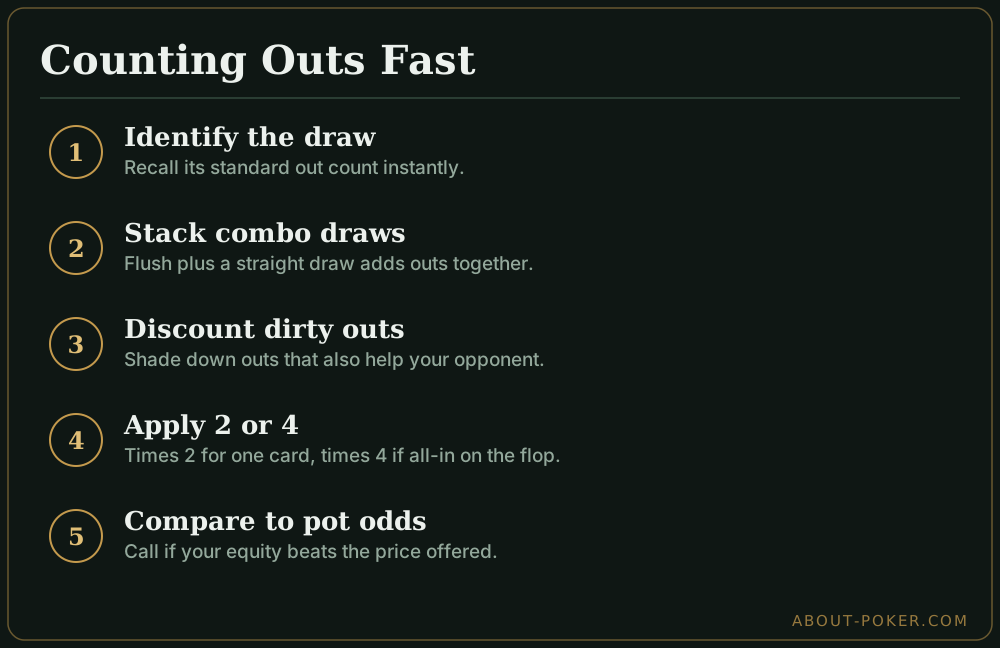
Turn this into a routine you run every time you have a draw:
- Identify your draw type and recall its standard out count.
- Check for combo draws that stack outs together.
- Discount any outs that could improve an opponent past you.
- Apply the rule of 2 for one card, or 4 if all-in on the flop.
- Compare that equity to the pot odds you are being offered.
Do this a few hundred times and the counts become reflexive. You will glance at the board, know you have twelve outs, know that is roughly 24% to the turn, and act correctly before the player behind you has even picked up their chips.
Frequently asked
What is an out?
An out is any unseen card that improves your hand to one that is likely to win. A flush draw with four cards of a suit has nine outs, because there are 13 cards of each suit and you can see four of them.
What is the rule of 2 and 4?
Multiply your outs by 2 for your rough equity on the next card, or by 4 to estimate equity across both the turn and river when you are all-in on the flop. Nine flush outs is about 18% for one card or 36% across two.
Should I count all my outs?
Not always. Discount outs that could give an opponent an even better hand — for example, a flush card that also pairs the board could hand someone a full house. Count clean outs fully and shade dirty outs down.