How to Calculate Poker Odds: A Simple Method
Calculate poker odds by counting outs, multiplying by 4 or 2 for your chance to hit, and comparing that to the pot's price. A four-step table method.
On this page · 6 sections
A poker odds calculation is a comparison of two numbers: how often your hand improves, and what the pot charges you to find out. Get both onto a percentage scale and the call-or-fold decision reads straight off the difference.
The method has four steps, and none of them need a calculator.
The four steps, in order
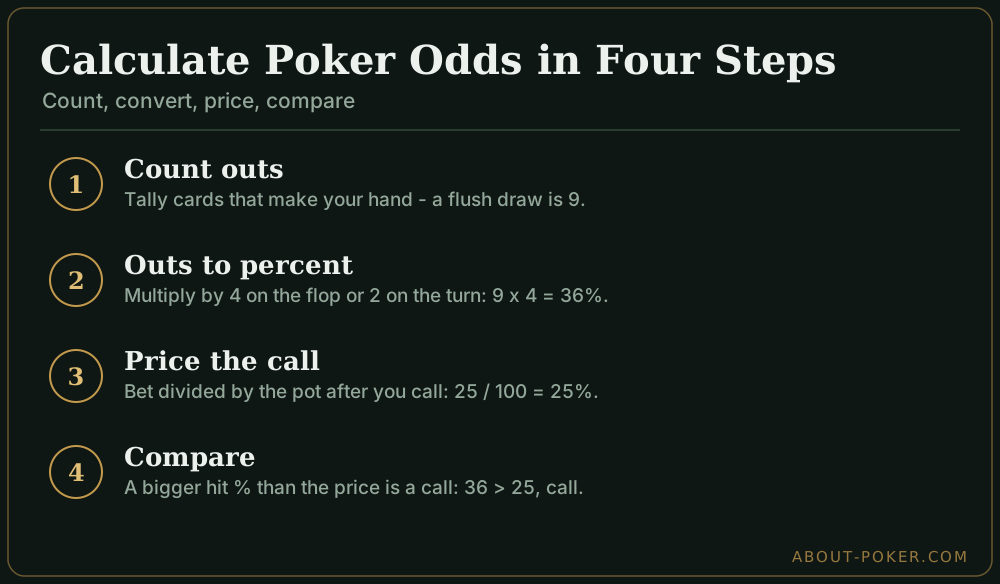
| # | Step | What you do | Example |
|---|---|---|---|
| 1 | Count outs | Tally cards that make your hand | Flush draw = 9 |
| 2 | Outs to % | Multiply by 4 (flop) or 2 (turn) | 9 × 4 = 36% |
| 3 | Price the call | Bet ÷ pot after you call | 25 ÷ 100 = 25% |
| 4 | Compare | Bigger hit % than price = call | 36 > 25, call |
Everything after this is the reasoning behind each row.
Counting outs
An out is any unseen card that turns your hand into a probable winner. The three you will meet constantly:
- A flush draw has 9 outs — thirteen cards of the suit minus the four you can see.
- An open-ended straight draw has 8 outs — two ranks, four cards each.
- A gutshot has 4 outs — the single rank that plugs the gap.
Count honestly. A card that fills your straight but also puts a third flush card on the board is a tainted out; shade it down or drop it. The finer points — overlapping draws, discounting dirty outs — are in counting poker outs.
Turning outs into a percentage
The rule of 4 and 2 converts an out count into a hit chance:
Two cards to come (flop): outs × 4 One card to come (turn): outs × 2
“Two cards to come” means you will see both the turn and the river before the hand ends — the case on the flop. “One card to come” is the turn, with only the river left. So ×4 answers “will I hit by the river?” and ×2 answers “will I hit on the very next card?” Use ×4 only when you expect to see both remaining cards; if the bet is large enough that you would fold the turn after missing, you are really getting one card, so price that street with ×2.
A nine-out flush draw is 9 × 4 = 36% from the flop, 9 × 2 = 18% from the turn. The exact figures are 35.0% and 19.6%, so the shortcut is close enough to bet on. It works because a single card hits roughly outs ÷ 46 of the time — about 9 / 46 = 19.6% on the turn — and doubling covers the two-card case. The rule of 4 and 2 covers where it drifts.
The dozen spots worth memorizing
You do not draw with random out counts. A handful recur, and their percentages are worth banking so you never calculate mid-hand:
| Draw | Outs | Flop (2 cards) | Turn (1 card) |
|---|---|---|---|
| Backdoor / one overcard | 2–3 | 8–12% | 4–7% |
| Gutshot | 4 | 16% | 9% |
| Two overcards | 6 | 24% | 13% |
| Open-ended straight | 8 | 32% | 17% |
| Flush draw | 9 | 35% | 20% |
| Flush + gutshot | 12 | 45% | 26% |
| Flush + open-ender | 15 | 54% | 33% |
Flop figures at 12+ outs are the true equity, not the raw ×4 output, which is why 15 outs reads 54% here rather than 60%.
Pricing the call
Your price is the bet you must call divided by the pot after the call lands:
Price = bet to call ÷ (pot after you call)
Pot is $50, opponent bets $25. You call $25 into a pot that becomes 50 + 25 + 25 = $100, so your price is 25 ÷ 100 = 25%. That is your break-even line: the hand has to win more than a quarter of the time to profit. This is the other half of every calculation — see what are pot odds.
When to override the pure-math call
The four-step compare only counts chips already in the pot. Implied odds are the extra bets you expect to win on later streets when you hit. They let you call spots that lose on paper. Say your draw hits 20% but the price is 25% — a fold by the straight math. If both players have $200 behind and your opponent will pay off a $60 bet the times you complete, that future money shrinks your effective price below 20%, and the call turns profitable.
Lean on implied odds when your draw is disguised (a gutshot or backdoor that hits, not an obvious four-flush board) and stacks are deep. Discount them toward zero when the pot is already large relative to stacks, when hitting makes the board scary enough to shut your opponent down, or when they can draw out on you — a made hand that still improves has reverse implied odds, the money you lose on the streets you hit second-best.
Putting a full hand through it
You hold Q♥ J♥ on T♥ 9♥ 2♣. The pot is $40 and the bet is $20.
- Outs. Nine hearts for the flush, plus an open-ended straight draw (Q-J-T-9) — any 8 or K completes it. Eight straight outs, but the 8♥ and K♥ are already counted as flush outs, so six new ones. Total: 9 + 6 = 15 outs.
- Percentage.
15 × 4 = 60%, trimmed to the true ~54%. - Price. Call $20 into
40 + 20 + 20 = $80, so20 ÷ 80 = 25%. - Compare. 54% dwarfs 25%. With a draw this strong, raising is on the table, not just calling.
Percentages and ratios both work
Some charts speak in ratios. This table crosses between them:
| Ratio against | Percentage | Hits |
|---|---|---|
| 1-to-1 | 50% | 1 in 2 |
| 2-to-1 | 33% | 1 in 3 |
| 3-to-1 | 25% | 1 in 4 |
| 4-to-1 | 20% | 1 in 5 |
| 9-to-1 | 10% | 1 in 10 |
From ratio to percentage, divide the win side by the sum: 3-to-1 is 1 / (3 + 1) = 25%. Most players just stay in percentages, since two percentages are easier to compare at a glance than two ratios.
Run these four steps a few hundred times and the common spots become instant recall. The place to drill them is Texas Hold’em, and the rest of the toolkit sits in the odds and math hub.
Frequently asked
How do you convert poker odds to a percentage?
Add the two sides of the ratio, then divide the win side by that total. A 4-to-1 shot is 1 / (4 + 1) = 20%. A 3-to-1 shot is 1 / 4 = 25%.
What is the fastest way to calculate poker odds?
Multiply your outs by 4 on the flop or by 2 on the turn for your chance to hit, and divide the bet by the final pot for your price. Both are two-second mental estimates.
Do you need to be good at math to calculate poker odds?
No. The method is counting to about 15 and multiplying by 2 or 4. Most players memorize the dozen common results, so you rarely calculate from scratch mid-hand.