KK vs QQ: Preflop Odds & Equity
Pocket kings are about an 82% favorite over pocket queens preflop — roughly a 4.5-to-1 edge. Here are the exact equities and why QQ needs a set to win.
On this page · 6 sections
Two big pairs, one small deck. You hold K♠ K♥, villain has Q♦ Q♣, and the money flies in. This is a near-worst-case for the queens: pocket kings are roughly an 82% favorite, about a 4.5-to-1 edge, and QQ is left drawing almost exclusively to a two-out set. When a bigger pair meets a smaller one with no shared cards, the result is brutally one-sided.
The headline equities
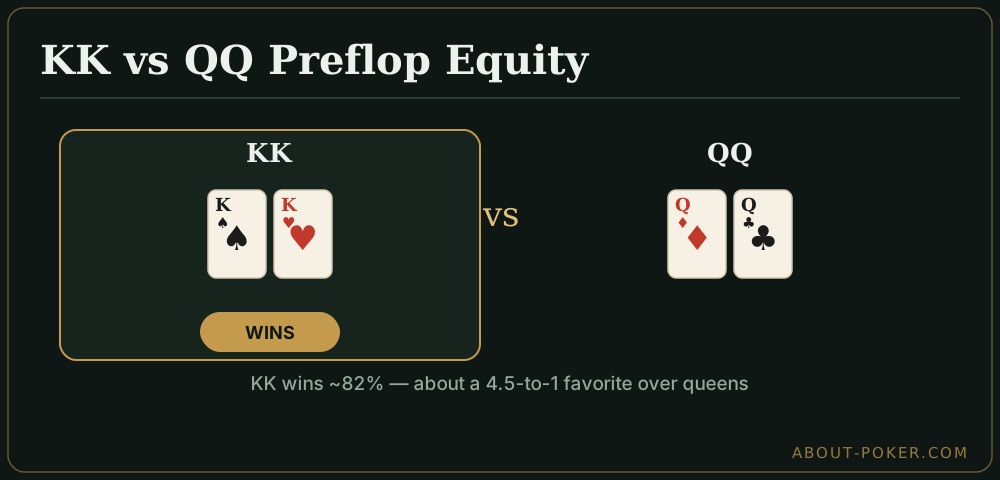
Every figure below comes from running the matchup across all possible boards and confirming with a Monte Carlo sim:
| Matchup | KK equity | QQ equity |
|---|---|---|
| KK vs QQ | 82.0% | 18.0% |
| (for reference) KK vs AK | ~70% | ~30% |
| (for reference) KK vs AA | ~19% | ~81% |
Notice how much wider KK’s edge is over queens (82%) than over ace-king (70%). That’s not a rounding quirk — it’s the difference between an opponent with two outs and one with six. Queens can only improve to trips by catching one of the two remaining queens; ace-king can pair either of two overcards.
Why queens are drawing so thin
Pocket queens are a made pair, but they’re outranked. On any board that doesn’t help either hand, higher pair wins — and queens can’t outrun kings by pairing their board cards, because king-high boards make kings’ overpair even bigger. QQ’s realistic paths to victory:
- Flop or turn a set of queens: the main route.
- Runner-runner straight: thin, and a queen-high straight needs specific cards.
- Runner-runner flush: rare, and only when suits cooperate.
Strip away the runner-runner scraps and QQ’s ~18% is essentially “how often do I make a set before kings make theirs.” Which brings us to the set math.
A worked example: the set that saves you
Holding a pocket pair, you flop a set (or better) about 11.8% of the time — roughly one flop in 8.5. That single number is the engine of QQ’s equity:
- Queens flop a set ~11.8% of the time.
- On most of those flops, QQ leaps ahead of KK’s overpair.
- Add the occasional straight, flush, and turn/river set, and QQ scrapes together its ~18%.
But even flopping a set isn’t a guarantee — kings can flop their own set over you, or fill a straight or flush by the river. The full flopping-a-set breakdown lives on odds of flopping a set, and it’s the same math that makes small pairs playable as set-mines. Meanwhile the contrast with KK vs AK shows why overcards are worth so much more than a lower pair’s two outs.
The range problem — and why QQ still gets it in
Fear of running into kings makes some players fold queens preflop. Usually a mistake. Against an unknown opponent’s shoving range, QQ is crushing far more than it’s crushed. Counting combos with combinatorics:
- KK and AA that dominate you: 6 combos each, and fewer if you hold blockers.
- AK you flip against: 16 combos, roughly a coinflip.
- JJ, TT, and lower pairs you crush: dozens of combos where you’re the 82% favorite.
- AQ, AJ you dominate: more combos in your favor.
Weight it out and queens clear the break-even bar against nearly any realistic range, because the handful of KK/AA combos are drowned by everything QQ beats or flips with. Only against a proven nit who jams strictly KK+ do queens become a genuine fold.
How the board changes the picture
The 82/18 split is preflop. Once the flop arrives, the matchup almost always resolves toward one extreme, and knowing which way tells you how hard to push.
- A low, ragged flop (say 8-5-2 rainbow, no queen) is great news for the kings. Both overpairs improved by nothing, but KK’s overpair is still bigger, and QQ has now used up one of its three chances at a set for free. The kings climb to roughly 90-91%.
- A queen on the flop is the reversal QQ is praying for. Now the queens hold a set and rocket to about 96%, while the kings’ overpair is suddenly the underdog needing runner-runner help or the case king. These are the flops that create the huge pots, because neither overpair wants to fold.
- A king on the flop is the opposite disaster for queens: KK makes an even more dominant set, and QQ is drawing to two outs and essentially dead.
The lesson mirrors the aces-versus-kings cooler: the lower pair lives or dies on hitting its two-out set, and it must do so on the flop before the board dries up its remaining equity.
Reading it from the queens’ seat
Most of the pain in this matchup lands on the player holding queens, so the useful skill is deciding when QQ is a get-it-in and when it is a rare fold.
- Against an unknown or aggressive shoving range: get it in. As the combo count above shows, KK and AA together are only 12 combos (fewer with blockers), while AK, JJ-down, AQ, and AJ pile up far more combos that QQ beats or flips against.
- Against a snug 3-bettor: still usually a call or a 4-bet, because most players include AK and sometimes JJ in that range, and those hands keep QQ well ahead of break-even.
- Against a proven nit who only ever stacks off KK+: this is the one spot queens can genuinely fold. If a player who has never shown down worse than kings jams into you, your 18-19% equity does not justify calling off. Those opponents are rare, and misreading a normal player as a nit costs far more over time than the occasional cooler.
Lock in the anchors — KK is 82% over QQ, and QQ’s 18% is almost all set equity — and you’ll read every big-pair-versus-big-pair spot correctly. When you hold the queens, remember the number cuts both ways: you’re an 18% dog to kings, but a huge favorite over everything below them, which is why folding queens preflop is almost always the wrong instinct. Keep sharpening through odds of flopping a set, combinatorics, and the poker odds & math hub.
Frequently asked
What are the odds of KK vs QQ preflop?
Pocket kings are about an 82% favorite over pocket queens, with QQ winning roughly 18% of the time. That's close to a 4.5-to-1 edge for the kings — one of the most lopsided pair-versus-pair matchups short of vs aces.
How does QQ ever beat KK?
Almost entirely by flopping a set. Pocket queens make a set (or better) about 12% of the time, and that accounts for most of their roughly 18% equity, with rare straights and flushes filling in the rest.
Is KK vs QQ the same as KK vs AK?
No. KK is about 82% against queens but only about 70% against ace-king. Queens are drawing to just two clean outs (the other two queens), while ace-king has six overcard outs, so AK has much more equity.
Should you ever fold QQ preflop against KK?
If you somehow knew villain had exactly KK or AA, queens would be a fold at 18-19% equity. But in practice you can't rule out AK and worse pairs, so QQ is almost always a get-it-in against an unknown opponent.