String Bets: Rules & Etiquette
A string bet is a bet made in two motions without a verbal declaration. Learn why it's ruled a call, how to avoid it, and the etiquette that prevents disputes.
On this page · 8 sections
A string bet is one of the most common rules violations you’ll see from newer players, and it almost always comes from a good-faith mistake rather than an angle. You reach out, put some chips in, then reach back for more — and the dealer stops you and rules that only the first chips count. Understanding why that happens, and the two simple ways to never do it, is basic betting hygiene at any live table.
What counts as a string bet
A string bet (or string raise) is a bet or raise made in more than one forward motion without a verbal declaration of the amount. The classic version: you push a stack of chips forward, pause, then go back to your stack and slide more chips in as a second, separate motion.
Because you didn’t declare the total out loud, the dealer can only enforce what your first single motion put in the pot. If that first motion covered a legal call, you’re ruled to have called — even if you clearly intended a raise. The extra chips are pulled back.
There’s a related idea: if your first motion doesn’t even cover a full call, rooms handle it under their betting rules, but the safest mental model is “one motion or one declaration.”
Why the rule exists
The whole point is to stop players from buying information. Imagine you could push out half a raise, watch your opponent’s face and body for a reaction, and then decide whether to complete the raise or pull back to a call. You’d be extracting a read that the rules never meant to give you.
The string-bet rule kills that. You must commit your full amount in one clean push, or state the amount before you move any chips. Either way, your opponent reacts to a fixed, final bet — no fishing for tells mid-motion. It’s the same fairness logic behind penalizing acting out of turn: the sequence and completeness of an action are part of the game’s integrity.
A worked example
You’re facing a $20 bet with a strong hand and you want to raise to $60. You grab a handful of chips and push $20 forward — matching the bet — then, seeing your opponent tense up, you reach back to your stack for another $40.
“String bet,” the dealer says, and stops you. Your first motion put in exactly a call ($20), and you never declared “raise.” The ruling: you called for $20. The $40 you were reaching for goes back to your stack, and your intended raise never happens.
Now replay it correctly. Before touching a chip you say, “Raise to 60.” A stated amount is binding, so you can now take as many trips to your stack as you need to assemble $60 — it’s all one declared bet. Or, saying nothing, you push a single clean motion of $60 across the line at once. Either way the raise stands. For the full mechanics of legal raise sizing, see how raising works in poker.
Etiquette that keeps you safe
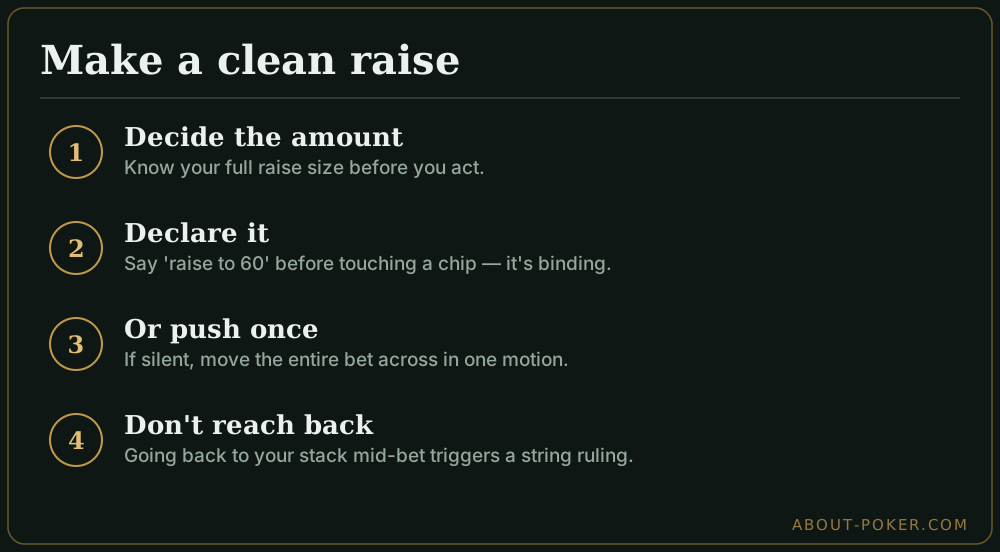
- Declare first, then move chips. “Raise to 50” said clearly, before you touch your stack, protects you completely. A verbal amount is binding and immune to string-bet rulings.
- Or push once, cleanly. If you don’t want to talk, get your full bet across the betting line in a single motion.
- Don’t reach back mid-bet. The instant your hand goes back to your stack after a forward push, you risk a string ruling.
- Watch the betting line. In rooms with a marked line, chips are committed once they cross it. Keep your motion decisive.
String bet versus string raise
People use the two terms loosely, but they describe slightly different situations. A string bet is the first wager into an unopened pot made in two motions. A string raise is the same fault when there is already a bet to answer, and it is the more painful of the two because the penalty is usually a bare call instead of the raise you wanted.
The distinction matters in one specific spot. When there is no prior bet, a two-motion move that fails as a raise sometimes just becomes a legal bet of whatever the first motion covered — you lose the extra chips but still bet. When you were trying to raise, the first motion is very often just a call, so the fault costs you the initiative entirely. Either way the fix is identical, but knowing that the raise version is the more expensive one is a good reason to be extra deliberate whenever there are chips already in front of you.
Common situations that trip players up
Most string-bet rulings are not deliberate angles; they come from a handful of repeat mistakes. Watch for these:
- Splashing then adding. You toss chips toward the pot, they scatter, and you go back to “top it up” to the right amount. The dealer only counts the first messy motion. Stack your chips neatly and push once.
- Counting out loud with your hands. Saying “twenty… forty… sixty” while sliding chips in three separate pushes is a string bet even though you named numbers, because you never declared a single total first. Declare the final amount (“make it sixty”), then arrange the chips.
- The single oversized chip problem. If you put out one chip larger than the current bet without saying “raise,” most rooms rule it a call, not a raise. A lone $100 chip tossed to call a $30 bet is a call for $30 unless you announced a raise. This is a cousin of the string-bet rule and catches new players constantly.
- Reaching for a stack you can’t reach. If your chips are behind another player’s or off to the side, plan the motion before you act so you are not making a second trip.
A quick pre-action checklist
Before you commit chips, run this three-second routine and you will essentially never be ruled for a string bet:
- Decide the exact amount first. Know your total before your hand moves.
- Words or one motion — pick one. Either say the number, or push everything across in a single clean slide.
- Hands off after you commit. Once chips cross the line, stop. Do not reach back “to fix it.”
The bottom line
A string bet is a bet made in two motions with no words attached, and the penalty is simple: only your first motion counts, which usually turns your intended raise into a call. The oversized-chip trap works the same way — one big chip with no words is a call. Avoid all of it with one habit — announce the amount before you move chips, or move all your chips at once. Do that every time and the string-bet rule will never cost you a pot. For the wider framework, review the betting rules and how raising works.
Frequently asked
What is a string bet in poker?
A string bet is when a player puts chips into the pot in more than one motion — reaching back to their stack for more — without first declaring the full amount verbally. Because the extra chips came in a separate motion, the dealer enforces only the first motion's amount.
Why is a string bet not allowed?
It prevents players from gauging a reaction before committing more chips. If you could push some chips, watch an opponent flinch, and then add more, you'd gain unfair information. The rule forces you to commit your full bet at once or declare it verbally.
How do I avoid making a string bet?
Either announce your amount first ('raise to 50') and then move the chips, or push your entire bet forward in a single clean motion. A clear verbal declaration always protects you, because a stated amount is binding regardless of how the chips move.