How to Run a Poker Tournament at Home
How to run a poker tournament at home — set the buy-in, distribute chips, build a blind schedule that ends on time, seat players, and pay out fairly.
On this page · 6 sections
Running a home poker tournament is more involved than dealing a casual cash game, but it is also far more fun: everyone starts equal, the tension builds as players bust, and it ends with a clear winner. The two things that separate a great home tournament from a shambolic one are a blind schedule that finishes on time and a chip distribution that makes change easy. Get those right and the rest falls into place.
If you have not hosted before, start with the fundamentals in how to set up a home poker game, then layer the tournament structure on top.
Step 1: Set the buy-in and payout up front
Pick a buy-in everyone is comfortable losing — a home game should sting a little, not hurt. Pool every buy-in into the prize fund and decide the payout split before a single card is dealt. For a single table of eight to ten, paying the top two or three is standard: something like 50/30/20, or 60/40 if you want a bigger first prize. The golden rule is that the money conversation happens first, in the open, so nobody argues at the final table.
Step 2: Distribute chips for easy change
Give every player an identical starting stack. A distribution that makes change painless matters more than the raw total. A clean example per player:
- 8 × 25 = 200
- 8 × 100 = 800
- 8 × 500 = 4,000
- 10 × 1,000 = 10,000
That is a 15,000 stack with enough small chips to post early blinds and pay antes without constant breaking. Only put the lowest denomination you will actually need into play — if your smallest blind is 25, you do not need 5-chips. For a full rundown of denominations and colors, see poker chip values and colors.
Step 3: Build a blind schedule that ends on time
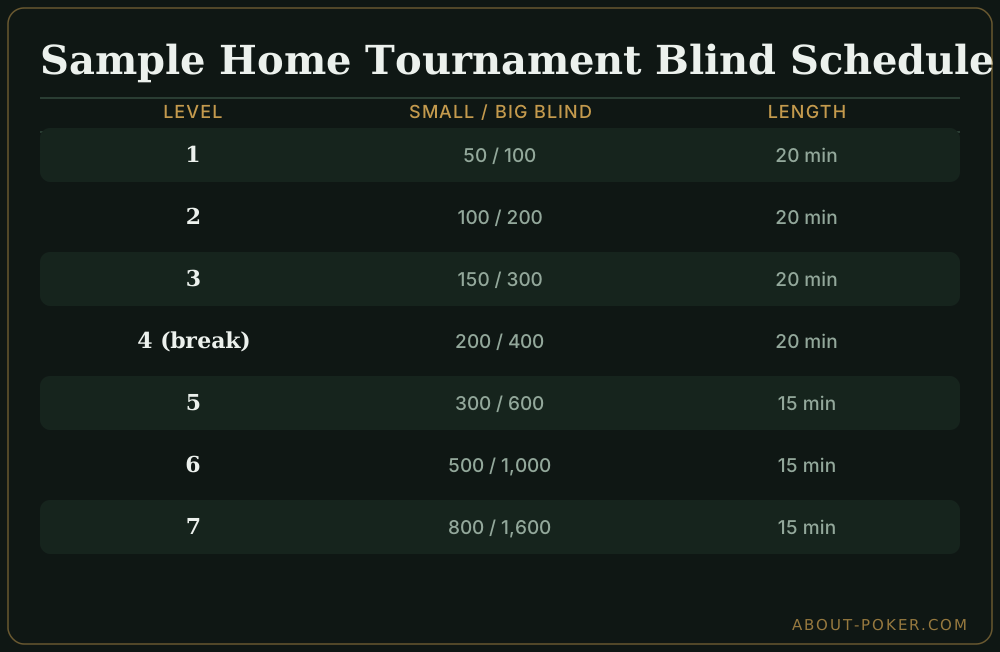
This is where most home tournaments go wrong. Decide your target finish time first, then work backward. For a three-to-four-hour evening with 15,000 starting stacks, a schedule like this works well:
| Level | Small / Big Blind | Length |
|---|---|---|
| 1 | 50 / 100 | 20 min |
| 2 | 100 / 200 | 20 min |
| 3 | 150 / 300 | 20 min |
| 4 (break) | 200 / 400 | 20 min |
| 5 | 300 / 600 | 15 min |
| 6 | 500 / 1,000 | 15 min |
| 7 | 800 / 1,600 | 15 min |
| 8+ | steepen to finish | 15 min |
Use a free tournament-clock app on a phone or TV so blinds rise automatically and nobody forgets to increase them — the single most common home-game mistake. Add antes from around level 5 to force action and speed up the finish.
Step 4: Seat players and manage the table
Seat players randomly — draw cards for seats so nobody can angle for position next to a friend. At a single table you simply play down to the winner. If you have enough players for two tables, balance them as people bust, moving players so the tables stay within one seat of each other, and combine into one final table when few enough remain. For the mechanics of blinds, all-ins, and eliminations, keep poker tournament rules explained handy.
A worked example
Ten friends each buy in for $20, giving a $200 prize pool, and each starts with the 15,000-chip stack above. That is a total of 150,000 chips in play — a useful number, because a player is “average” when they hold 15,000 and the chip leader’s dominance is easy to eyeball.
With a 60/30/10 payout the finishers win $120 / $60 / $20. Using the schedule above, the field typically halves by the second break as the 300/600 and 500/1,000 levels put short stacks all-in, and you reach the money spot (three players left) somewhere around level 7. By the time blinds hit 1,600 the remaining stacks are shallow enough that the tournament resolves quickly — usually inside three and a half hours from the first hand, exactly as planned.
The night-of checklist
Have the clock running before the first hand, chips counted into equal stacks in advance, the payout posted where everyone can see it, and a spare deck ready. Announce the structure and payout aloud at the start, then let the blinds do the work. A well-structured home tournament practically runs itself — your only real job once cards are in the air is keeping the blinds rising on schedule.
Frequently asked
How many chips should each player start with in a home tournament?
A common home starting stack is between 5,000 and 10,000 in chips. The exact number matters less than the ratio to the blinds — you want players to begin with roughly 75 to 100 big blinds so there is room to play real poker before the blinds bite.
How long should a home poker tournament last?
Decide your finish time first, then size your blind levels to hit it. For an evening event of eight to ten players, 15- to 20-minute levels usually produce a three- to four-hour tournament. Shorter levels and bigger blind jumps end it faster.
How do you pay out a home poker tournament?
Pool the buy-ins and pay the top finishers, typically the final two or three at a small table. A common split for a single-table event is roughly 50/30/20 or 60/40, with more places paid as the field grows. Agree on the payout before cards are dealt.