Buying Chips at a Casino: Rules & Etiquette
Buying chips at a casino poker table: how to get on the list, cash you can play, buy-in limits, buying between hands, and the etiquette that marks a regular.
On this page · 5 sections
Your first buy-in at a casino poker table is the moment most new players feel out of place — everyone else seems to know a routine you don’t. The good news is that the routine is short and forgiving. This guide covers exactly how chips get to your seat, the buy-in limits every game enforces, and the small etiquette points that quietly tell the table you belong there.
Getting a seat before you can buy in
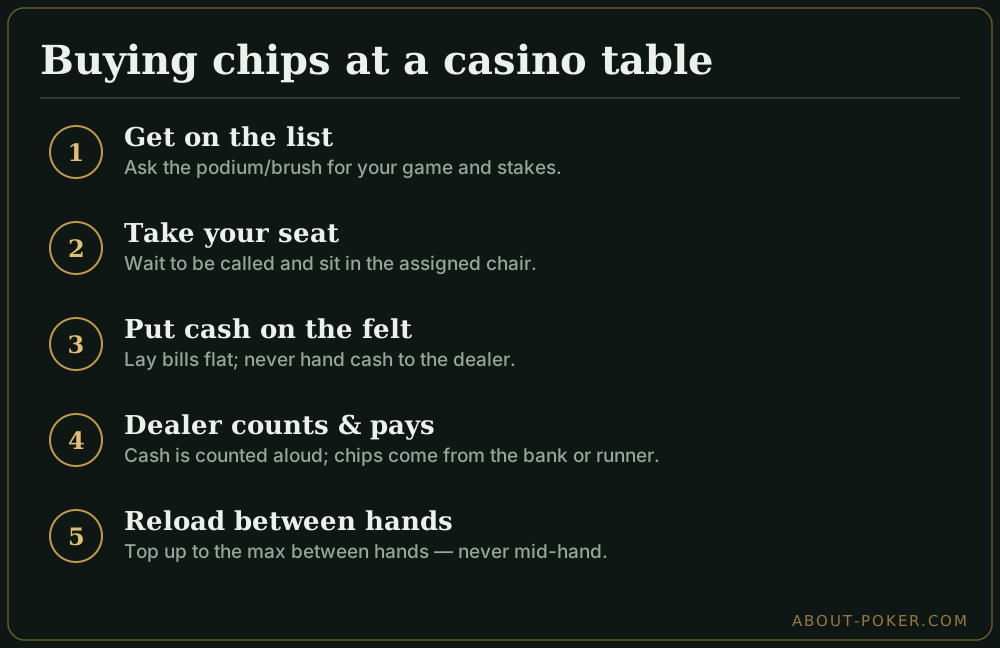
You don’t buy chips until you have a seat, and you don’t get a seat until you’re called off the list. Walk up to the poker room podium (the brush) and ask for the game and stakes you want — say “1/2 no-limit hold’em.” They’ll either seat you immediately or add your name to the waitlist and call it when a seat opens. This whole process, and how the room is organized, is covered in how does poker work at a casino.
When your seat is ready, the floor points you to the exact table and chair. Sit down, and now you’re ready to buy in.
How the buy-in actually happens
Bring cash to the table — U.S. cardrooms run cash games on cash, not cards or vouchers. When you sit, place your bills on the table in front of you and tell the dealer you want to buy in. Do not hand cash directly to the dealer; casinos require it to stay on the felt so the cameras can verify the count.
The dealer counts your cash out loud, then either gives you chips from the table’s chip bank or calls a chip runner to bring them to your seat. You can play the very next hand once you have chips. If you’re waiting on a runner, most rooms let you post cash into the pot temporarily, but it’s cleaner to wait one hand for chips. If cash games are new to you, the mechanics of the game itself are in how a cash game works.
Buy-in minimums, maximums, and reloading
Every table has a posted minimum and maximum buy-in, usually shown on a placard or at the podium. These are almost always expressed in big blinds:
| Game | Typical min buy-in | Typical max buy-in |
|---|---|---|
| 1/2 no-limit | $40–$100 | $300 (or uncapped) |
| 1/3 no-limit | $100 | $500 |
| 2/5 no-limit | $200 | $1,000+ |
You can add chips (reload or top up) between hands at any time, up to the table maximum where one applies. What you cannot do is add chips during a hand — the table-stakes rule freezes your stack the instant the cards are dealt. Whatever sits in front of you when the hand starts is all you can win or lose that hand.
Worked example: sitting down at 1/2 no-limit
You’re called for a 1/2 no-limit seat. The table posts a $40 minimum and a $300 maximum buy-in. You sit, put four $100 bills on the felt, and say, “Three hundred, please.” The dealer counts it aloud — “buying in three hundred” — sets one bill aside for the runner if needed, and pushes you $300 in chips, typically a mix like $200 in red $5 chips and $100 in $1 chips.
You’re now sitting with 150 big blinds, a deep and comfortable stack. Two hours later you’ve dropped to $110. Between hands you pull another $190 from your pocket and top back up to the $300 maximum. That’s a legal reload. If instead you’d tried to reach for your wallet mid-hand while facing a big bet, the dealer would stop you cold — table stakes.
Etiquette that marks you as a regular
The mechanics are easy; the etiquette is what separates a tourist from a regular. A few habits, most of which appear in our full guide to poker etiquette for beginners:
- Keep cash flat on the table until the dealer handles it — never pass it hand-to-hand.
- Wait for a break in the action to buy in or reload; don’t interrupt a live hand to count cash.
- Stack your chips in clean, countable piles so opponents can see roughly what you have.
- Tip the chip runner a dollar or two when they bring your chips — it’s customary and appreciated.
- Convert chips at the cage, not the table, when you leave. You rack your chips, carry the rack to the cashier, and they give you cash.
Do those five things and nobody will ever guess it was your first buy-in.
Frequently asked
Can you buy chips directly at the poker table?
Yes. In most cardrooms you sit down with cash and the dealer starts a chip runner or gives you chips from the table bank. You put your cash on the table and the dealer counts it out loud, then pushes over the equivalent in chips.
What is the minimum buy-in at a poker table?
Each game has a posted minimum and maximum buy-in, usually shown at the table or podium. A common minimum for a 1/2 no-limit game is 40 to 100 big blinds, and the maximum is often capped at a set number of big blinds too.
Can you add chips to your stack during a hand?
No. Because of the table-stakes rule, you can only buy more chips or add cash between hands, never in the middle of one. Whatever you have in front of you at the start of a hand is all you can win or lose that hand.
Do you buy chips from the dealer or the cage?
For cash games you almost always buy in at the table with cash. The cage (the casino cashier) is where you convert chips back to cash when you leave, and where you'd buy a tournament entry. Chip runners can also bring chips to your seat.