Odd Chip Rules in Split Pots
How poker awards the odd chip in a split pot — the position-based and high-card rules, hi-lo splits, and worked examples so ties never cause an argument.
On this page · 6 sections
Most split pots divide cleanly, but every so often the math does not work out to whole chips — a pot of 305 split two ways leaves a single chip that cannot be cut in half. Poker solves this with the odd chip rule, a deterministic procedure for deciding exactly who gets the leftover. Knowing it keeps friendly games friendly and stops a one-chip disagreement from stalling the table.
Why the odd chip exists
When two or more players tie for the best hand, the dealer divides the pot into equal shares. If the pot does not divide evenly by the number of winners, there is a remainder — usually a single chip, sometimes more in a three- or four-way tie. That remainder has to go to a specific player, and it has to be decided by rule rather than by argument. The odd chip rule fills that gap so every split is reproducible and fair.
The chip in question is always the smallest denomination in play. Dealers do not break a bigger chip for this; they use the lowest chip on the table, which keeps the leftover value trivial while still following procedure.
The position rule (most common)
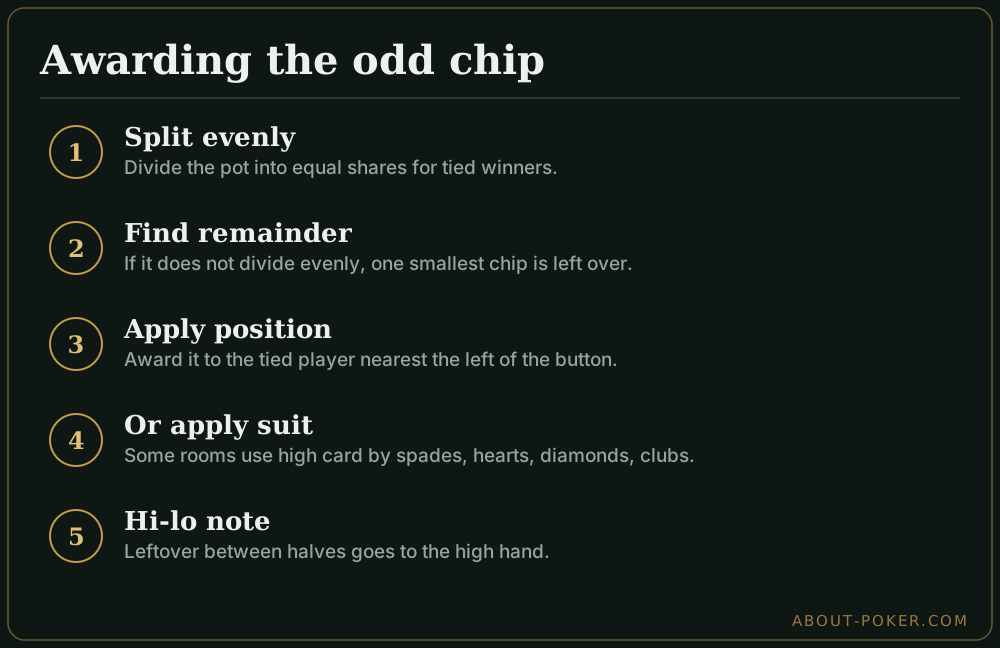
In most modern cardrooms, especially in hold’em, the odd chip goes by position: the tied player in the worst position receives it. “Worst position” means the player closest to the left of the dealer button — the first player who would act first after the flop. The logic is a small courtesy to the out-of-position player, and, more importantly, it is simple and unambiguous.
So among tied winners, the dealer starts at the button and moves clockwise; the first tied player they reach gets the odd chip. If you understand who acts first at showdown, you already understand the seat order used here.
The high-card-by-suit rule
Some rooms — and many stud games — decide the odd chip by high card by suit instead. The standard suit ranking from high to low is spades, hearts, diamonds, clubs. The tied player holding the highest-ranked card by this order takes the odd chip. Because every card in a deck is unique, this always produces exactly one winner with no further tiebreak needed. It matters most in stud, where players have visible up-cards, but you will see it in some hold’em rooms too.
Worked example: a two-way tie in hold’em
The board reads Kh Kd 7s 7c 2d and two players both turn over an ace, so both play the same two pair over two pair with an ace kicker — an exact tie. The pot is 305 in chips, and the smallest chip in play is worth 1.
Half of 305 is 152.5, which is impossible in whole chips. The dealer awards 152 to each player, leaving a single odd chip. Under the position rule, whichever of the two tied players sits closer to the left of the button gets that final chip — so one player receives 153 and the other 152. Under a suit rule, the player whose highest relevant card is the higher suit would take it instead. Either way, the outcome is fixed the moment the rule is known.
Odd chips in hi-lo split games
High-low split games such as Omaha Hi-Lo add a layer. First the pot splits into a high half and a low half. If the total pot cannot be halved evenly, the odd chip between the two halves usually goes to the high hand by default. Then, if several players tie within the high or the low, the position or suit rule breaks that sub-tie for that half. So a hi-lo pot can involve two separate odd-chip decisions — one between high and low, one within a tied side.
Quick checklist
- The odd chip is always the smallest denomination in play.
- Position rule: the tied player nearest the left of the button gets it.
- Suit rule: the tied player with the highest card by spades–hearts–diamonds–clubs gets it.
- Hi-lo: the leftover between halves goes to the high hand; sub-ties use position or suit.
- House rules decide which system a room uses — ask before a big pot rides on it.
The value of an odd chip is almost never meaningful, but the certainty is. When a pot has to be shared, these rules mean the dealer never has to guess and no one has to argue. For how the money reaches the table in the first place, review the betting rules, and for multiway all-ins where several pots form at once, see all-in and side pots explained. Back to the how-to-play hub for more.
Frequently asked
Who gets the odd chip in a split pot?
In most cardrooms the odd chip goes to the player in the worst position — the first seat to the left of the button among the tied players. Some rooms instead award it by high card by suit. House rules decide, so ask if it matters.
What is the odd chip rule in poker?
When a pot cannot be divided evenly among tied winners, the leftover single chip must go somewhere. The odd chip rule specifies exactly who receives it, so the split is deterministic rather than argued case by case.
How is the odd chip decided in a hi-lo split?
In high-low games, if the pot cannot be halved evenly, the odd chip typically goes to the high hand. If multiple players tie for high or low, the position or suit rule then breaks that sub-tie.
Does suit ever decide the odd chip?
Yes. Some rooms award the odd chip to the highest card by suit ranking (spades, hearts, diamonds, clubs). This is more common in stud than in hold'em, where position is the usual tiebreaker.