Faro Card Game Rules: How to Play
Faro card game rules explained: the layout, how the banker deals losing and winning cards, placing bets, the case count, and why faro faded away.
On this page · 5 sections
Faro is a banking card game in which players bet on which card ranks will win or lose, while a banker deals two cards each turn — the first is the losing card, the second is the winning card.
That one sentence is nearly the whole game. There are no hands to build and no opponents to read; you simply back ranks on a painted layout and watch the deck deal itself out, turn by turn. For a century faro was the loudest game in the American West, easily outdrawing poker, before it collapsed under its own cheatability.
The table
Three things make a faro game: a standard 52-card deck fed from a dealing box (historically a spring-loaded shoe), a layout painted with one card of each rank from Ace through King — usually the full suit of spades — and a banker who deals and settles every bet. Any number of players can crowd around and place chips on the ranks.
The layout is a simple two-row grid of thirteen ranks. Suit doesn’t matter — only rank — so a single card of each rank stands in for all four:
A   2   3   4   5   6   7
K   Q   J  10   9   8
You drop chips on (or just off the edge of) whichever rank you want to back, and you can cover as many ranks as you like at once.
Losing card, then winning card
Play runs in turns, and each turn pulls two cards from the box:
- The losing card comes first. This is the bank’s card: every plain bet sitting on that rank is collected by the bank.
- The winning card comes second. This is the player’s card: every plain bet on that rank is paid even money.
The naming is from the player’s point of view, not the card’s. “Losing” and “winning” describe what happens to a plain (bet-to-win) chip. A coppered chip inverts that — it wins on the bank’s card and loses on the player’s card — so the same first-card/second-card deal settles both kinds of bet in opposite directions.
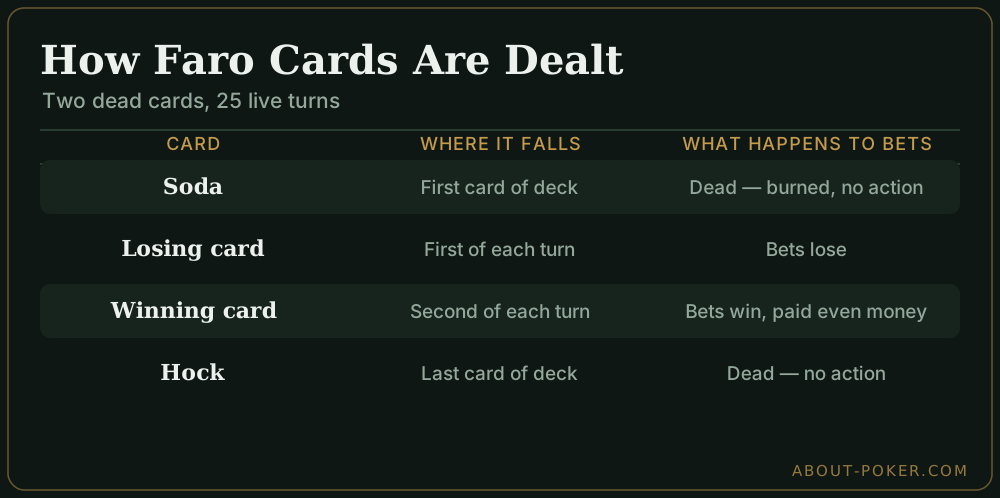
Two cards are dead and never form a turn: the soda (the very first card, burned before play) and the hock (the last card). Everything between them is dealt two at a time, which gives exactly 25 turns per deck (50 live cards ÷ 2).
| Card | Where it falls | What happens to bets on that rank |
|---|---|---|
| Soda | First card of the deck | Dead — burned, no action |
| Losing card | First of each turn | Bets lose |
| Winning card | Second of each turn | Bets win, paid even money |
| Hock | Last card of the deck | Dead — no action |
Betting the ranks
You place chips directly on ranks of the layout, and you have a few moves:
- Bet to win — plain chips on a rank, which win if that rank is dealt as the second (winning) card.
- Copper the bet — a marker (a copper token, or “hexbit”) on top of your chips flips the wager, so now you win if the rank is dealt as the losing card.
- Move between turns — you may add, pull, or shift chips before each new turn, which is why tracking the deck pays off.
One nasty wrinkle: if both cards of a turn are the same rank — a split — the bank takes half of all bets on that rank. Historically this split was the banker’s main mathematical edge.
A worked turn
Say you put $10 to win on the Nine and $10 coppered on the Queen, then the banker deals the turn:
- Loser (bank’s card): Queen. Your coppered Queen bet wins, so the bank pays you $10 and your $10 stake stays. Coppered bets pay even money, same as plain bets.
- Winner (player’s card): Nine. Your plain Nine bet wins even money, so the bank pays you another $10.
You started the turn with $20 on the table and end it up $20 — both bets landed. If the Nine had instead been the loser, that $10 stake would have gone to the bank. And if the turn came up Nine–Nine (a split), the bank would rake half your $10 Nine bet — you’d lose $5 on it no matter which way you’d bet the rank.
Counting the deck
Serious games ran a casekeeper, an abacus-like frame that logged every card as it left the box. Because only four of each rank exist, watching them deplete told everyone exactly what remained. When just one card of a rank was left, it was said to be “in case” — and case cards escaped the split penalty entirely, since a split is impossible with one card left. That made them especially attractive to bet.
Near the very end, only three live cards remain (the hock aside). A player can then call the turn, betting on the precise order those last cards will fall. It’s the game’s one high-payout swing, worth around 4 to 1 for guessing right.
Why faro disappeared
Faro was fast, simple, and gave the honest house only a thin edge — which was exactly the problem. That edge came almost entirely from the split rule, and it worked out to roughly 1.5% of total action over a full deck (splits get rarer as ranks deplete, and case cards are exempt entirely). Compared with the house margins on games like roulette (around 5.3% on a double-zero wheel), that is a razor-thin cut. The thin margin tempted operators to cheat, and gaffed dealing boxes made it notoriously easy to rig against players. As trust eroded and richer-margin games spread, faro drained out of the casinos that had once been built around it. If you want to see what filled the void, look at how poker works at a casino and the range of modern poker game variants.
Frequently asked
Is faro a type of poker?
No. Faro uses a standard 52-card deck but has no five-card hands, no hand rankings, and no bluffing. It's a banking game where you bet on card ranks. It was more popular than poker in American gambling halls before fading in the early 20th century.
What does it mean to 'copper' a bet in faro?
Coppering means placing a small marker on top of your chips to reverse the wager, so you're betting that a rank will come up as the losing card rather than the winning card.
What is 'calling the turn' in faro?
On the last three live cards, a player can bet on the exact order they'll fall. Guessing the precise sequence is much harder than a single rank bet, so it pays a far larger reward — traditionally around 4 to 1.