Poker ROI Explained
Poker ROI is your profit as a percentage of what you buy in for. Here's how to calculate it, what a good ROI looks like, and why sample size makes or breaks it.
On this page · 7 sections
ROI — return on investment — is the standard way tournament and sit-and-go players measure how good they are. It answers a simple question: for every dollar you put into buy-ins, how many dollars do you get back on average? Cash-game players lean on win rate in big blinds per 100 hands, but for tournaments, where you pay a fixed fee to enter and win a variable prize, ROI is the natural yardstick.
The formula is easy. Interpreting it honestly — with enough games and an eye on variance — is where most players go wrong.
The ROI formula
The calculation is one line:
ROI = (total winnings − total buy-ins) ÷ total buy-ins × 100.
Total buy-ins must include the entry fee (the rake), because that’s real money out of your pocket. If you play a tournament advertised as “$100 + $9,” your buy-in for ROI purposes is $109, not $100. Skip the fee and you’ll overstate your edge — a classic beginner error.
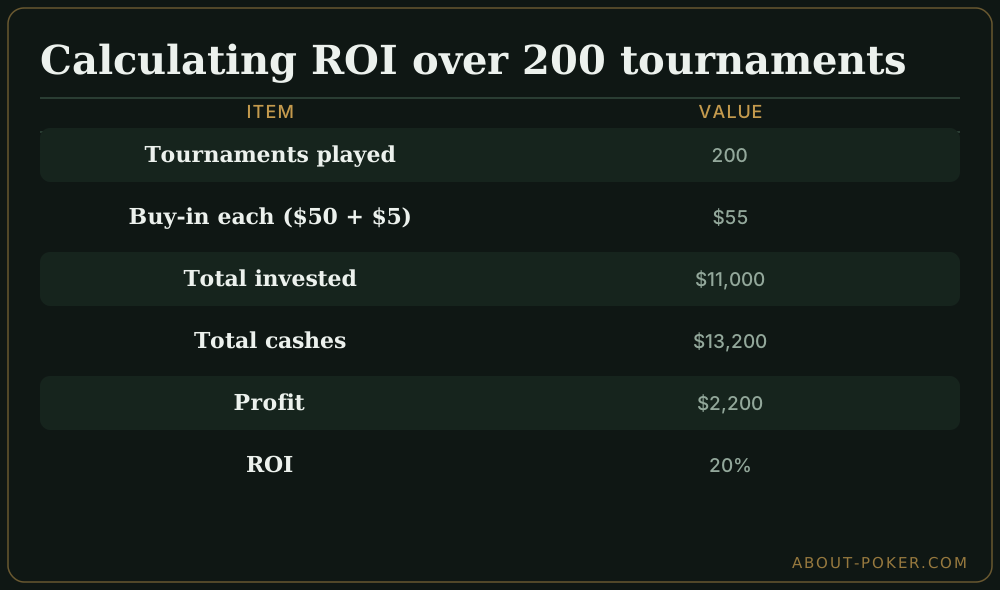
Here’s a worked example. Over a month you play 200 online tournaments, each with a $55 buy-in ($50 + $5 fee). Your total invested is 200 × $55 = $11,000. You cash for $13,200 across all of them. Your profit is $13,200 − $11,000 = $2,200. Your ROI is $2,200 ÷ $11,000 × 100 = 20%. That means for every dollar entered, you returned twenty cents of profit on average — a genuinely strong number, if the sample is big enough to trust.
What counts as a good ROI
ROI benchmarks depend heavily on format and stakes:
- Online MTTs: a sustained 10–20% ROI over a large sample is very good; 20%+ is elite. Fields are big and tough, so edges are thin.
- Turbo and hyper SNGs: ROIs run lower, often 3–8%, because faster structures compress skill edge and the rake takes a bigger relative bite.
- Live tournaments: softer fields can support ROIs of 50%, 100%, or more — but samples are tiny, so these numbers are almost meaningless as predictions.
- Satellites: measured differently, since the “prize” is a seat, not cash.
Notice the pattern: the softer and rarer the games, the higher the possible ROI but the less reliable the measurement. A live grinder claiming a 200% ROI over 40 tournaments is quoting noise, not skill.
Why sample size is everything
Tournament ROI is one of the highest-variance stats in poker, and the reason is structural: the bulk of your profit comes from a handful of deep runs and wins, which happen rarely. You can play technically perfect poker for fifty tournaments, min-cash a few, and post a negative ROI purely because you didn’t spike a final table.
Because of that, your measured ROI wobbles wildly until you’ve logged a serious volume. A rough guideline: it takes on the order of a few thousand MTTs before your observed ROI settles close to your true long-run figure. Under a few hundred games, the number is dominated by variance, not skill. This is the same statistical reality covered in poker variance and standard deviation — tournaments just have it in the extreme.
The practical takeaway: don’t quit your day job because of a hot 300-tournament stretch, and don’t panic during a cold one. Judge yourself over the largest sample you can.
ROI, win rate, and the money question
ROI tells you your efficiency per dollar entered, but it doesn’t directly tell you your hourly earn — that depends on how fast you play and how many tables you run. A 15% ROI grinding one live tournament a week is a fun hobby; the same 15% ROI over a thousand online tournaments a month is a serious income.
To turn ROI into money, you combine it with volume: expected profit = ROI × total buy-ins invested. Twenty percent ROI on $11,000 of monthly volume is $2,200; the same ROI on $110,000 of volume is $22,000. That interplay between edge and volume is exactly what poker win rate and ROI unpacks in more depth.
ROI’s link to bankroll
A high ROI does not mean you need less bankroll — often the opposite. High-ROI tournament play is high-variance play, and variance is what drives bankroll requirements. That’s why tournament players carry far more buy-ins than cash players; a 100-buy-in roll is often the floor for serious MTT grinding. See poker bankroll for tournaments for the specifics.
Common ROI mistakes
- Excluding the entry fee from buy-in totals, inflating your number.
- Quoting ROI over tiny samples as if it were a settled skill measure.
- Confusing ROI with hourly rate — efficiency isn’t income without volume.
- Comparing ROIs across formats without adjusting for structure and field strength.
- Chasing high-ROI soft games without the bankroll to survive their variance.
An ROI checklist
Before you trust an ROI figure — your own or someone else’s — ask:
- Does the buy-in total include fees and rake?
- How many tournaments is it based on, and is that enough to matter?
- What format and stakes produced it, and do they match what I’m comparing to?
- Have I paired it with volume to estimate actual dollars earned?
- Is my bankroll deep enough for the variance this ROI implies?
Get those right and ROI becomes exactly what it should be: an honest, comparable measure of your tournament edge — one that rewards patience and punishes anyone reading too much into a good week.
Frequently asked
What is ROI in poker?
ROI (return on investment) is your total profit divided by your total buy-ins, expressed as a percentage. A 20% ROI means that for every $100 you put into tournaments, you profit $20 on average over the long run.
How do you calculate poker ROI?
ROI = (total winnings − total buy-ins) ÷ total buy-ins × 100. Include entry fees and rake in your buy-in total. Sum every tournament over a large sample, not a handful, to get a number that means anything.
What is a good poker ROI?
For online multi-table tournaments, a sustained 10–20% ROI over thousands of games is strong, and anything above 20% is elite. Live tournaments can support higher ROIs because fields are softer, but the small samples make the figure far less reliable.
Why does sample size matter for ROI?
Tournament results are extremely high-variance because most of your profit comes from rare deep runs. It takes thousands of games before your measured ROI settles near your true skill edge — a few hundred tournaments tells you almost nothing.