Rakeback Math Explained
Rakeback returns a slice of the rake you pay. Here's the math — dealt vs contributed, effective rakeback, and how it can flip a losing win rate positive.
On this page · 7 sections
Rakeback is the portion of the rake a poker room returns to you for your play. Rake is the house’s cut of each pot (or the fee on a tournament buy-in), and it’s a bigger drag on your results than most players realize — often the difference between a winning and losing month. Rakeback claws some of that back, and once you can do the math, you can see exactly how much it adds to your bottom line.
The mechanics are simple arithmetic, but the details — dealt vs. contributed, effective percentages, how it scales with stakes — are where the real understanding lives.
The core formula
At its heart, rakeback is one multiplication:
Rakeback earned = total rake paid × rakeback percentage.
If you generate $2,000 of rake in a month and your deal returns 35%, you collect $700. That $700 is pure addition to your win rate — money you’d otherwise never see again. It doesn’t matter whether you won or lost at the tables; rakeback is paid on volume, not results.
The hard part is estimating the first number, total rake paid, because rooms don’t hand you a running tally in real time. You approximate it from three inputs: hands played, average rake per hand, and any per-hand caps.
Estimating your rake paid
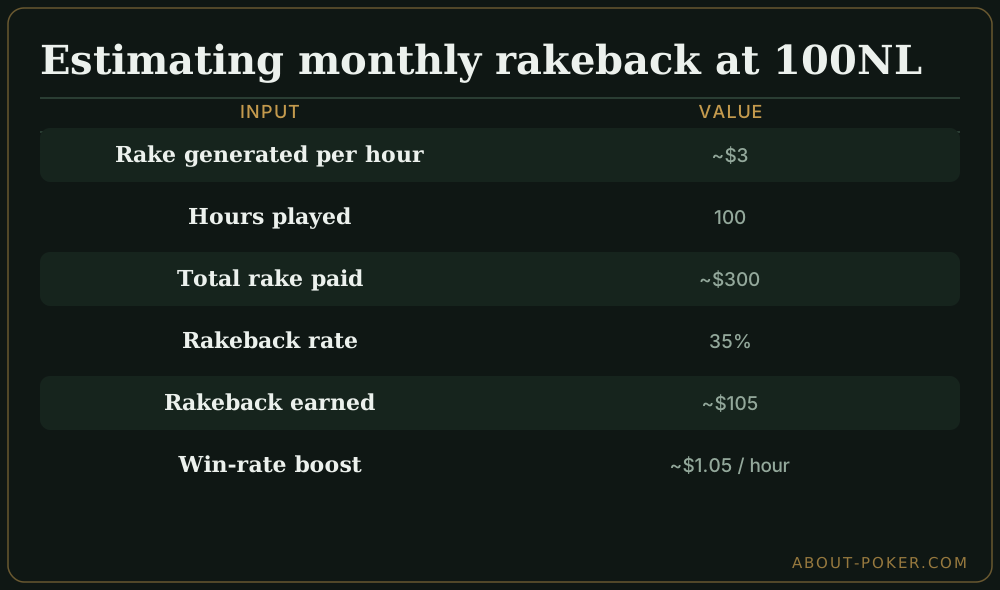
Here’s a worked example for an online cash grinder. Say you play $0.50/$1 (100NL) online:
- You four-table and see about 75 hands per table per hour, so 300 hands/hour.
- Average rake at 100NL runs roughly $0.40 per raked hand, but you’re only dealt into a pot to the flop about 25% of the time you play, and rake only hits pots that see a flop. A common working figure is about $0.30 of rake attributable to you per 100 hands at this level under a dealt model — but let’s use a rounder table-level number: your seat generates roughly $3 of rake per hour here.
- Over a 100-hour month, that’s about $300 of rake paid.
At 35% rakeback, you’d get back about $105 that month. On its own that’s modest — but expressed as a win-rate boost it’s meaningful. If you were breaking even at the tables over those 100 hours, rakeback alone made you a $1.05/hour winner. The exact per-hand figures vary by room and stake, so treat these as a model, not gospel.
Dealt vs. contributed rakeback
Rooms calculate how much rake is yours in two main ways, and the difference matters:
- Dealt rakeback splits each pot’s rake evenly among everyone dealt into the hand, whether or not they put chips in. A tight player who folds a lot loves dealt, because they get credited for pots they never contested.
- Contributed rakeback credits you only in proportion to the chips you actually contributed to raked pots. A loose, aggressive player who’s often in the pot earns more here.
Rule of thumb: if you’re tight, prefer dealt; if you’re loose, prefer contributed. Knowing your own VPIP (how often you voluntarily put money in) tells you which method quietly pays you more. This ties directly into how you measure your true results — see poker win rate and ROI, because rakeback should always be folded into your net win rate.
Effective rakeback vs. the headline number
The percentage in a deal is rarely the whole story. Modern rooms bury rakeback inside tiered rewards programs: you climb levels by volume, and your effective return rises the more you play. A program might advertise “up to 60%” but only deliver 20–30% at the volume a recreational player actually reaches.
Effective rakeback is what you actually get: total rewards received ÷ total rake paid. Always compute that number, not the marketing headline. A flat 30% cash deal frequently beats a flashy 60% program you’ll never grind hard enough to unlock.
When rakeback matters most
Rakeback’s power is inversely tied to stakes. Rake is roughly fixed in dollar terms per pot (and usually capped), while pot sizes explode as you move up. So:
- At micro and small stakes, rake is a huge fraction of pots, and rakeback is enormous relative to your edge — often the biggest single line in a winning grinder’s profit.
- At high stakes, rake is a rounding error against the pots, and rakeback barely registers.
This is why small-stakes online players treat rakeback as a core part of strategy, chasing the best deals and grinding for tier bonuses. It’s also why moving up isn’t a pure win: you often trade a fat rakeback cushion for a thinner one. Once you’ve stacked up rewards, remember to actually pull them out — see withdrawing poker profit for doing that cleanly.
Common rakeback mistakes
- Chasing headline percentages instead of computing effective rakeback at your real volume.
- Ignoring dealt vs. contributed when your playing style clearly favors one.
- Playing extra hours purely to hit a bonus tier — grinding a game you don’t beat just to unlock rewards is a net loss.
- Forgetting to include rakeback in your win rate, which makes you underestimate how well you’re actually doing.
A rakeback checklist
Before committing to a room or deal, run through this:
- What is the effective rakeback at my expected monthly volume, not the max?
- Is the room’s rake calculated dealt or contributed, and which suits my style?
- Are rewards paid as cash or locked into store credit / tickets?
- Does the deal have a volume floor below which I earn nothing?
- Have I added rakeback into my win-rate tracking so my numbers are honest?
Get those answers and rakeback stops being a mysterious perk and becomes what it really is: a predictable, calculable line item that can meaningfully — sometimes decisively — improve your poker bottom line.
Frequently asked
How does rakeback work?
Rakeback returns a percentage of the rake you generate back to your account, usually as cash or via a rewards program. If you pay $1,000 in rake in a month and get 30% rakeback, you receive $300 back — money that goes straight to your bottom line.
How do you calculate rakeback?
Rakeback = rake paid × rakeback percentage. To find rake paid, estimate hands per hour, average rake per hand, and hours played. Multiply the resulting rake total by your rakeback rate to get the dollar amount returned.
What is the difference between dealt and contributed rakeback?
Dealt rakeback credits you for every pot you were dealt into, split evenly among players. Contributed rakeback credits you only in proportion to the chips you actually put in the pot. Tight players usually earn more under dealt; loose players earn more under contributed.
Can rakeback make a losing player a winner?
Sometimes. If your at-the-table win rate is slightly negative, enough rakeback can flip your net result positive. But rakeback shrinks as you move up in stakes relative to pot sizes, so it rescues small-stakes grinders far more than high-stakes players.