Cash Game C-Bet Strategy
A c-bet wins the pots the flop misses for everyone. When to fire, which board textures to bet or check, how to size, and how position shifts the plan.
On this page · 9 sections
You raise A♣ K♦ from the cutoff, the big blind calls, and the flop comes K♠ 7♦ 2♣. You should bet — but not because you flopped top pair. You should bet because this board smashed the range you raised and whiffed the range that called, so you can fire your entire range cheaply and win the pot far more often than the pot you’re risking. That is what a continuation bet is: a flop bet by the preflop raiser, continuing the story, cashing in on the fact that neither player pairs up roughly two-thirds of the time.
The skill is knowing when the board lets you do that and when it doesn’t.
Read the board before you reach for chips
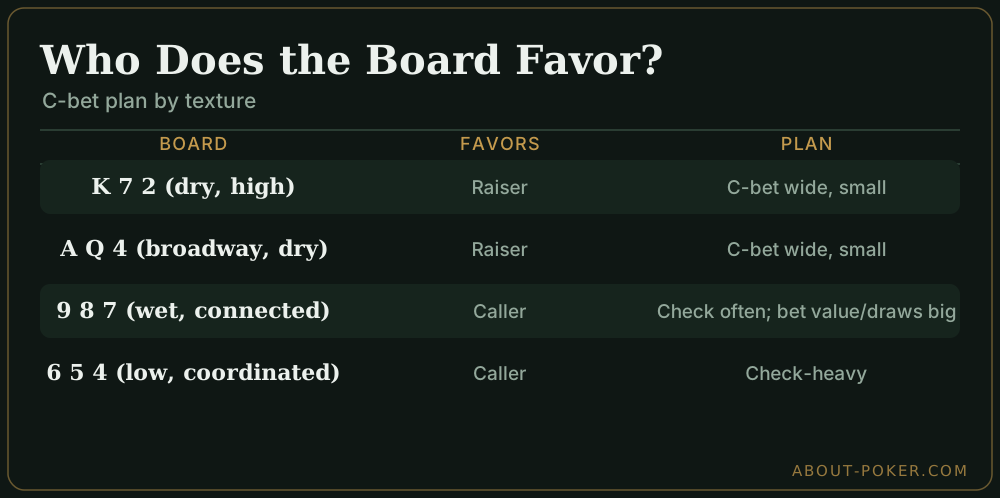
The single biggest input isn’t your hand — it’s whether the flop favors your preflop range or the caller’s. You raised, so your range is dense with high cards and pairs. Boards full of high cards belong to you; low, connected boards belong to the player who called with suited connectors and small pairs.
| Board | Favors | Plan |
|---|---|---|
K♠ 7♦ 2♣ (dry, high) | Raiser | C-bet wide, small |
A♥ Q♦ 4♠ (broadway, dry) | Raiser | C-bet wide, small |
9♣ 8♦ 7♥ (wet, connected) | Caller | Check often; bet only value and draws, big |
6♠ 5♠ 4♦ (low, coordinated) | Caller | Check-heavy — this hits their calls |
K-7-2 hammers an ace-king-heavy raising range and misses a big blind’s suited junk, so you can bet almost everything for a small price. 9-8-7 does the reverse: it connects with their calling range and leaves yours full of overcards, so you slow down. More on reading these textures lives in the postflop hub.
Size to your range, not your hand
Once you know who the board favors, sizing follows almost automatically:
- Small, 25–33% pot, on dry boards where you’re c-betting a wide range. You don’t need to risk much to fold out air, and you keep your own bluffs cheap.
- Large, 66–75% pot, on wet boards where you bet a narrow, strong range. You want to charge draws and build a pot with the value hands that will get called.
The trap to avoid is letting hand strength pick the size. Bet big only with monsters and small only with air, and every observant regular reads you instantly. Let the texture set one size for your whole range on that board. Full multi-street sizing frameworks are in the bet sizing guide.
Position widens what you can get away with
You c-bet meaningfully wider in position than out of it, for a simple reason: acting last means you’ll see the turn card before you commit more, and you can give up cheaply when called. Realizing equity is easy.
Out of position you can’t guarantee a free card, so checking becomes more attractive — and you need a real checking range, not just your giveups. If every check is surrender, opponents float you relentlessly; if some checks are second pair or a slow-played strong hand, they can’t. The positional edge underneath all of this is covered in the positions hub.
Add a player, subtract a bluff — multiway pots
Everything above assumes one caller. Add a second or third and the math flips: someone connecting with the flop now becomes the likely outcome, not the exception. Against two callers, roughly one of them holds a piece often enough that a pure-air c-bet is folding out very little and getting called by the one hand that beat you. So bet a much tighter range and lean toward checking your bluffs.
- Value: bet top pair good kicker and better, and your strong draws — you want money in while you’re ahead, and you get called by worse across two ranges.
- Bluffs: cut them hard. A naked overcard bluff that works heads-up gets snapped multiway. Keep only high-equity semi-bluffs (a flush draw with two overcards, say) that can barrel or improve.
- Sizing: go bigger, 66% pot and up. You’re betting mostly value now, and you need to charge the draws that multiple opponents will chase.
The rule of thumb: for each extra player in the pot, drop your bluffs and tighten your value. Three-handed, a c-bet is closer to a value bet than a range bet.
The turn — barrel with a reason
A flop c-bet buys you the turn; it doesn’t commit you to it. Fire a second barrel when something has changed in your favor, not out of momentum:
- The turn improves your range or hand — an overcard to the board, a card that completes a draw you’d have, or a card that gives you equity (a gutshot, a flush draw).
- The turn is bad for the caller’s range — a scare card that hits your perceived hands, not theirs.
Give up when the turn helps them and not you, or when a flop caller has shown they won’t fold. On the K♠ 7♦ 2♣ example, an A, K, or Q turn is a great second-barrel card for your AQ/JT bluffs; a 6 or 8 that brings a straight draw to a big-blind calling range is a clean spot to check and give up. Roughly, a good flop-c-bet range narrows to about half its bluffs on the turn — you keep the ones that picked up equity or a scare card and abandon the rest.
Adjust to who you’re betting into
Balanced ranges are the default, but cash-game profits come from exploiting the player across the table:
| Opponent type | Adjustment |
|---|---|
| Nit / tight-passive | C-bet more air — they fold everything but real hands. But stop barreling when they call or raise; that’s the nuts. |
| Calling station | Almost never bluff. C-bet value thin and often, but fire without a hand and you’re lighting money on fire. Let them pay off your pairs. |
| Floater / aggressive reg | They call flops to steal turns. C-bet a tighter, tougher-to-attack range, then be willing to check-call or double-barrel through their float. |
Frequency and ratios — a sanity check
You don’t need to count combos at the table, but a few targets keep you honest. On a dry, range-favorable board you can c-bet near 100% of your range for a small size — that’s the whole point of the texture. On wet boards a c-bet frequency around 40–60% is healthier than firing everything. And when you do bluff for value-sized bets, aim for roughly 2 value hands to 1 bluff on the flop, tightening toward 1:1 by the river as the pot grows and fewer bluffs are needed to stay unpredictable.
Beyond the single-raised pot
Two spots change the plan enough to flag:
- 3-bet pots: stacks are shallower relative to the pot and ranges are stronger and narrower, so a c-bet commits more of your stack. Size smaller (33–50%) and lean on the fact that your 3-betting range is already condensed toward strong hands.
- C-betting as the out-of-position PFR from the blinds: you raised, got called, and now act first with no positional cushion. Check more of your range here — including some strong hands to protect it — and reserve your c-bets for boards that genuinely favor you.
Back to the hand — and when to abandon it
On that K♠ 7♦ 2♣ flop you bet about a third of the pot, say $10 into $30. That price lets you fire AK and KQ for value and AQ or JT as bluffs at the same cost, so the big blind can’t tell which you hold. Most of their missed suited connectors and low cards fold; when they call, you still hold the best hand and a clean plan for the turn.
Now change the flop to 9♣ 8♦ 7♥ with the same A♣ K♦. Firing here is a mistake — you have no pair, no draw, and the board favors the caller. This is a check. So is a medium hand like second pair that wants to see a cheap showdown, and so is most of your air when you’re out of position. Checking these spots isn’t weakness; it’s what keeps your c-bets on the good boards credible.
The through-line is one question asked every flop: does this board favor me? Bet wide and small when it does, big and selective when it doesn’t, wider in position than out — and fold that into your broader flop game in poker cash game strategy and the cash game strategy hub.
Frequently asked
What is a c-bet in poker?
A continuation bet (c-bet) is a flop bet by the player who raised before the flop. It continues the preflop aggression and often wins outright, because the flop misses both players most of the time.
Should you always c-bet after raising preflop?
No — auto-c-betting every flop is one of the most common leaks. Check back boards that miss your range or hit your opponent's, and use those checks to protect your checking range and control the pot with medium hands.
What size should a c-bet be?
Match size to how wide you're betting. Small (about 25–33% of the pot) on dry boards where you c-bet a wide range; larger (66–75%) on wet boards where you bet mostly value and strong draws.