Poker Cash Game Rules Explained
Cash game rules: chips are real money at face value, blinds stay fixed, and you can buy in or cash out any time between hands.
On this page · 4 sections
A cash game — also called a ring game — is poker where every chip equals a fixed dollar amount, the blinds never rise, and you can join or quit between any two hands. That’s the whole shape of it: real-money chips at face value, fixed stakes, free entry and exit. Nobody gets eliminated, the stakes never change, and you walk away with the exact value of your chips whenever you like.
Everything else is standard Texas Hold’em procedure layered on top of those three facts. Here’s how a session actually runs.
The four facts that define the format
- Chips are money at face value. Win a $150 pot and those chips are worth $150 the instant you cash out.
- Blinds are fixed. A $1/$2 table stays $1/$2 all night — the small blind posts $1, the big blind posts $2, and the game is named after them.
- You come and go freely. Sit down, take a break, or leave between hands.
- No elimination. Bust your stack and you can rebuy and keep playing.
For a side-by-side look at the elimination format, see the cash game vs tournament breakdown.
Buy-ins and topping up
The buy-in is what you exchange for chips when you sit. Tables set a range — typically a minimum around 40–50 big blinds and a maximum around 100 (deep-stacked games allow more). Between hands you can add chips up to that maximum, which is standard practice so you always have a full stack behind when a big pot comes.
How a single hand runs
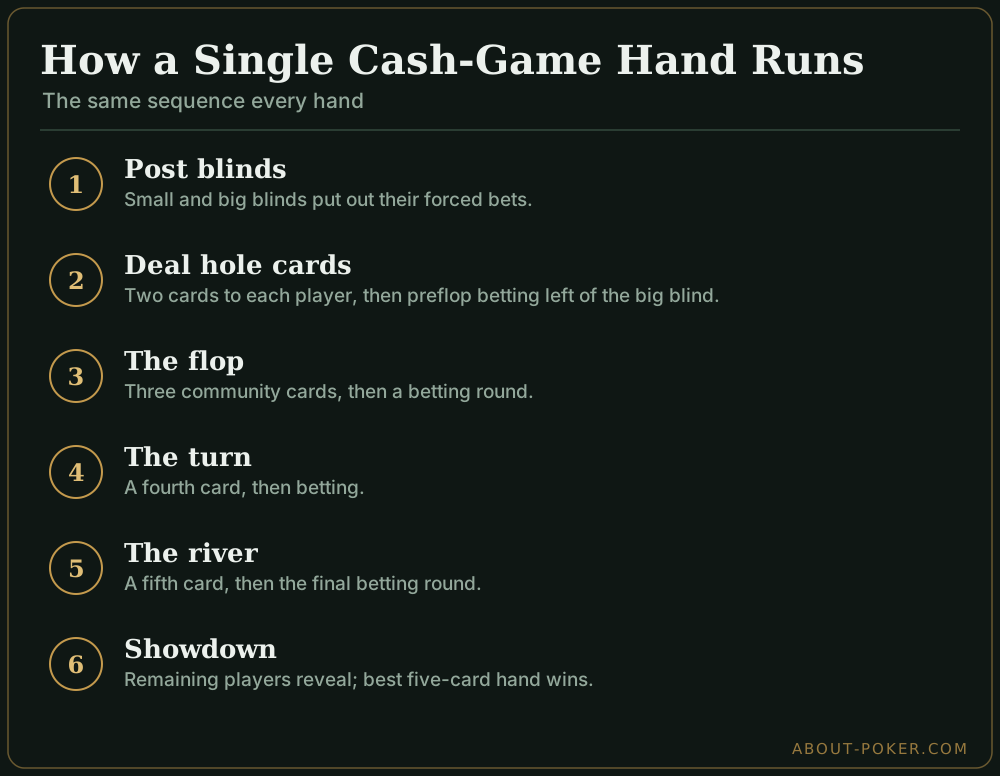
Each hand follows the same sequence:
- Small and big blinds post their forced bets.
- Two hole cards are dealt to each player.
- Preflop betting, starting left of the big blind.
- The flop — three community cards — then a betting round.
- The turn — a fourth card — then betting.
- The river — a fifth card — then the final betting round.
- Showdown: remaining players reveal, and the best five-card hand wins.
A round ends when everyone has matched the largest bet or folded. If one player bets and everyone else folds, the pot is won with no showdown.
Table rules and etiquette
These are the concrete rules that trip up new players. Get them right and nobody at the table will bat an eye.
- Table stakes — no adding money mid-hand. You can only wager the chips in front of you at the start of a hand. You can’t reach into your pocket for more once cards are out; you top up only between hands.
- Minimum raise. A raise must be at least as large as the previous bet or raise. In a $1/$2 game the first raise is to at least $4 (double the $2 big blind); if someone then makes it $6 (a $4 raise), the next re-raise must add at least another $4, to $10 or more.
- No string bets. Put your chips in with one clean motion, or say the amount first. Betting in two grabs — sliding out a call, then reaching back for a raise — is a string bet and the dealer will only count the first motion.
- Verbal is binding, and in turn. If you say “raise” or “call” it stands, even before your chips land. Always act in turn — declaring or folding out of turn gives away information and can be penalized.
- The single-oversized-chip rule. If you drop one chip bigger than the amount to call without saying “raise,” it’s ruled a call and you get change. To raise with an oversized chip, announce it.
- Protect your hand and don’t splash the pot. Keep a chip or card protector on your hole cards so they aren’t mucked by accident, and stack your bet neatly in front of you rather than tossing chips into the middle so the dealer can verify the amount.
All-in pots, side pots, and showdown order
When a player goes all-in for less than a full bet, the chips they can match go into the main pot and any further betting forms a side pot they cannot win. Example: three players see the river with $100 each in front, but Player A is all-in for $40. The first $120 ($40 × 3) is the main pot A can win; the remaining action between B and C builds a side pot only those two contest.
At showdown, the order to reveal is fixed. If there was betting on the river, the last player to bet or raise shows first, then clockwise. If the river checked through, the first active player left of the button shows first. You may always muck (fold face-down) rather than reveal a losing hand, forfeiting the pot.
Optional conventions you’ll run into
Some cash games add house options on top of the base rules — none are required, but it helps to recognize them:
- Straddle. A voluntary blind, usually double the big blind (so $4 in a $1/$2 game), posted before cards are dealt by the player left of the big blind. It buys the last preflop action and inflates the stakes for that hand.
- Antes. A small forced bet from every player (or a single “big blind ante”) on top of the blinds, more common in tournaments but sometimes added to cash games to build bigger pots.
- Run it twice. When two players are all-in, they can agree to deal the remaining board twice, each run worth half the pot, to reduce variance. Both players must consent.
Beyond the mechanics, one thing quietly shapes your win rate: the rake, the house’s small cut of most pots (often around 5% capped at a few dollars). It matters most at low stakes, where a capped rake eats a bigger share of each pot — which is part of why stake selection ties into bankroll management.
That’s the game. Once the rules feel automatic, the next question is which hands to play from each seat — start with a solid opening range in the cash game preflop strategy guide, and the balanced version of those ranges in the preflop GTO hub.
Frequently asked
Do cash game blinds go up?
No. A $1/$2 game stays $1/$2 for the entire session. Fixed blinds are the key structural difference from tournaments, where the stakes rise on a timer.
Can you leave a cash game whenever you want?
Yes — that's the defining feature. You can stand up between any two hands and exchange your chips for their exact dollar value, with no obligation to play a set number of hands.
What is a buy-in in a cash game?
The money you convert to chips when you sit. Tables set a minimum and maximum, commonly 40 to 100 big blinds, and you can top up between hands up to that maximum.
If I put in one big chip without saying anything, is it a raise?
No. Dropping a single chip larger than the amount to call, with no verbal declaration, is ruled a call and you get change. To raise, you must either announce 'raise' first or put out the full raise amount in one motion — betting in two grabs is a string bet and won't count.