PLO Bankroll Swings
PLO swings are far larger than Hold'em. Learn why Omaha variance is so high, how many buy-ins you need, and how to survive downswings without going broke.
On this page · 8 sections
If you come to Pot-Limit Omaha from Hold’em, the first thing that will surprise you is not the strategy — it is the size of the swings. PLO is a game where a winning player can lose for a very long time. Understanding why, and preparing for it, is the difference between surviving to profit and going broke on the way.
Why PLO variance is so high
Everyone at the table holds four cards, and you use exactly two. That single rule compresses equities dramatically. In Hold’em, aces are an 80%+ favorite over most hands preflop. In PLO, even the best starting hand — A♠A♥K♠K♥ — is often only a modest favorite, and premium hands routinely go to the flop as coin-flips against big draws.
On the flop the effect intensifies. A wrap draw with a flush draw can have more equity than a made set. When the money goes in on the flop, you are frequently in a near coin-flip, and coin-flips resolve against you half the time by definition. Multiply that across thousands of big pots and you get swings far larger than Hold’em produces. For a side-by-side look at the numbers, see our breakdown of PLO vs NLHE variance.
Draws hit — a lot
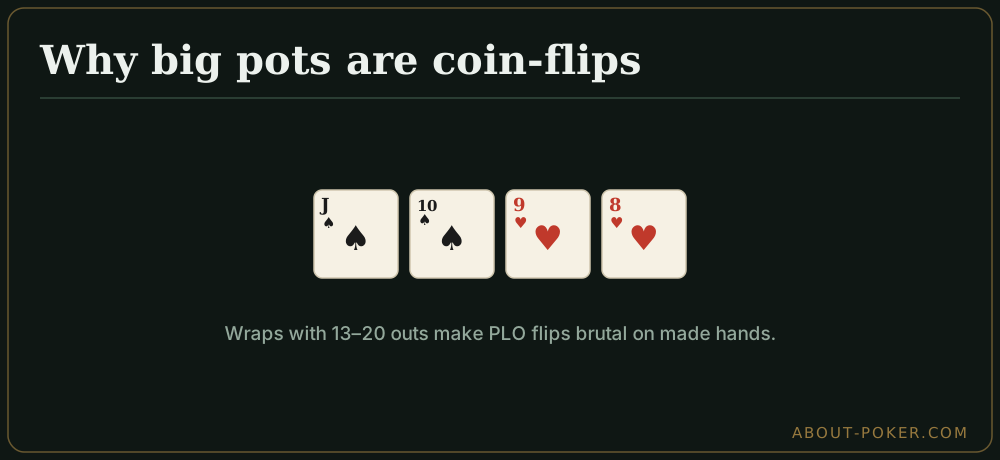
The other engine of PLO variance is how often draws come in. A big wrap can have 13, 17, even 20 outs. A hand that looks crushed on the flop can be a favorite to win by the river. This is great when you hold the draw and brutal when you hold the made hand. Because both happen constantly, your results bounce around wildly even when every decision is correct.
How big a bankroll you need
Because the swings are structural, your protection is a bigger bankroll — full stop. Rough guidelines for cash PLO:
- Absolute minimum: 40–50 buy-ins for your stake.
- Comfortable: 75 buy-ins.
- Conservative / moving up: 100 buy-ins.
Compare that to the 20–30 buy-ins a Hold’em cash player might run on, and you can see how much extra cushion PLO demands. Our full PLO bankroll management guide breaks these numbers down by game type and stake.
A worked example of a swing
Say you are a genuine winner at $1/$2 PLO with a 5 big-blind-per-100-hands win rate — a strong result. Your standard deviation in PLO might run around 150 bb/100, roughly double a Hold’em player’s. Over a 10,000-hand stretch, your expected profit is about 500 bb. But the natural swing around that (one standard deviation over 10,000 hands) is roughly 150 ÷ 10 × 100 = about 1,500 bb in either direction.
Read that again: your expected win is 500 bb, and the normal fluctuation is three times larger than your expectation. It is entirely ordinary for a winning player to be down 1,000 bb — five buy-ins — after 10,000 hands of perfect play. Over a bad stretch, being 20–30 buy-ins underwater is well within normal variance. That is why a 50-buy-in bankroll can feel thin.
Surviving downswings
The math tells you these downswings are coming, so plan for them before they hit:
- Move down when your roll shrinks. If you drop below your buy-in threshold for a stake, step down without ego. It is the single most important discipline in high-variance games.
- Avoid thin gambles. You cannot remove variance, but you can avoid adding to it by taking marginal flips and drawing to non-nut hands. Favor nut draws and clear equity edges.
- Separate results from decisions. A 30-buy-in downswing does not mean you are playing badly. Review your play for leaks, but do not tear apart a sound strategy because of a normal bad run.
- Have a stop-loss. Tilt turns a normal downswing into a catastrophic one. Set a per-session loss limit and honor it.
Is it even worth it?
Given all this, players reasonably ask whether the game is beatable. It is — the swings do not change your long-run expectation, only how bumpy the ride is. Whether PLO is profitable for you depends on edge and game selection; our guide on whether PLO is profitable covers that in detail. The key insight is that variance is the price of admission, not a verdict on your skill.
Common mistakes
- Playing PLO on a Hold’em-sized bankroll. This is the fastest way to go broke as a winning player.
- Reading a downswing as a skill problem and abandoning a sound strategy.
- Taking every flip because “it’s PLO and everything’s close.” Close is not the same as +EV.
- Not moving down when the roll drops, hoping to win it back at the higher stake.
Quick checklist
- Do I have at least 50 buy-ins for this stake?
- Am I mentally prepared for a 20–30 buy-in swing without tilting?
- Do I have a move-down rule and a stop-loss written down?
PLO rewards patience and punishes the undercapitalized. Build the bankroll first, and the swings become weather you ride out rather than storms that sink you.
Frequently asked
Why are PLO swings bigger than Hold'em?
In PLO everyone holds four cards, so equities run much closer together preflop and on the flop. Big pots are frequently near coin-flips between a made hand and a big draw, and draws hit far more often. That closeness means more all-in gambles resolve against you in the short run, producing larger swings.
How many buy-ins do I need for PLO?
More than for Hold'em. A common guideline is 50 buy-ins minimum for cash PLO, and many pros carry 75–100 to comfortably absorb the higher variance. If you are moving up or playing higher-variance short-handed games, err toward the larger number.
How long can a PLO downswing last?
Longer than most players expect. Because variance is high, a winning PLO player can run below expectation for tens of thousands of hands. Downswings of 20–30 buy-ins happen to solid players and are not necessarily a sign that anything is wrong with your game.
Does good play reduce PLO swings?
It reduces them somewhat by avoiding thin gambles and non-nut draws, but it cannot eliminate them. PLO variance is structural — a function of four-card equities running close — so even flawless play produces large swings. Bankroll size, not just skill, is your protection.