PLO Bare Aces
Bare aces in PLO are a pair of aces with no straight, flush, or pairing support. Learn why they are a trap hand and how to play AA when it dangles.
On this page · 6 sections
New PLO players see two aces and their eyes light up the way they would in Hold’em. In Pot-Limit Omaha, that reflex is expensive. “Bare aces” are pocket aces with no support from the other two cards, and they are one of the most misplayed holdings in the game. Understanding why they are weak, and how to squeeze the most out of them, separates winning PLO players from the field that keeps punting stacks with what looks like the best starting hand.
What “bare” actually means
A bare-ace hand is something like Ah As 8d 3c. The aces are there, but the other two cards do nothing. Neither ace is suited to a card that could make a nut flush, the side cards are not connected for straights, and there is no second pair to make two-pair or a bigger set. Contrast that with As Ah Ks Kh, a double-suited, double-paired monster, or As Ah Ks Qs, which adds a nut-flush draw and Broadway connectivity. Same aces, wildly different hands. In PLO the two “kicker” cards are half the hand, not an afterthought. See how supported aces rank in our PLO starting hands guide.
Why bare aces are a trap
The core problem is that Omaha equities run close together. Preflop, bare aces are only a modest favorite over most hands, and they need to flop a set of aces or catch a favorable ace-high board to win. A hand like Ah As 8d 3c flops a set roughly one time in eight and otherwise has an overpair that is easily outdrawn by the wraps, two-pair combos, and flush draws that opponents wake up with. Because there is no straight or flush backup, when the flop misses you, you have a naked overpair with no redraw, which is a recipe for getting stacked when you refuse to let go.
A worked example
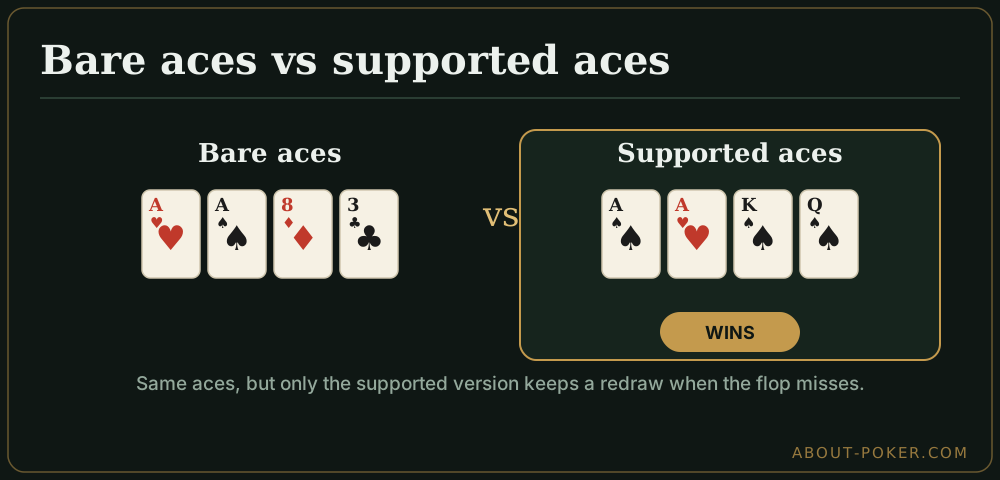
You hold Ah As 8d 3c and open, getting one caller. Flop comes Jc Ts 6h. You have an overpair, but think about what beats or draws against you: any two Broadway cards make a wrap, sets are possible, and Q-9, K-Q, and similar hands have big straight draws. If you bet and get raised, you are often behind and drawing thin, because your aces have no straight or flush outs to fall back on. Now imagine the same board with As Ah Ks Qs. You still have the overpair, but you also hold a gutshot to Broadway and can pick up a nut-flush draw on many turns. That backup is the entire difference between a hand you can continue with and a hand you must give up on. Bare aces leave you in the first situation over and over.
Playing bare aces before the flop
The instinct to fold them entirely is too extreme. Bare aces still have preflop equity and blockers, so they are usually a raise or a 3-bet rather than a fold, especially heads-up. The goal is to use their equity while it is highest: get the pot heads-up and take it down before the board runs out cards that leave you drawing dead. Raising to reduce the field is the whole point, because bare aces perform badly in multiway pots where someone almost always connects. For sizing and combos, our PLO 3-betting strategy covers when to press and when to flat.
Position and stack depth
Depth matters enormously. Deep-stacked, bare aces lose value fast because more money goes in on later streets where your hand rarely improves and opponents realize their draws. Shallow or heads-up, the preflop equity edge is more meaningful and you can commit more comfortably. In position you can control the pot size and check back flops that miss; out of position, weak bare-ace hands are frequent folds against aggression. Fitting them into a coherent range is part of building sound PLO preflop ranges.
Checklist for bare aces
- Recognize the hand: aces with no suited ace, no pair, and no connectivity.
- Raise or 3-bet to get heads-up; avoid family pots.
- Try to win the pot early, while your equity edge is at its peak.
- Do not fall in love postflop; a naked overpair with no redraw is a fold to real pressure.
- Play them more cautiously deep-stacked and out of position.
Treat bare aces as a hand that wants to win small and fast, not one that wants to build a giant multiway pot, and they stop being the trap that quietly drains your stack.
Frequently asked
What are bare aces in PLO?
Bare aces are pocket aces whose other two cards give no meaningful support, such as Ah As 8d 3c. There is no suit connected to an ace, no pair, and no straight coverage, so the hand relies almost entirely on flopping a set.
Should you 3-bet bare aces in PLO?
You can raise or 3-bet bare aces to charge draws and thin the field, but they play poorly multiway and rarely improve. Prefer to keep pots smaller in position or fold weak bare-ace holdings out of position, especially deep-stacked.
How much is AA worth in Omaha?
Double-suited connected aces are premium, but bare aces are only a small favorite preflop and lose value fast postflop. Against a random hand AA has roughly 55 to 65 percent equity, far less dominant than the 80 percent-plus edge AA holds in Hold'em.