PLO Flopped Sets
Flopping a set in PLO is strong but not a lock. Learn how top, middle, and bottom sets differ, when to stack off, and how to dodge set-over-set disasters.
On this page · 7 sections
Flopping a set is one of the most exciting moments at a PLO table, and one of the most misplayed. In Hold’em a flopped set is close to a guaranteed winner. In Pot-Limit Omaha it is a strong hand that must be handled with care, because everyone holds four cards and the board is dense with the straights, flushes, and higher sets that beat you. The difference between top set and bottom set can be the difference between a stack won and a stack lost.
Why sets flop more often in PLO
With a pocket pair among your four hole cards you flop a set or better around 24 percent of the time, roughly double the Hold’em frequency, because you effectively have two pairs pulling toward trips. That higher rate is a double-edged sword. You hit more often, but so does everyone else, which is why set-over-set is a genuine and recurring cooler in Omaha rather than the once-in-a-blue-moon event it is in Hold’em.
Top set versus middle and bottom set
Not all sets are created equal. Top set is the one you want: it dominates lower sets and is ahead of most single draws. Middle and bottom set are dangerous. They lose to higher sets, and they leave your opponent more room to hold a hand that has you drawing to a full house while they are already made. On the same wet board, top set might be a happy stack-off while bottom set is a hand you should be ready to fold to real pressure. This distinction is the heart of PLO set play.
A worked example
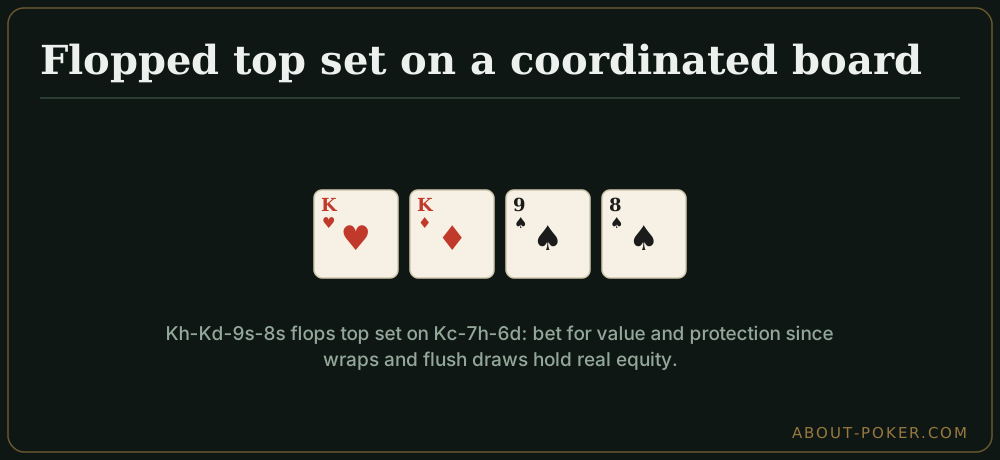
You hold Kh Kd 9s 8s in the cutoff and call a raise. Flop comes Kc 7h 6d, giving you top set. This is a clear bet for value and protection: you are ahead of overpairs, two-pair hands, and single wraps, and the board is coordinated enough that you do not want to give free cards to the 9-8-5-4 or 10-9-8 type holdings that are drawing at you.
Now flip it. You hold 7s 7c As Kd on that same Kc 7h 6d flop. You have bottom set, but you are behind top set and only slightly ahead of the biggest wraps. If the pot gets big and multiway, this is a hand where you proceed with far more caution, because a made straight or top set has you drawing to just ten outs for a boat.
Betting for value and protection
The default with a strong set is to bet, often pot. You accomplish two things at once: you get value from worse made hands and you charge the draws that have real equity against you. A wrap plus a flush draw can hold well over 50 percent against a set, so checking to keep the pot small usually just gives a coin-flip a free card. On dry boards you can sometimes size down or check to induce, but on wet boards, protection wins. This is standard PLO postflop strategy.
The set-over-set problem
Because sets flop so often, running your set into a bigger one is a normal part of PLO variance. There is no magic read that saves you every time, but board texture and action help. When you hold bottom set and face a raise and a re-raise on a wet board in a multiway pot, higher sets and made straights are very much in range. Bottom set is not a hand to blindly stack off with in those spots. Top set faces the same risk far less often, which is another reason it is so much more valuable.
Common mistakes
The first leak is treating every set like the nuts and stacking off with bottom set into obvious strength. The second is the reverse: slow-playing top set on a draw-heavy board and letting a wrap peel a free card that gets there. The third is ignoring position. Out of position with a vulnerable set, you have less control and should lean toward betting to deny equity rather than checking and facing a tough decision.
Quick checklist for flopped sets
Ask yourself: is this top set or a lower one? How wet is the board, and how many draws connect with it? Am I heads-up or multiway? In or out of position? With top set on a wet board heads-up, bet big and be willing to get it in. With bottom set facing multiple raises on a coordinated board, respect the range that beats you. A set is a great hand in PLO, but only if you know which set you have and what the board is telling you.
Frequently asked
Is a flopped set the nuts in PLO?
Almost never. A set is a strong made hand, but with four hole cards in every opponent's hand, straights, flushes, higher sets, and full houses all appear far more often than in Hold'em. Top set is a favorite over a single big draw but is regularly no better than a coin flip on wet boards.
Should you slow-play a flopped set in PLO?
Usually not. Boards run out dangerously in Omaha, so a set generally wants to bet for value and protection while it is ahead. Slow-playing lets wraps and flush draws get there cheaply and can turn a big favorite into an underdog by the river.
How often do you flop a set holding a pair in PLO?
About 24 percent of the time you will flop a set or better with a pocket pair in Omaha, roughly double the Hold'em rate, because you have two chances at the pair among your four cards. That higher frequency is exactly why set-over-set is a real danger in PLO.