Omaha Poker Rules: The Complete Guide
Omaha rules: four hole cards, use exactly two plus three from the board, pot-limit betting. Full deal-to-showdown walkthrough with a worked hand.
On this page · 8 sections
Omaha poker rules are almost identical to Texas Hold’em, with three key changes: you get four hole cards instead of two, you must use exactly two of them plus exactly three community cards to make your hand, and betting is pot-limit — the biggest bet allowed is the size of the pot. Everything else — blinds, betting rounds, hand rankings — matches Hold’em.
The deal and the objective
Omaha is a community-card game for 2 to 10 players. The goal is to make the best five-card poker hand — or to bet in a way that makes everyone else fold.
- Each player receives four hole cards, dealt face down.
- Five community cards are shared by everyone, dealt in stages.
- Your final hand is two hole cards + three community cards, always.
The hand rankings are the same as in every standard poker game: a royal flush is best, a high card is worst.
The dealing sequence mirrors Hold’em. Starting with the small blind, the dealer distributes the four hole cards one at a time, going around the table until everyone has four. Before each community stage the dealer burns the top card of the deck face down — one burn before the flop, one before the turn, one before the river — then deals the board cards face up. The burn card guards against anyone reading a marked or exposed top card.
The betting rounds
Action moves clockwise. Before any cards are dealt, the two players left of the dealer post the small blind and big blind — forced bets that seed the pot. There are four betting rounds:
- Pre-flop — after the four hole cards are dealt.
- The flop — three community cards are dealt; a betting round follows.
- The turn — a fourth community card is dealt; another betting round.
- The river — the fifth and final community card; the last betting round.
On each round you can check, bet, call, raise, or fold, exactly as in Hold’em. If two or more players remain after the river betting, there’s a showdown and the best hand wins.
Heads-up (two players): the positions flip, just as in Hold’em. The player on the button posts the small blind and acts first pre-flop, then acts last on every later street. The other player posts the big blind. So the button is the last to act after the flop but the first to act before it.
How pot-limit betting works
In pot-limit Omaha, the maximum bet or raise is the current size of the pot. The minimum bet is the size of the big blind.
The catch is calculating a maximum raise. A pot-sized raise equals: the amount you need to call, plus the size of the pot after you make that call.
Example: the pot is $100 and an opponent bets $50. To raise the pot, you first call the $50 (pot becomes $200), then raise by that $200 — for a total bet of $250. Pots grow quickly, but there’s no instant all-in bet like in no-limit games.
The exactly-two rule, worked out
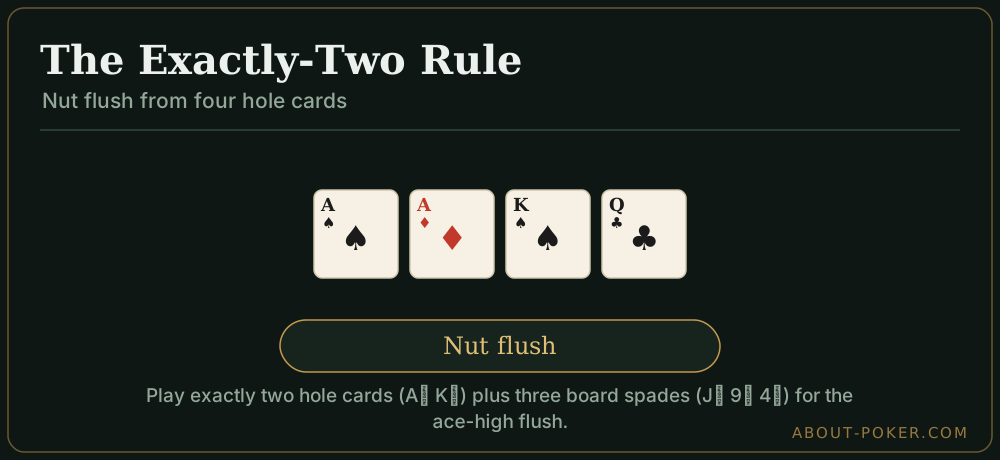
This is the rule to burn into memory. Suppose you hold:
A♠ A♦ K♠ Q♣
The board comes:
J♠ 9♠ 4♠ 3♠ 2♦
There are four spades on the board and you hold two spades of your own: A♠ and K♠. Because Omaha forces you to use exactly two hole cards, those are the two you play.
So you take A♠ K♠ from your hand plus three board spades (J♠ 9♠ 4♠) to make the nut flush — an ace-high flush that no one can beat. Notice that you only get to use two of the four board spades; the exactly-two rule caps you there no matter how many spades sit on the board.
The lesson: always find your best legal two-card combination before deciding what you have. Here you happened to hold two spades, so the flush is real. Had you held only one spade, it would be a different story.
What makes a strong starting hand
Because you build your hand from exactly two of four hole cards, a good Omaha hand is one where the cards work together — six two-card combinations pulling in the same direction beat four random cards. The strongest starting hands share three traits:
- Connectedness. Cards close in rank make straights.
J T 9 8can flop dozens of straight draws;K 9 4 2almost none. - Suitedness — ideally double-suited. Two cards of one suit plus two of another (e.g.
A♠ K♠ Q♥ J♥) give you two flush possibilities. A single suit is worth far less, and being “rainbow” (four suits) removes flush potential entirely. - High-card and pair value. Big pairs like aces and kings play best when they’re also suited or connected, so they can make more than just a pair. A bare
A A x xwith two dangling low, offsuit cards is weaker than beginners expect.
The premium hand A♠ A♦ K♠ K♦ has all four: two high pairs, two suits, and connected top cards. Contrast that with A♥ A♦ 7♣ 2♠ — the same aces, but nothing else coordinates, so most flops leave you with just one pair.
Common variants
- Pot-Limit Omaha (PLO): the standard game, best-high-hand-wins, described above.
- Omaha Hi-Lo (8-or-better): the pot splits between the best high hand and the best qualifying low hand (five unpaired cards ranked eight or lower). The exactly-two rule still applies, and you can use different two-card combos for your high and your low.
- 5-Card Omaha: dealt five hole cards, but you still use exactly two.
Quick reference
| Rule | Omaha |
|---|---|
| Hole cards dealt | 4 |
| Hole cards used | Exactly 2 |
| Board cards used | Exactly 3 |
| Betting rounds | 4 (pre-flop, flop, turn, river) |
| Betting structure | Pot-limit |
| Hand rankings | Standard poker rankings |
Next steps
You now know the rules. To see them in motion, walk through how to play a full Omaha hand from blinds to showdown. If you’re coming from Hold’em, read how Omaha differs from Hold’em so you don’t carry over habits that lose money. For the bigger picture, return to the Omaha & PLO hub.
Frequently asked
What is the main rule in Omaha poker?
You must use exactly two of your four hole cards and exactly three of the five community cards to make your five-card hand. No more, no fewer. This holds even for flushes and straights.
How many cards do you get in Omaha?
Each player is dealt four private hole cards face down. Five community cards are then dealt across the flop, turn, and river, shared by everyone at the table.
What does pot-limit mean in Omaha?
You can bet or raise up to the current size of the pot. A pot-sized raise equals the amount you'd call plus the total pot after that call, so it's larger than it first appears.
Can you use all four hole cards in Omaha?
No. You use exactly two hole cards, every hand, every time. Even if all four of your cards are the same suit as three board cards, you still only play two of them.