Open-Face Chinese Poker Strategy & Tips
Open-face Chinese poker strategy: avoid fouls, set rows in order, and chase royalties and Fantasyland safely. Card placement tips and worked examples.
On this page · 8 sections
Winning open-face Chinese poker (OFC) rests on three priorities, in order: don’t foul, set your rows legally, then chase royalties and Fantasyland. OFC deals cards a few at a time and you place each one face-up before seeing the next — so you’re constantly committing to positions without knowing what’s coming. If you know the open-face Chinese poker rules, this guide is about playing them well.
The golden rule: a fouled hand (rows out of order) scores zero and pays every opponent. Avoiding that disaster outweighs almost every fancy play.
The one rule that governs everything: don’t foul
Your three rows must ascend in strength: bottom (5 cards) beats middle (5 cards) beats top (3 cards). Because you place cards one at a time and can’t move them later, a single greedy early placement can trap you into a foul.
The safe default is to keep your strongest developing hand aimed at the bottom and your weakest at the top. When an early card could go in two rows, favor the placement that keeps your future setting flexible rather than the one that maximizes a single row.
Card placement: think two rows ahead
Every placement is a small bet on your future cards. A few reliable habits:
- Start balanced. With your first cards, avoid over-committing the top row. A high card up top is fine; a big pair up top early can strand you.
- Protect the bottom. Route pairs, flush cards, and connectors toward the bottom where they can grow into your strongest holding.
- Keep the middle honest. The middle only needs to beat the top and lose to the bottom — don’t overload it and accidentally outrank your own bottom row.
- Leave escape routes. When unsure, make the placement that keeps the most legal endings available.
Placement priority: a quick reference
| Situation | Preferred placement | Reason |
|---|---|---|
| Early pair, unclear direction | Bottom row | Room to grow into two pair, trips, or a boat |
| Single high card, first street | Top or middle | Flexible; avoids stranding the top |
| Flush draw forming | Bottom row | Bottom rewards big hands and royalties |
| Big pair (QQ+) with weak board | Cautious — only top if rows are safe | Top QQ+ triggers Fantasyland but risks fouling |
| Forced placement, no good spot | Least damaging row | Preserve a legal final setting |
The table is a decision aid, not a script — but “protect the bottom, keep escape routes” wins more than any aggressive royalty chase.
Royalty values: know what you’re chasing
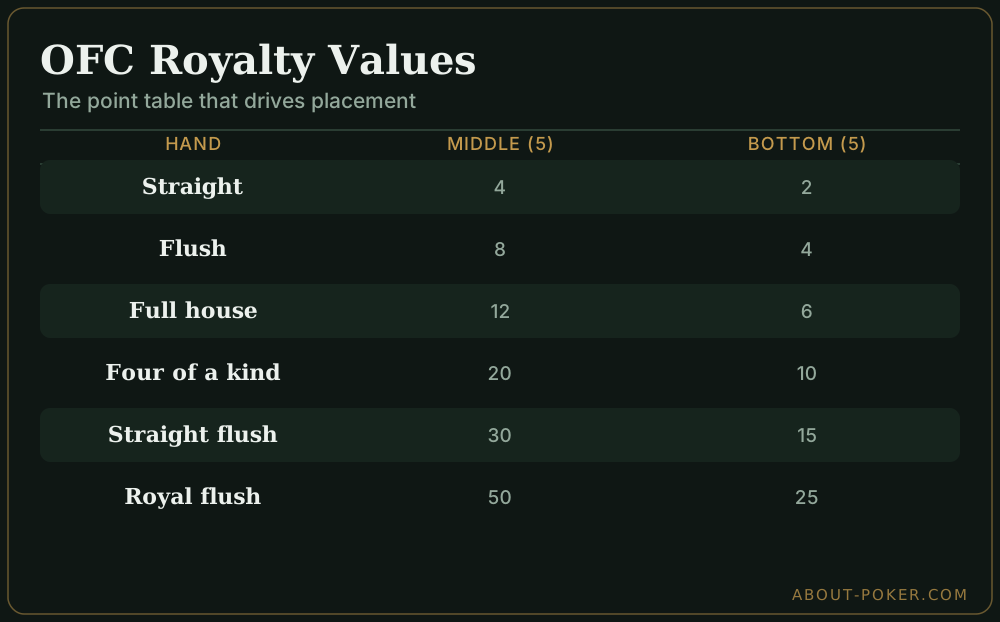
Royalties are the bonus points that reward strong hands in the right row. Because the same hand pays more on the bottom than the middle, and the top pays for pairs no other row rewards, the point table is what turns “chase royalties” into an actual EV decision. Standard OFC values:
| Hand | Top (3 cards) | Middle (5 cards) | Bottom (5 cards) |
|---|---|---|---|
| Pair 66–AA | 1 (66) up to 9 (AA) | — | — |
| Trips | 10 (222) up to 22 (AAA) | — | — |
| Three of a kind | — | 2 | — |
| Straight | — | 4 | 2 |
| Flush | — | 8 | 4 |
| Full house | — | 12 | 6 |
| Four of a kind | — | 20 | 10 |
| Straight flush | — | 30 | 15 |
| Royal flush | — | 50 | 25 |
Two takeaways drive placement. First, the middle pays double the bottom for the same made hand — a flush in the middle is 8 points versus 4 on the bottom — so a big hand you can safely route to the middle is often worth more than forcing it down. Second, top-row pairs are the only royalties the top can earn, and they climb fast (a top pair of aces is 9 points, worth more than a middle straight), which is a large part of why aiming premium pairs up top is profitable when it’s safe.
Chasing Fantasyland the smart way
Fantasyland is the biggest edge in OFC: place queens or better in the top row without fouling, and next hand you receive all your cards at once and set them in secret. That informational advantage is worth chasing — but only when your bottom and middle can still be set legally.
The trap is committing to a top-row big pair before your other rows are secure. If you place Q♠ Q♦ up top and then can’t build a middle that beats it and a bottom that beats the middle, you foul and score zero. Chase Fantasyland when your board supports it safely; abandon the chase the moment staying legal is in doubt.
Staying in Fantasyland
Getting into Fantasyland is only half the value — the bigger edge is repeating it. Once you’re in Fantasyland, you keep it for another hand only if you hit one of the retention thresholds (usually called “stay in Fantasyland” or a re-entry):
- Trips in the top row (e.g.
2♠ 2♥ 2♦or any higher set up top), or - Quads or better in the bottom row (four of a kind, straight flush, or royal flush).
A queens-or-better pair up top gets you in, but it does not keep you there — you need the harder trips-on-top or quads-on-bottom to loop. That changes how you set a Fantasyland hand: beyond simply avoiding a foul, actively look for a legal setting that lands trips up top or quads on the bottom, since retaining Fantasyland is worth far more than any single royalty.
Worked example: passing up a risky Fantasyland
You have a Q♥ Q♣ pair and it’s tempting to slap it in the top row to aim for Fantasyland. But your current rows are thin: your middle is only a weak pair of sevens, and your bottom is an unmade flush draw with two cards to come.
Place the queens up top and you now need your middle to beat a pair of queens and your bottom to beat that middle — with only a couple of cards left to get there. If the draws miss, you foul: a full sweep loss to every opponent.
The disciplined line is to split the queens — one to the middle to shore it up, keeping the top row modest — accepting a clean, legal hand over a coin-flip at Fantasyland. You give up the bonus, but you avoid the sweep. Chasing Fantasyland from an unstable board is the most common way strong-looking OFC hands blow up.
Pineapple OFC: the variant most players actually play
Most modern OFC is played as Pineapple OFC, and its dealing pattern changes strategy meaningfully. The structure:
- First deal: you receive 5 cards and place all 5.
- Every deal after: you receive 3 cards, place 2, and discard 1 face-down.
- That’s four 3-card deals, so you place 5 + (2 × 4) = 13 cards total, discarding 4 along the way.
The discard is the whole game. Because you throw away one of every three later cards, you get to decline cards that would strand a row — a luxury standard OFC never gives you. Practical consequences:
- Foul less, commit more. With a discard as a safety valve, you can start bigger hands (a top pair, a bottom flush draw) because a bad third card can simply be thrown away instead of forced into a dangerous row.
- Chase Fantasyland harder. Pineapple’s extra card-selection makes premium top pairs and the trips-on-top / quads-on-bottom retention hands much more reachable, so Fantasyland is a bigger share of your EV than in classic OFC.
- In Fantasyland you’re dealt 14 cards, keep the best 13, and discard 1 — an enormous edge on top of the usual set-in-secret advantage. Set with retention in mind: prioritize a legal board that also makes trips up top or quads on the bottom to loop.
Quick strategy checklist
- Never foul — a legal hand beats a greedy one every time.
- Protect the bottom row; route pairs and draws there.
- Place with escape routes so you always have a legal ending.
- Chase Fantasyland only when your other rows can stay legal.
- In Fantasyland, aim to retain it — set for trips up top or quads+ on the bottom.
- Weigh the middle — the same made hand pays double there versus the bottom.
- Use the Pineapple discard to decline cards that would strand a row.
- Take royalties as a bonus, not a reason to gamble your whole hand.
OFC grew out of classic Chinese poker, where you set all 13 cards at once — comparing the two sharpens both. Keep the hand rankings guide close while learning the royalty spots, and explore more formats on the poker variants hub.
Frequently asked
How do you avoid fouling in open-face Chinese poker?
Your three rows must be ordered from weakest at the top to strongest at the bottom: the bottom must beat the middle, and the middle must beat the top. To avoid fouling, place cards conservatively early, keep your strongest hand headed for the bottom, and don't commit the top row to a big pair until you know your other rows can beat it.
What is Fantasyland in OFC?
Fantasyland is a bonus round you enter by placing a pair of queens or better in the top row without fouling. In Fantasyland you receive all your cards at once and set them in secret, a huge advantage. Chasing it is a central part of open-face strategy, but only when your other rows can still be set legally.
Should I chase royalties in open-face Chinese poker?
Royalties are bonus points for strong hands like flushes, full houses, and quads in the right rows, but chasing them recklessly leads to fouling. Chase royalties when your board can support them without risking a foul; otherwise prioritize a clean, legal setting first.
How is open-face different from regular Chinese poker?
In regular Chinese poker you get all 13 cards at once and set them privately. In open-face you receive cards a few at a time and place them face-up one by one, so you must commit to positions without knowing your future cards. This makes card placement and foul avoidance the core skills.