3-Bet Range by Position: Charts for Every Seat
Your 3-bet range should change with your seat. See position-by-position 3-bet charts, combo math, and a worked spot from the small blind.
On this page · 11 sections
Your 3-bet range by position is not one fixed list — it shifts with the seat you’re re-raising from and the seat the opener came from. The core logic never changes (value hands plus bluffs), but how wide and how polarized your range should be depends on two things: whether you’ll play the pot in position or out, and how strong the opening range you’re attacking is.
Why position changes the whole range
A 3-bet from the button against a cutoff open is a completely different bet than a 3-bet from the small blind against a button open, even if the hand is identical. On the button you’ll act last on every postflop street; from the small blind you’ll act first, with the big blind still lurking behind you. Out of position, your bluffs realize less equity because opponents can check back and see free cards, so out-of-position ranges skew tighter and more value-heavy. In position, you can add extra speculative bluffs because you control the pot size and steal more pots on later streets.
The opener’s range matters just as much. Early-position opens are tight and 4-bet you back, so you attack them with premiums and a few high-blocker bluffs. Late-position opens are wide and fold-heavy, so you can pressure them with a much broader polarized range. For the flip side of this — what to do when someone 3-bets you — see defending against 3-bets.
3-bet range from the button
Against a cutoff or middle-position open, the button is the best seat to 3-bet from. You’ll be in position for the rest of the hand, so you can run a wide polarized range.
| Bucket | Example hands | Notes |
|---|---|---|
| Premium value | A-A, K-K, Q-Q, A-K | Always 3-bet |
| Value | J-J, 10-10, A-Q suited, A-Q offsuit | 3-bet, occasionally flat |
| Bluffs | A-5s to A-2s, K-Qs, Q-Js, suited connectors 8-7s, 7-6s | Pressure the loose open |
Total width lands near 10-14% against a wide open. The suited wheel aces (A-5s down to A-2s) are the workhorse bluffs: they carry an ace blocker and flop nut-flush and wheel-straight draws.
3-bet range from the small blind
The small blind is the trickiest seat. You’re out of position against everyone, and the big blind still has to act. Flat-calling from the SB is usually a trap — you invite the big blind to squeeze and you play the rest of the hand out of position. So the SB range is built polarized around 3-betting, not flatting.
| Bucket | Example hands | Notes |
|---|---|---|
| Value | 9-9+, A-J suited+, A-K, A-Q, K-Q suited | 3-bet for value |
| Bluffs | A-5s to A-2s, K-J suited, Q-J suited, J-10 suited | Suited blockers only |
| Fold | Offsuit junk, small offsuit aces | No playability out of position |
Against a button open this is roughly 9-13% of hands. Notice the bluffs are all suited: out of position you can’t afford dead-money bluffs, so every bluff needs blocker value or the ability to flop a real draw.
Combo math: how the ace blockers stack up
Bluff selection is a counting exercise. There are 16 combos of any two unpaired ranks, but only 4 of those are suited. The suited wheel aces — A-5s, A-4s, A-3s, A-2s — give you 4 suited combos each, 16 total of premium bluff material. Each combo holds an ace, so together they remove meaningful chunks of your opponent’s A-A (6 combos), A-K (16 combos), and A-Q (16 combos) — the exact hands that 4-bet you. That blocker density is why suited wheel aces anchor almost every position’s bluffing range, while offsuit hands like K-7o (which offer no blocker to premiums and no suited playability) never make the cut.
A worked spot from the small blind
You’re in the small blind with A♠ 3♠. The button opens 2.5bb — a wide, position-driven late-position range.
- Flat-calling is bad: you’d play out of position with the big blind still able to squeeze, and A-3 suited flops too few strong pairs to defend comfortably.
- Folding surrenders a hand with real bluff equity.
- 3-betting is best. The ace blocks A-A and A-K, so the button’s 4-bet range shrinks. When the button folds their loose opens, you win outright. When they call, A-3 suited flops nut-flush draws and wheel outs, so you can keep barreling.
Now move that same A♠ 3♠ to the button facing an UTG open. It becomes a fold — that early range is too strong to bluff-raise, and you’d rather keep your button 3-bets value-heavy against tight opens.
3-bet range from the cutoff
Facing a middle-position, hijack, or UTG open, the cutoff still has the button and both blinds behind, so keep the range tighter and more linear (value-weighted) than a button range — a cold-call or squeeze can still land on you.
| Bucket | Example hands | Notes |
|---|---|---|
| Value | Q-Q+, A-K, A-Q suited | Always 3-bet |
| Thin value / mix | J-J, 10-10, A-Q offsuit, A-J suited | 3-bet, sometimes flat |
| Bluffs | A-5s to A-4s, K-Qs, K-Js | Fewer bluffs than the button |
Total width sits near 7-10% — narrower than the button because two seats can still wake up behind you.
3-bet range from early and middle positions (UTG, MP, HJ)
From the earliest seats you’re re-raising into an even earlier (very strong) open, and you’ll have the whole table behind you. These ranges are the tightest and most value-heavy of all — almost pure value, with only a token bluff or two.
| Your seat | Facing an open from | Range shape | Example hands | Approx. width |
|---|---|---|---|---|
| UTG (vs a limp/early raise) | — | Value only | K-K+, A-K, sometimes Q-Q | 2-3% |
| MP / Hijack | UTG or MP | Linear, value-heavy | Q-Q+, A-K, A-Q suited, + A-5s as a token bluff | 4-6% |
The rule from these seats: if in doubt, fold the bluffs. With seven or eight players still to act, a light 3-bet gets punished by cold 4-bets and flat-calls that leave you playing a bloated pot with a marginal hand.
3-bet range from the big blind
You’re closing the action and already have a blind invested, so you can flat much wider than the SB — you’re getting a price and nobody can squeeze you. Reserve the 3-bet for a polarized range against steals.
| Bucket | Example hands | Notes |
|---|---|---|
| Value | 9-9+, A-Q suited+, A-K, A-Q offsuit, K-Q suited | 3-bet to punish loose steals |
| Bluffs | A-5s to A-2s, K-9s, Q-9s, J-9s, suited connectors | Suited hands you don’t want to flat |
| Flat | Most suited broadways, pairs, playable offsuit aces | You have a price and closed action |
Against a button or cutoff steal, a polarized big-blind 3-bet of roughly 8-12% works well; everything else that’s playable simply defends by calling.
Your seat vs the opener’s seat, at a glance
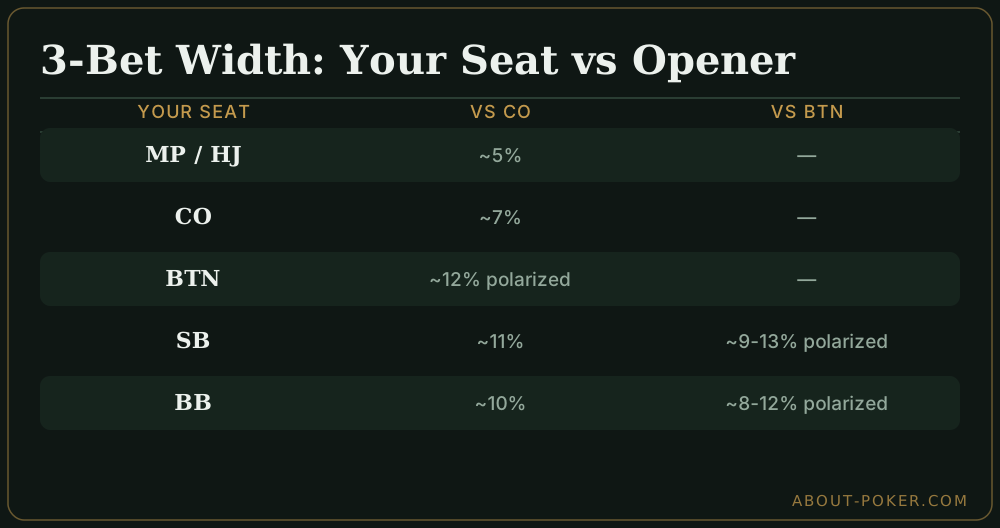
The two levers combine into one map. Read across from your seat to the opener’s seat: the tighter of the two constraints wins. Widths are approximate 100bb cash-game defaults.
| Your seat ↓ / Opener → | UTG | MP / HJ | CO | BTN |
|---|---|---|---|---|
| MP / HJ | ~4% (value) | ~5% | — | — |
| CO | ~6% | ~7% | — | — |
| BTN | ~7% linear | ~9% | ~12% polarized | — |
| SB | ~6% value-heavy | ~8% | ~11% | ~9-13% polarized |
| BB | ~6% value-heavy | ~7% | ~10% | ~8-12% polarized |
Two patterns fall straight out of the grid: every range widens left-to-right as the opener’s seat gets later and looser, and in-position seats (BTN) run wider and more polarized than the out-of-position blinds facing the same opener.
Common position mistakes
- Same range from every seat. The single biggest leak — a button 3-bet range used from the small blind is far too loose out of position.
- Flat-calling from the SB. You invite squeezes and play out of position. Prefer 3-bet-or-fold from the small blind with most hands.
- Offsuit bluffs out of position. Without blockers or suited playability they can’t realize equity. Cut them.
- Ignoring the opener’s seat. Widen against late opens, tighten against early ones, regardless of your own seat.
Putting it together
A 3-bet range by position is the same value-plus-bluffs framework tuned by two dials: your seat and the opener’s seat. Go wide and polarized in position against loose opens; go tight and value-heavy out of position against strong opens. Pair this with a solid default 3-bet range and you’ll re-raise correctly from every chair. The full preflop framework lives in the preflop strategy hub.
Frequently asked
Should my 3-bet range change by position?
Yes. The seat you 3-bet from decides how much of the pot you'll play out of position and how strong the opener's range is. In-position 3-bets from the button can be wider and more polarized, while out-of-position 3-bets from the blinds lean tighter and more value-heavy against early opens.
How wide should I 3-bet from the small blind?
Against a button open, roughly 9-13% of hands is a reasonable balanced small-blind 3-bet range, built polarized: premiums plus suited-ace and suited-broadway bluffs. You 3-bet rather than flat often from the SB because cold-calling out of position with the big blind still to act is a losing proposition with most hands.
What's a good 3-bet range from the button?
Against a cutoff or middle-position open, a button 3-bet range near 10-14% works well. Because you'll be in position postflop, you can add more speculative suited hands as bluffs than you could from the blinds.
Do I 3-bet the same against early and late opens?
No. Widen your 3-bet range against late-position opens, which are loose and fold more, and tighten it against early-position opens, which are strong and 4-bet back at you. Position of both you and the opener matters.