Splitting a Tied Pot
Splitting a tied pot in poker: how identical hands share the pot, why kickers and the board matter, and how the odd chip is awarded when it won't divide evenly.
On this page · 7 sections
A split pot happens when two or more players end up with hands of exactly equal value at showdown. Instead of one winner, the pot is divided evenly. It sounds simple, but there are real subtleties — what counts as “equal,” how kickers break near-ties, and what happens to a chip that won’t divide cleanly. Here’s the complete picture.
When a pot actually splits
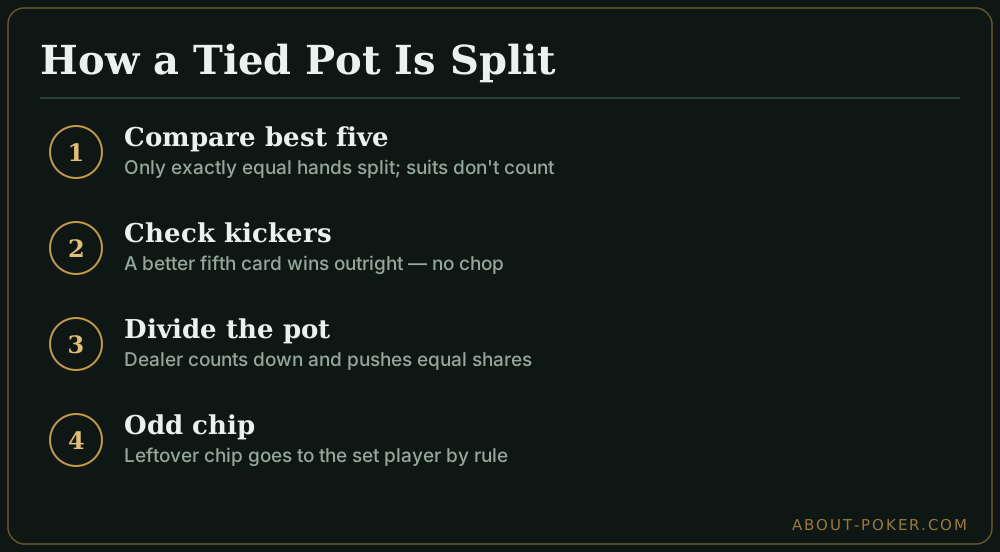
A pot splits only when the players’ best five-card hands are identical in rank. Two things matter here:
- Only five cards count. In hold’em you make the best five from your two hole cards plus the five community cards. If those five cards tie exactly, it’s a split.
- Suits never break ties. Unlike some other card games, standard poker treats all suits as equal. A flush in spades does not beat the same flush in hearts.
So a split isn’t about “close” hands — it’s about exactly equal hands. Very often that means the board plays: the five community cards make the best hand for both players, and their hole cards are irrelevant.
A worked example
The board reads Ah Kh Qc Jd Ts — an ace-high straight (Broadway) sitting right there in the community cards. Player A holds 8c 8d; Player B holds 4s 4h.
Neither player’s hole cards improve on the board’s ready-made A-K-Q-J-T straight. Both players’ best five-card hand is exactly the board: Broadway. Since they’re identical, the pot splits evenly between A and B. The pocket pairs are worthless here — a perfect illustration of the board playing.
Now change Player A’s hand to Ac 9c. Now A can use the ace… but the straight is still A-K-Q-J-T either way, so it’s still a chop unless a card beats the straight. Only a hand that actually outranks the board wins outright. This is why understanding what your five best cards really are — and how kickers factor in — is essential; see our what is a kicker in poker guide.
Kickers: the usual tie-breaker
Most “near-splits” are resolved by kickers before any division happens. Say both players have a pair of kings, but the pot only splits if their remaining cards match too. If Player A plays K-K-A-Q-J and Player B plays K-K-A-Q-9, then A’s jack beats B’s nine on the fifth card — A wins outright, no split. They’d only chop if all five cards were identical (e.g., both playing K-K-A-Q-J because the top three kickers are on the board).
The odd chip rule
Pots don’t always divide evenly. A pot of 301 chips split two ways leaves one chip that can’t be halved. Poker never leaves that chip in the middle — there’s a fixed odd chip rule to award it:
- In most hold’em and stud cash games, the odd chip goes to the player in the worst position — the first seat to the left of the button (or the low seat by other house conventions).
- In high-low split games, the odd chip from an overall split goes to the high hand.
- Some rooms award the odd chip by highest card by suit for specific situations; house rules govern.
The principle is that the rule is deterministic — everyone knows in advance who gets the extra chip, so there’s nothing to argue about. For how odd chips interact with layered pots, see all-in and side pots explained.
Splits with side pots
When someone is all-in, you can have a main pot and a side pot, and each pot is evaluated separately for splits. It’s entirely possible for the main pot to split three ways while a side pot goes to a single player who beats the others’ equal main-pot hands with an extra card that only two players contest. The dealer resolves each pot in turn, applying the odd chip rule to each if needed.
How it varies by format
Cash games: Straightforward chops; the odd chip rule handles remainders. Rake is taken before the split in most rooms.
Tournaments: Chops are common late, especially double-paired boards. The odd chip still goes by position, and it can matter for chip-count survival.
Home games: Agree on your odd chip convention up front — position-based is cleanest. Also confirm suits don’t break ties, since new players sometimes think spades are “highest.”
Online: Splits are handled automatically to the chip, including odd-chip distribution by the site’s programmed rule. Chops between three or four players with the board playing are handled instantly.
Quick checklist
- Compare best five cards — only exactly equal hands split.
- Suits don’t matter — never break a tie by suit in standard poker.
- Check kickers first — a single better card wins outright, no chop.
- Odd chip has a home — it goes to a set player, never left in the pot.
- Evaluate each pot separately when side pots exist.
At showdown, always table your cards face up before assuming a chop — the dealer reads the hands and applies these rules precisely. If you’re unsure who shows first when a split is possible, our showdown rules guide has you covered.
Frequently asked
How do you split a tied pot in poker?
When two or more players have hands of exactly equal value, the pot is divided equally among them. Suits never break ties in standard poker, so identical five-card hands truly split. The dealer counts the pot down and pushes an equal share to each winner.
What happens to the odd chip in a split pot?
If the pot won't divide evenly, the leftover odd chip goes to a single player by a fixed rule — in most cardrooms, to the player in the worst position (closest to the left of the button), or by highest card by suit for high-low specifics. The odd chip is never left in the middle.
Do kickers matter in a split pot?
Yes. Two players only split if their best five cards are identical. If one player has a better kicker that plays, they win outright. Ties often happen because the board plays and both players' hole cards are irrelevant.