What Happens If the Dealer Makes a Mistake
What happens when a poker dealer makes a mistake — misdeals, wrong pot pushes, exposed cards, and how the floor rules to keep the game fair and moving.
On this page · 7 sections
Dealers are human, and even skilled ones make mistakes — a card slips face-up, chips get pushed to the wrong seat, or the flop hits the felt a beat early. The good news is that poker has well-established procedures for almost every dealer error. What happens next depends on what went wrong and when it was caught. This guide walks through the most common dealer mistakes and how each one is resolved.
The one principle behind every ruling
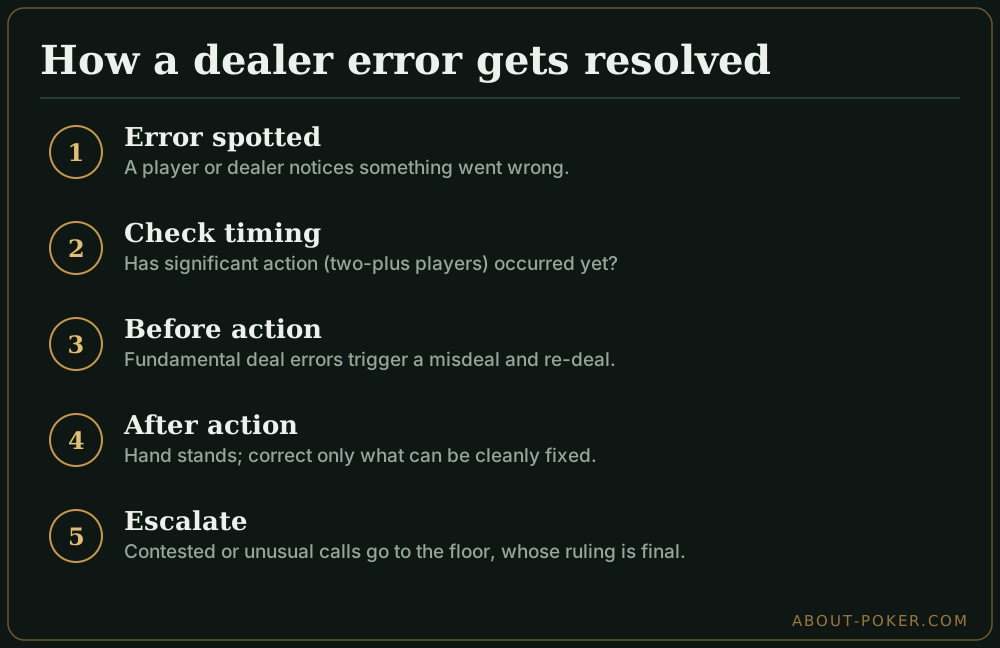
Every dealer-error decision comes back to a single idea: protect the integrity of the hand while disrupting play as little as possible. A room does not throw out a hand just because something went slightly wrong. Instead, it asks whether the error can be cleanly corrected. If it can, the hand plays on. If it cannot — if the error taints who has what or who acts next — the hand may be voided and re-dealt.
The other constant is timing. The magic threshold is “significant action,” which usually means two or more players have acted on their hands. Before that point, many errors trigger a misdeal. After it, the hand almost always stands, mistakes and all. That is why dealers and players alike are expected to speak up the instant something looks wrong.
Errors that force a misdeal
Some mistakes are fundamental enough to the deal that the only fair fix is to start over. On a misdeal, all cards are collected, the deck is reshuffled, and the hand is re-dealt. Nobody is penalized and nobody loses chips. Common misdeal triggers include:
- The first card is dealt to the wrong seat.
- A player receives too many or too few cards (caught early).
- Two or more hole cards are exposed during the deal.
- A boxed card (face-up inside the deck) reaches a player’s hand.
- The deck is found fouled — wrong count, or a stray card or joker present.
For the full breakdown of what does and does not void a hand, see poker misdeals and irregularities.
Errors corrected without killing the hand
Many dealer slips are irregularities, not misdeals. The dealer fixes them and play continues:
- One exposed hole card: the deal finishes, the player keeps their hand, the exposed card is replaced off the top, and the flashed card becomes the first burn.
- Flop dealt without a burn, or one card short: the dealer follows house procedure — often reshuffling the affected board card back in and re-dealing after a proper burn.
- A card flashed while dealing the board: handled by set procedure for that street rather than a full re-deal.
Worked example: the premature flop
Say four players see a flop-bound hand. Two players check, and the dealer — anticipating the third check — spreads the flop before the third player has acted. That third player still has a decision to make, so the board cannot stand as dealt.
The standard fix: the dealer pulls the three flop cards back, the third player completes their action, and then the flop is re-dealt from the remaining stub (the three cards are typically reshuffled into the stub first, with a fresh burn). No chips move incorrectly, and the player who was skipped keeps a full, uninfluenced decision. This is a textbook case of “correct the error, keep the hand alive.”
When chips go to the wrong place
Payout errors are their own category. If the dealer pushes the pot to the wrong player, the ruling depends on how far things have gone:
- Caught immediately, before the pot is mixed into a stack, the chips are simply returned and pushed to the correct winner.
- Cards still identifiable at showdown, the correct hand is awarded even if a mistake was made reading it.
- Chips already merged into a stack and the next hand started, a room may rule the result stands — reconstructing an untangled stack is often impossible.
Side-pot mistakes follow the same logic; the dealer or floor rebuilds the pots according to who was all-in for how much. If you are unsure how those pots form, review all-in and side pots explained.
Who makes the final call
The dealer handles routine corrections on the spot. Anything contested, unusual, or involving real money on the line goes to the floor supervisor, whose ruling is final. In a home game, the host or table agrees in advance and rules in the moment — which is exactly why settling your house rules before the first hand saves arguments later. Clean dealing procedure prevents most of these situations from ever coming up.
Player checklist when a dealer errs
- Speak up immediately — most fixes are only available before significant action.
- Do not touch the pot or the board while a ruling is pending; let the dealer or floor manage it.
- State facts, not opinions — describe exactly what you saw, calmly.
- Ask for the floor if you disagree with the dealer’s call; that is your right.
- Protect your own cards so you never contribute to the confusion.
Dealer mistakes feel dramatic in the moment, but the system is built to absorb them. Learn the common rulings and you will stay calm, protect your equity, and keep the game moving. For everything else, head back to the how-to-play hub.
Frequently asked
What happens if a poker dealer makes a mistake?
It depends on the error and its timing. Some mistakes force a misdeal and a re-deal, some are corrected while the hand plays on, and a few are ruled by the floor supervisor. The guiding principle is to fix the error while disrupting the hand as little as possible.
Can a dealer's mistake be reversed after the pot is pushed?
Sometimes. If chips have already been mixed into a player's stack and the hand is truly over, a room may rule the result stands. But an obvious, provable error caught quickly is usually corrected, and the floor has final say.
Who fixes a dealer error in a casino?
The dealer handles routine corrections, but any contested or unusual situation goes to the floor supervisor. The floor's ruling is final, even if a player disagrees.
Do you get your money back if the dealer misdeals?
On a misdeal caught before significant action, all cards are returned, the deck is reshuffled, and the hand is re-dealt with no penalty. No chips are lost because the hand is treated as if it never happened.