What Happens If Two Players Go All-In
What happens if two players go all-in in poker: how the pot is capped, when cards get flipped, running it out, and how side pots form when stacks differ.
On this page · 8 sections
Two players shoving all their chips into the middle is poker at its most dramatic — but mechanically it’s very orderly. Once both are all-in and no one has action left, the outcome is decided by fixed rules: cards get flipped, the board runs out, and the pot is awarded. Here’s exactly how it works, including the tricky bits around uneven stacks.
The short version
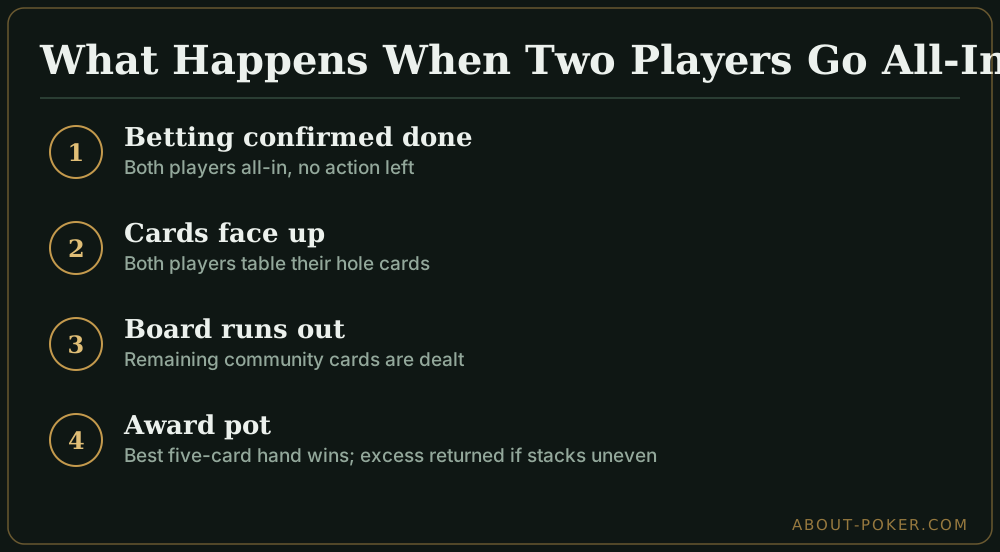
When two players are all-in and there’s no more betting to be had, the hand is effectively over as a decision — everything left is just card exposure and dealing. The dealer:
- Confirms betting is complete.
- Has both players turn their hole cards face up.
- Deals out any remaining community cards (flop, turn, river as needed).
- Reads the board and awards the pot to the best five-card hand.
Because neither player can act further, there’s no bluffing left — the math is locked in the moment the chips go in.
Even stacks: the simple case
If both players have the same number of chips, the whole thing is clean. Say it’s heads-up on the turn and both players jam for their last 60 big blinds each. The chips match exactly, the river is dealt, and whoever makes the better hand takes the entire pot. No side pots, no returns.
A worked example with equity
Player A holds Ac Ah and Player B holds Ks Kc. Both are all-in pre-flop for equal stacks. The dealer turns the cards up and runs the full board.
Aces are roughly an 82% favorite over kings pre-flop (kings win about 18% of the time, ignoring the rare chop). But that’s just probability — one board decides this hand. If the flop, turn, and river bring, say, Kd 7s 2h 9c 4d, Player B rivers… actually flops a set of kings and wins the pot despite being the underdog. That’s the nature of an all-in: the favorite is usually right, but the cards still have to fall. For the odds behind other classic all-in matchups, our showdown rules guide pairs well with a good equity chart.
Uneven stacks and the excess-chip return
Here’s where beginners get tripped up. Suppose Player A has 500 chips and Player B has only 300. Both go all-in.
- Player A can only win what Player B matched — 300 of Player A’s chips are “covered.”
- The extra 200 chips Player A committed are returned immediately, because Player B couldn’t call them.
So the contested pot is 600 (300 from each), and A’s surplus goes back to their stack before the board even runs out. This flows directly from the table stakes rule — you can only win from an opponent what they had in front of them. See our table stakes rule explained for why you can’t be forced to cover more than the chips on the table.
When a third player creates a side pot
Two players all-in gets more interesting the moment a third is involved. Imagine three players:
- Player A (short) is all-in for 100.
- Player B and Player C both have 400 and both call, then jam the rest.
The dealer builds two pots:
- Main pot: 100 from each of A, B, and C = 300. All three are eligible.
- Side pot: the remaining chips B and C put in beyond 100. Only B and C can win this.
If Player A has the best hand, A wins the 300 main pot but cannot touch the side pot — A never had chips in it. B and C fight over the side pot separately. This layered structure is the whole point of side pots; we break down every case in all-in and side pots explained.
Running it once vs multiple times
In some cash games (and by agreement), players who are all-in can “run it twice” — dealing the remaining board two separate times, each for half the pot. This reduces variance without changing anyone’s long-run expectation. It’s a courtesy option, not a rule, and it’s rarely available in tournaments, where every board is run exactly once.
How it changes by format
Cash games: Uncalled chips are returned; running it twice may be offered.
Tournaments: Same all-in mechanics, but no chip is ever “returned” to a stack outside table-stakes math, and boards are run once. All-in confrontations decide who advances and who busts.
Multiway pots: Expect side pots. Track which players are eligible for which pot — the dealer will announce them, but you should verify.
Quick checklist for an all-in
- Is all action done? If a third player still has chips behind, betting may continue.
- Turn cards up — both all-in players must expose before the board runs.
- Match the stacks — the bigger stack only risks what the smaller can cover; excess is returned.
- Watch for side pots whenever more than two players are involved.
- Best five-card hand wins each pot it’s eligible for.
Once the chips are in and the cards are up, poker becomes pure math and a little luck. Knowing the pot-building rules means you always know exactly what you can win before the river even lands.
Frequently asked
What happens if two players go all-in?
When two players are all-in and no one else has action left, betting is over for the hand. The cards are turned face up, the remaining community cards are dealt out, and the best five-card hand wins. If stacks were uneven, the extra chips of the bigger stack are returned and only the matched amount is contested.
Do you show your cards when both players are all-in?
Yes. Once all action is complete and at least one player is all-in with no more betting possible, both players' hole cards are turned face up before the remaining board is dealt. This is required at any showdown involving an all-in.
What happens if one player has more chips when both go all-in?
The larger stack can only win what the smaller stack matched. The uncalled excess is returned to the bigger stack immediately. If a third player is involved, a side pot forms for chips the all-in short stack couldn't cover.