What Is an All-In Call
What is an all-in call in poker? What happens when you call a shove, how side pots form, when cards are shown, and the rules that decide who wins the pot.
On this page · 7 sections
An all-in call is one of the most decisive moments in poker: you push your entire remaining stack forward to match a bet, and once it’s done, the outcome is out of your hands. There’s no more betting between you and the shover for that pot — the cards will simply decide. Knowing exactly what happens next, and how side pots form, keeps you from costly confusion at the table.
The core idea
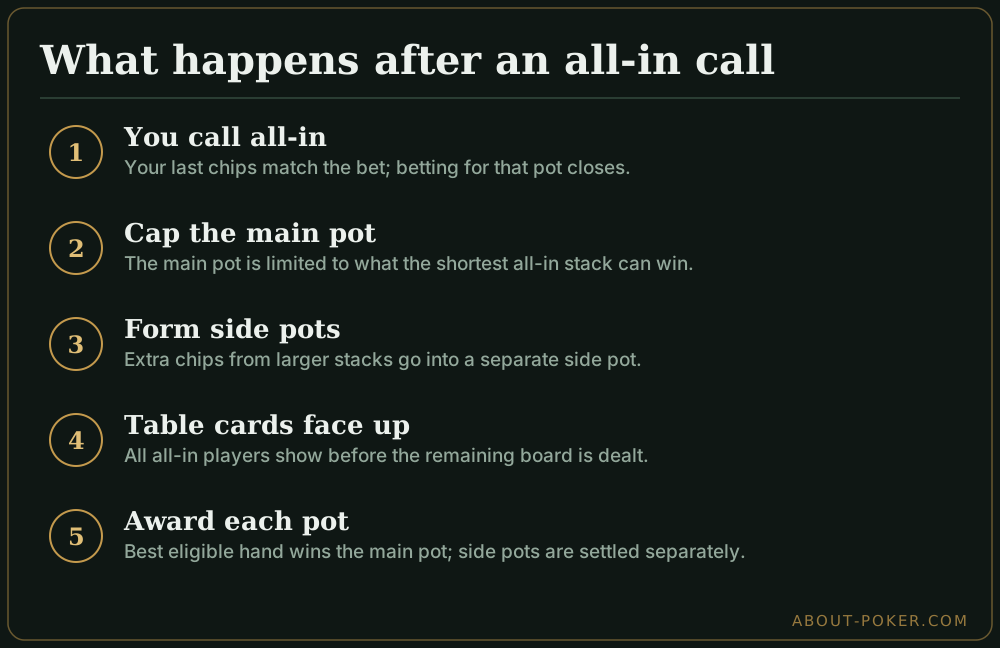
When you call all-in, you commit every chip you have left to match another player’s wager. Because you have nothing left to bet, betting for that pot is closed. The dealer runs out any remaining community cards, everyone involved shows their cards, and the best five-card hand wins. It’s the ultimate commitment — you can’t fold, raise, or bet again on this hand.
Two things matter most after an all-in call: when the cards get shown and how the money is divided if stacks are unequal.
Cards go face up
When action is all-in and there’s no more betting to be had, the standard rule is that all all-in players’ hole cards are tabled face up before the rest of the board is dealt. This transparency protects the integrity of the game — no one can influence the runout, and everyone sees the equities. This is different from a normal showdown, where the last aggressor shows first; in an all-in-and-called spot, everyone with a stake reveals.
Side pots: the crucial rule
If everyone has the same stack, an all-in call is simple: one pot, best hand wins. But when stacks are unequal, you get side pots.
A player can only win as much from each opponent as they themselves put in. So if a short stack is all-in for less than others can wager, the pot is split:
- The main pot is capped at what the short stack can win — their all-in amount matched by each caller.
- Any additional chips form a side pot, contested only by the players who still have chips.
The short stack is eligible only for the main pot. The side pot is awarded separately. Our full guide to all-in and side pots walks through multi-way situations in detail.
A worked example
Three players see a flop, all with different stacks:
- Player A has $40 and goes all-in.
- Player B has $100 and calls.
- Player C has $100 and calls.
The main pot is capped at $40 from each player: $40 (A) + $40 (B) + $40 (C) = $120. B and C each have $60 left, so they can keep betting. Say B shoves the remaining $60 and C calls. That $120 ($60 + $60) forms a side pot.
The board runs out. Cards are shown:
- Player A holds As Ac (pocket aces).
- Player B holds Ks Kc (pocket kings).
- Player C holds 7h 7d (pocket sevens).
Preflop, aces are roughly an 82% favorite over kings heads-up. But here three hands run out. Suppose the board comes Kd 9s 4c 2h 7s. Player B makes a set of kings and Player C makes a set of sevens. Player B’s set of kings is the best hand overall.
- Main pot ($120): B’s kings beat A’s aces and C’s sevens — B wins the $120.
- Side pot ($120): contested only by B and C. B’s set of kings beats C’s set of sevens — B wins that too.
Player A, despite starting with the best hand, wins nothing because the board favored B. Crucially, A could never have won the side pot at all — A was all-in for less and was only ever eligible for the main pot.
When you should make an all-in call
Calling all-in is a pure equity decision: compare the price you’re getting to your chance of winning. Roughly, if you must call $X to win a total pot of $Y, you need about X ÷ Y equity to break even (pot odds). If you’re getting 2-to-1 (calling $50 to win $150 total), you need only about 33% equity. Against a shoving range you beat often enough, the call is correct. For the mechanics of legal all-in amounts and minimum raises, see all-in betting rules.
Common mistakes
- Forgetting you can only win what you covered. A short stack all-in cannot scoop a side pot they never contributed to.
- Not tabling cards. In an all-in-and-called spot, expose your hand — hiding it can void your claim and slows the game.
- Miscalculating pot odds. Include the money already in the pot, not just the shove amount, when deciding whether to call.
- Calling off out of frustration. All-in calls are final. Make them on equity, not tilt.
Quick checklist
- Confirm the amount you must call and whether it puts you all-in.
- Estimate your equity versus the shover’s likely range.
- Compare that equity to your pot odds (call ÷ total pot).
- If unequal stacks, understand which pot(s) you’re eligible for.
- Table your cards face up and let the board run out.
An all-in call takes the decisions out of your hands and hands them to the deck. Make it for the right price, understand the side-pot math, and you’ll never be surprised by who’s eligible to win when the last card falls.
Frequently asked
What is an all-in call?
An all-in call is when you put your entire remaining stack into the pot to match another player's bet or shove. Once called, no more betting can happen between those players for that pot, and the hand runs to showdown to determine the winner.
What happens after an all-in call?
Betting for that portion of the pot is closed. If there are more players or extra chips, a side pot may form. Remaining community cards are dealt out, then all involved players show their cards and the best hand wins the relevant pot.
Do you have to show your cards after calling all-in?
Yes. When a hand goes all-in and is called with no further betting possible, all all-in players' cards are typically tabled face up before the remaining board runs out. This prevents collusion and lets everyone see the outcome.
What is a side pot in an all-in call?
If a player goes all-in for less than others can bet, a main pot is capped at what the short stack can win, and additional chips go into a side pot contested only by the players with chips left. Each pot is awarded separately at showdown.