EV in Poker: What Expected Value Means
EV stands for expected value — the average a decision wins or loses long term. Here's how to calculate it and why it drives every choice.
On this page · 4 sections
EV means expected value — the average amount a decision wins or loses if you made it over and over. A play with positive expected value (+EV) makes money in the long run; a play with negative expected value (-EV) loses money in the long run. Nearly every good poker decision reduces to a single test: does this action have positive expected value?
Why the whole game runs on averages
Expected value isn’t a poker invention. It’s a probability concept — the weighted average of every possible outcome, each one weighted by how likely it is. Gamblers and mathematicians have used it for centuries to size up bets of all kinds.
Stated plainly, the formula is: EV = sum of (each outcome × its probability). List every way the hand can end, multiply what you win or lose in each by how often it happens, and add the pieces together. That single formula is behind every worked example below.
Poker leans on it because the game is a long string of decisions made without complete information. You never see your opponent’s cards, so you can’t guarantee any single result. What you can do is measure whether a decision is profitable on average. That average is the EV, and players reference it in almost every strategy conversation because it’s the only honest way to grade a choice.
Running the numbers on a river call
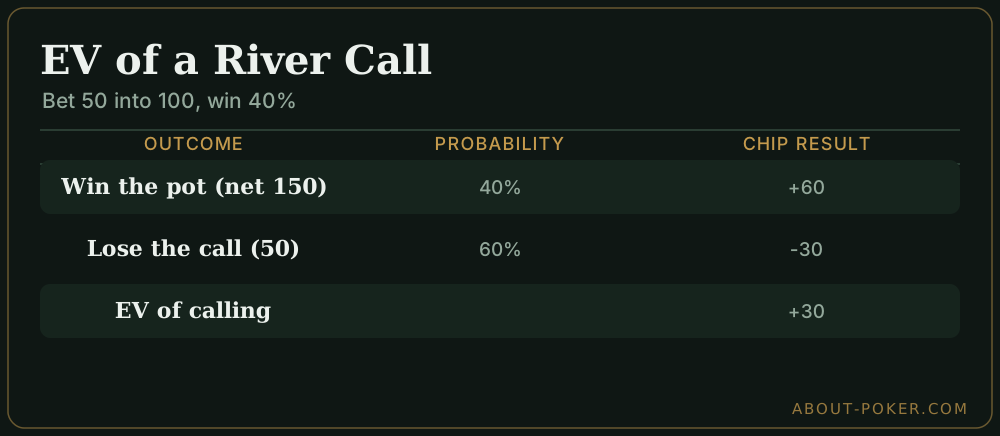
You’re on the river facing a bet of 50 into a pot of 100. Calling costs 50. When you win, you collect everything already in the middle — the 100 pot plus their 50 bet, so 150 — while your own 50 call simply comes back to you; when you lose, you forfeit that 50. You figure your hand is good about 40% of the time.
Here’s the EV of calling:
- Win (40% of the time): you net the 150 in the middle, so 0.40 times 150 equals +60.
- Lose (60% of the time): you forfeit your 50 call, so 0.60 times 50 equals -30.
- EV of calling: 60 minus 30 equals +30.
The call is worth +30 chips on average. You’ll still lose this exact hand 60% of the time — but calling makes money over the long haul, so it’s correct. Fold instead and you hand back that +30 every single time the spot comes up. A call that loses today can be the right call, because the arithmetic favors you across a large sample.
That same arithmetic applies to every decision at the table — call, raise, fold, bluff, or value bet. Any time chips are on the line, each option carries an expected value, and the aim is always to pick the highest one.
Running the numbers on a bluff
A bluff flips the calculation around. Instead of your chance of winning at showdown, the driver is how often the opponent folds — that fold percentage is called your fold equity. When they fold, you scoop the pot without a showdown; when they call, you lose the chips you bluffed.
Say the pot is 100 and you shove a 60-chip bluff on the river with a hand that can’t win if called. You reckon your opponent folds half the time:
- They fold (50% of the time): you win the 100 pot, so 0.50 times 100 equals +50.
- They call (50% of the time): you lose your 60 bluff, so 0.50 times 60 equals -30.
- EV of bluffing: 50 minus 30 equals +20.
So this bluff prints +20 chips on average purely from fold equity. Notice the break-even point: the bluff turns unprofitable only if folds drop below 60/(60+100), or 37.5% — below that, the -30 side outweighs the fold winnings. The general rule is that a bluff needs a fold percentage above risk ÷ (risk + pot) to be +EV. Every action bows to the same EV = sum of (outcome × probability) formula; only the outcomes and probabilities that go into it change.
Why correct plays still lose
The hard part of EV is emotional, not mathematical. Because expected value is a long-run average, any single hand can buck it — and often will. The gap between the average result and the actual result is called variance, and it’s why poker feels like a rollercoaster even when you play well.
Picture a spot where you’re a 70% favorite for your whole stack. That’s strongly +EV; you take it every time. Yet you’ll still lose it three times in ten. Stack a few of those together and it feels like the game is rigged — but nothing’s broken. The math is simply playing out over too small a sample. A player who understands EV keeps getting the chips in as a 70% favorite without flinching, because over hundreds of such spots the profit is unavoidable.
This is also why judging decisions by their outcomes is a trap. Variance rewards some of your mistakes with wins and punishes some of your best plays with losses. Anchor to EV instead of results, and you keep making the right calls long enough for the long run to actually arrive. In tournaments the picture shifts slightly — chips there don’t convert to cash at a fixed rate, which is where ICM adjusts raw chip EV into real-money equity — but the underlying logic never changes. For the arithmetic that sits beneath all of it, the odds and math hub is where to build the foundation.
Frequently asked
What does EV mean in poker?
EV stands for expected value — the average result of a decision if you made it over and over. A +EV play wins money on average; a -EV play loses money on average, no matter what a single hand does.
How do you calculate EV in poker?
Multiply each outcome by its probability and add them up. For a call, weigh what you win when ahead against what you lose when behind, using your realistic chance of winning the pot.
What is a +EV decision?
A positive expected value decision is one that makes money on average over the long run. Good players make as many +EV decisions as they can and ignore the short-term result of any one hand.
Can a +EV play still lose?
Yes, all the time. EV is a long-run average, so a correct call can lose a specific hand to variance. Repeated thousands of times, that same decision still shows a profit.
Is EV the same as pot odds?
No, but they're related. Pot odds tell you the price you're getting on a call; EV uses that price plus your chance of winning to say whether the call actually makes money. Pot odds are an input to the EV calculation.