How to Calculate Equity in Poker by Hand
Equity is how often your hand wins by showdown. Count clean outs, apply the rule of 2 and 4, and estimate it at the table without software.
On this page · 5 sections
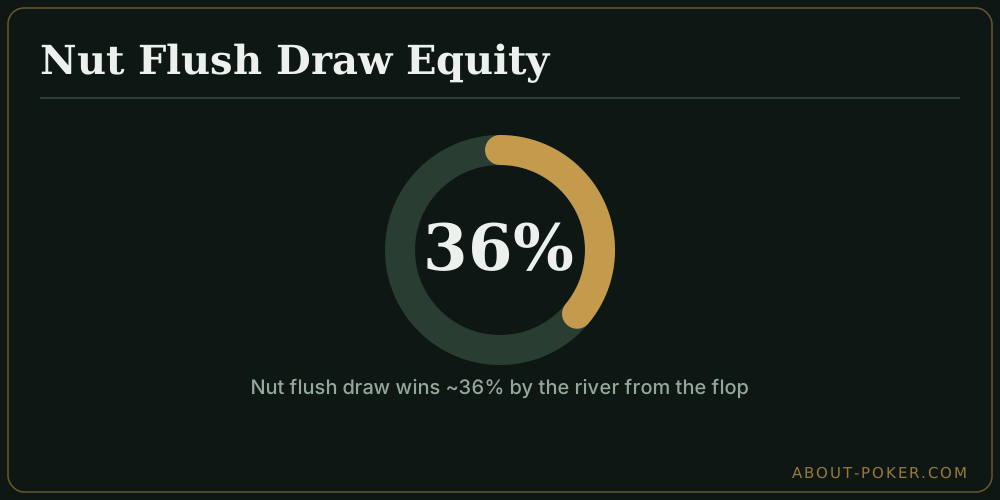
Equity is the share of the pot your hand wins on average if the hand goes to showdown, written as a percentage. To calculate it by hand you count your outs — the unseen cards that make you the winner — and translate that count into a win probability. A flush draw wins about 36 percent of the time from the flop; that 36 percent is its equity.
Counting outs, honestly
An out is any card left in the deck that turns your hand into the likely best one. The common draws are worth memorizing:
- Flush draw — 13 cards of the suit, minus the 4 you can see, leaves 9 outs.
- Open-ended straight draw — two ranks complete it, four of each, so 8 outs.
- Gutshot — one rank completes it, 4 outs.
The honesty part matters. If the card that fills your straight also puts a third flush card on the board, it may hand your opponent a stronger hand — that out is tainted, and you should not count it fully. Overcounting outs is the most common way a by-hand estimate goes wrong.
The rule of 2 and 4
With a clean out count, one shortcut does the conversion:
- Flop, two cards to come: outs × 4.
- One card to come (turn to river, or flop when you’ll only pay for the turn): outs × 2.
So 9 flush outs is roughly 9 × 4 = 36 percent by the river from the flop, or 9 × 2 = 18 percent for the turn card alone. Eight straight outs run about 32 percent and 16 percent. Multiplying by 4 drifts a little high once you have many outs — with 12-plus outs, subtract a couple of points — but for live decisions it is close enough to act on. How far off is it? For a nut flush draw the true flop-to-river equity is about 35 percent versus the rule’s 36, and a 12-outer (open-ender plus flush draw counted cleanly at 15 outs) is roughly 54 percent true against the rule’s raw 60 — which is exactly why you shave points at the top end.
A worked example, start to finish
You hold A♥ K♥. The flop comes Q♥ 7♥ 2♣. You have the nut flush draw plus two overcards.
- Count clean outs. Nine hearts complete the flush. Add the three aces and three kings that pair you — but only count those if a top pair would be good, and against a made hand like a set they may not be. Counting conservatively for the flush alone: 9 outs.
- Apply the rule. Two cards to come, so 9 × 4 = 36 percent equity by the river.
- Sense-check. A calculator puts A♥ K♥ against a hand like Q♦ Q♠ (top set) at about 26 percent — lower than 36, because the set can fill up and some of your “overcard” outs are dead. Against a single pair such as A♠ Q♣ your flush draw plus live overcards climbs back to roughly 45 percent.
The lesson: the rule of 2 and 4 answers “how often does one of my outs arrive,” but your real equity also depends on how strong the opponent’s hand is.
Estimating equity against a made hand or a range
Draws are the easy case. When you already have a made hand, or you are guessing against an opponent’s whole range, lean on a few memorized benchmarks instead of counting:
- Two overcards vs a made pair (you hold A-K, they hold a set or two pair) — you are drawing to about 6 outs, near 25 percent.
- One pair vs a flush draw on the flop — the made pair is ahead but only about 60/40, because the draw has nine live outs.
- A set vs a flush draw on the flop — the set is a big favorite, roughly 65 to 70 percent, and it can still redraw to a full house.
- Against a range rather than one hand, average the matchups: if half their range is pairs that crush you and half is draws you beat, your equity lands somewhere in the middle. This is the estimate a poker equity calculator makes exact.
Common all-in and preflop equities
For the classic all-in confrontations, memorizing the ballpark is faster than any count. These are approximate heads-up win rates:
| Matchup | Example | Favorite equity |
|---|---|---|
| Overpair vs two overcards | Q-Q vs A-K | ~55% |
| Pair vs lower pair | J-J vs 8-8 | ~80% |
| Pair vs one overcard + undercard | 7-7 vs A-9 | ~70% |
| Dominated ace | A-K vs A-Q | ~73% |
| Two overcards vs pair (“coin flip”) | A-K vs Q-Q | ~43% |
| Top pair vs flush draw (on flop) | pair vs flush draw | ~65% |
The famous “race” or coin flip is a pair against two higher cards: A-K versus Q-Q runs about 43 percent for the A-K (a touch higher, ~46 percent, when A-K is suited). It feels even, but the pair is a small favorite every time.
Where this becomes a real decision is against pot odds: equity tells you how often you win, and the price the pot offers tells you how often you need to. That comparison is covered in the odds and math material, and the exact range-versus-range math that is too heavy to do in your head is what a poker equity calculator is for. See the wider kit in tools & software.