Freezeout Strategy
A freezeout has no rebuys — bust once and you're out. Learn how that single rule shapes survival, chip preservation, and stage-by-stage play, with a worked spot.
On this page · 5 sections
The freezeout is the original tournament format and still the standard for most major events: you buy in once, and when you’re out of chips, you’re out of the tournament. There’s no reloading, no re-entry, no second bullet. That one rule — bust once and you’re done — shapes every strategic decision, from how you handle early coinflips to how you navigate the money bubble. This page explains how the no-rebuy structure changes your play and walks through a concrete decision.
The one rule that changes everything
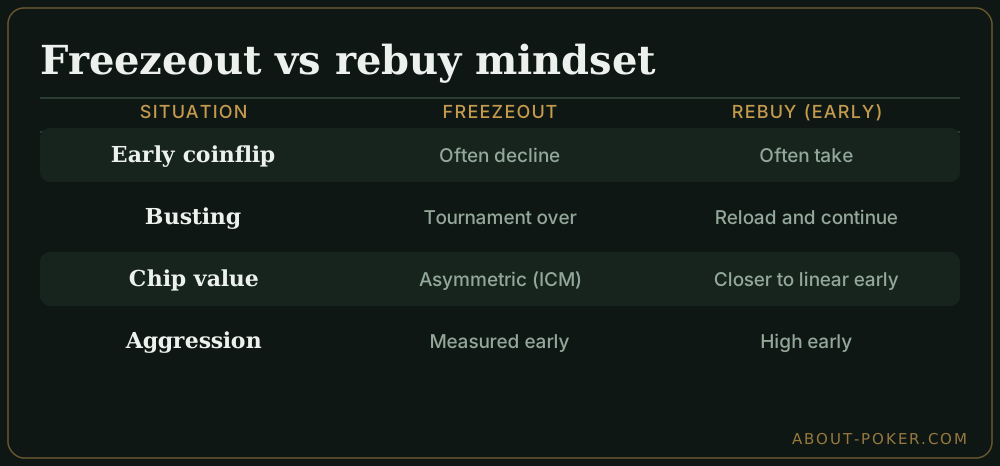
In a freezeout, chips have asymmetric value. The chips you win are worth less than the chips you lose, because the chips you lose can end your tournament and take all your future equity with them. This is the intuition behind ICM — the idea that a tournament chip’s cash value isn’t linear.
Contrast this with a rebuy or re-entry event. Early in a rebuy, busting isn’t the end — you reload and keep playing, so you can (and often should) gamble to build a big stack while the reload option exists. In a freezeout, that same early all-in flip is a genuine coin toss on your entire tournament life. That’s why disciplined freezeout players avoid marginal all-ins early when there’s little to gain and everything to lose.
Stage by stage
Freezeout strategy tracks the stages of a tournament, and your approach shifts as blinds rise relative to stacks.
Early (deep stacks, small blinds): Play solid, positional poker. Blinds are tiny relative to your stack, so there’s no rush. Avoid dumping your stack in a marginal spot for a pot that barely moves the needle. Accumulate through skill edges postflop, not preflop gambles.
Middle (blinds rising, antes in): Now the blinds and antes are worth stealing. Open up your stealing and 3-betting, apply pressure to medium stacks, and start paying attention to stack sizes. This is where most of your chips get made or lost.
Late / bubble: ICM and pay-jump pressure peak. Big stacks bully, short stacks tighten to ladder, and every all-in decision carries real cash consequences. Because there’s no rebuy safety net, the survival premium is at its highest — a needless bust here costs you a guaranteed cash.
In the money / final table: Pay jumps grow steeply. Reassess constantly: cover who you can, avoid getting stacked by bigger stacks, and pick your spots to accumulate toward the top prizes.
Chip preservation is not the same as folding
The most misread idea in freezeout play is “survival.” Survival does not mean folding your way to the money. Blinds and antes rise relentlessly; a stack that never fights back gets blinded into a short-stack shove-or-fold spot with no fold equity. Correct freezeout play balances two failure modes: busting recklessly and withering passively. You preserve chips by avoiding bad gambles, not all aggression.
A worked example
Level 3 of a freezeout, blinds 100/200, you have 20,000 chips (100 big blinds). A loose player opens, you 3-bet with AKs, and they shove all-in for your whole stack. You’re getting the standard price and AK is a premium — call, right?
It depends on the read, and here’s where the freezeout mindset bites. If this player’s shoving range is only QQ+ and AK, you’re in bad shape: against QQ+ you’re roughly a 43% underdog (AKs vs a pair like QQ is about 46%, AKs vs AA/KK far worse), and you can only chop or beat their AK. Calling turns your entire 100bb tournament into a coinflip-or-worse against a strong range this early, when the blinds are still tiny and you have all the room in the world to outplay the field.
In a rebuy, you might gamble here — bust and reload. In a freezeout, folding AKs to a tight all-in this deep and this early is often correct: there’s little upside (the pot is small relative to your deep stack) and catastrophic downside (your tournament ends). The deep stacks and small blinds mean you don’t need to flip. That asymmetry is the freezeout in one hand.
The bottom line
A freezeout rewards players who respect the value of their tournament life without becoming passive. Gamble less early than you would in a rebuy, ramp aggression as the antes kick in, and let ICM guide your late-stage all-ins. One bust is all it takes — so make sure every chip you risk is buying you something worth the risk.
Frequently asked
What is a freezeout tournament?
A freezeout is a tournament with no rebuys, add-ons, or re-entries. You buy in once, and when your chips are gone you're eliminated. It's the classic tournament format and the purest test of tournament skill because every chip you lose is gone for good.
How is freezeout strategy different from a rebuy?
Because you can't buy back in, survival matters more. Early in a rebuy you can gamble to build a stack knowing you can reload; in a freezeout that same gamble ends your tournament. So freezeout play is more measured early and leans harder on chip preservation and ICM in the later stages.
Should I play tight the whole freezeout?
No. Play solid and avoid needless coinflips early when the blinds are small, but you still have to accumulate chips. The mistake is either extreme: reckless gambling that busts you, or nitty over-folding that lets the blinds eat your stack. Adjust aggression to the stage and your stack depth.