Satellite Bubble Strategy
How to play the satellite bubble where every seat pays the same. Learn why chips lose value, when to fold aces, and how to lock up a ticket.
On this page · 6 sections
A satellite is a tournament that awards seats into a bigger event instead of cash prizes, and its endgame is unlike anything else in poker. Every seat pays exactly the same. Whether you finish with the chip lead or scrape in with two big blinds, you win the identical ticket. That single fact rewires optimal strategy on the bubble and produces the most extreme folds you will ever make correctly.
Why chips lose their value near the seats
In a standard tournament, chips have accumulation value: doubling your stack roughly doubles your equity because the payout ladder keeps climbing toward a large first prize. In a satellite, the ladder is a cliff. Say a satellite awards ten seats. The moment you have enough chips to be one of the top ten, every additional chip is nearly worthless to you, because it cannot buy a better prize than the seat you already have. Meanwhile chips you might lose are catastrophically expensive, because losing them can knock you out of the seats entirely.
This is the same ICM pressure that shapes any bubble, but taken to its logical extreme. On a normal bubble, ICM makes chips worth less at the margin. On a satellite bubble, the marginal chip is worth essentially zero once you are safe, and the whole game becomes about not busting.
The fold-aces spot, worked out
Here is the classic example. A satellite awards 9 seats, 11 players remain. Eight players are comfortably stacked. You are ninth in chips with 12 big blinds, and the two short stacks each have 3 big blinds. Under the gun shoves, it folds to you in the big blind, and you look down at pocket aces.
Fold. If you fold, the two 3-blind stacks are near-certain to bust before you do, and you lock your seat by doing nothing. If you call and win, you gain chips you do not need. If you call and lose, you crater to 3 big blinds and become a bubble casualty. You are risking your entire tournament life to win a prize you already effectively hold. Folding aces here is not a gamble-avoidance quirk; it is the mathematically correct play.
Reading the bubble instead of the clock
The key skill is watching stacks, not blinds. Count how many players are all but drawing dead. If three players have under 2 big blinds and only two spots remain to lose, the bubble may burst in a single hand. When elimination is imminent, tighten to the point of near-paralysis if you are safe. When eliminations stall, you may need to keep chipping to stay ahead of the pace.
The corollary matters too: if you are one of the short stacks, you cannot fold your way in. You must find spots to accumulate before the mid stacks realize they can shut down. The best time for a short stack to move is a beat or two before the table tightens up.
Big stack, medium stack, short stack
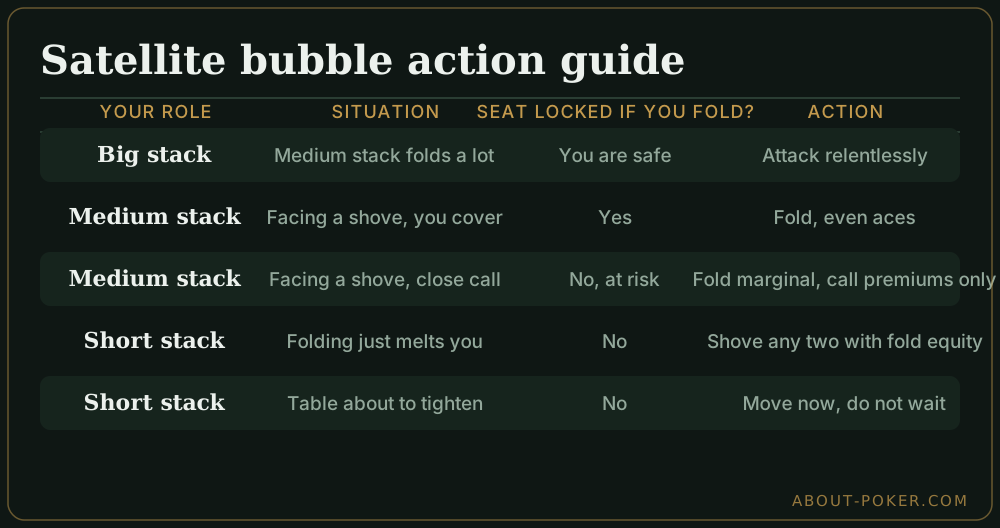
Your role dictates everything on a satellite bubble.
As the big stack you become a bully, but a targeted one. Attack the medium stacks who are trying to fold into a seat: they will surrender relentlessly because calling risks their qualification. Do not tangle needlessly with a desperate short stack who is happy to gamble.
As a medium stack, your default is caution. You have enough to fold toward a ticket, so avoid marginal confrontations and let the shorts bust. This mirrors the survival mindset in short-stack push-fold play, except your incentive to survive is even stronger.
As a short stack, you must gamble, and you should gamble early. Any two cards can be a shove when folding just melts you into elimination. Look for fold equity against medium stacks before they lock up.
Common satellite bubble mistakes
The biggest error is playing a satellite like a regular MTT and trying to win it. There is no winning; there is only qualifying. Players who keep raising to build a “commanding” chip lead are taking on risk for zero reward.
The second mistake is calling shoves with strong-but-not-necessary hands while safe. Queens are a monster, but not when a fold locks your seat and a call could bust you. The third is a short stack waiting too long, hoping to sneak in, until the table tightens and the free chips vanish. For the broader mechanics of qualifiers, see the general satellite strategy guide.
Bubble checklist
Before every decision on a satellite bubble, run through this: Am I currently in a seat if the tournament ended now? How many players are so short they will likely bust before me? Does this hand risk my qualification, and do I need the chips at all? If you are safe and the hand risks your seat, folding is almost always right no matter how strong your cards. If you are short, is this my last good spot to shove with fold equity? Answer those honestly and the correct play usually announces itself.
Frequently asked
Should I ever fold aces on a satellite bubble?
Yes. If you already have a stack big enough to lock a seat and calling risks your qualification, folding aces preflop can be correct. In a satellite every ticket pays the same, so surviving matters more than winning the pot. This is one of the few spots in poker where folding the best starting hand is unambiguously right.
How is a satellite bubble different from a normal MTT bubble?
In a normal MTT, first place is worth far more than the min-cash, so chips still have accumulation value near the bubble. In a satellite, every qualifying seat is identical in value, so extra chips beyond a locked seat are almost worthless. That flattening makes survival vastly more important.
What stack size guarantees me a satellite seat?
There is no fixed number, but a common rule is that once your stack is more than roughly the average of the seats being awarded plus a buffer, you can effectively fold to a ticket. Watch the other stacks and the pace of eliminations rather than a single threshold.