What Is a Guarantee in Poker Tournaments
A guarantee (GTD) is the minimum prize pool an operator promises to pay, even if entries fall short. Learn how guarantees, overlays, and dead money work.
On this page · 7 sections
A guarantee — usually shown as “GTD” on a tournament listing — is a promise from the operator about the size of the prize pool. When a tournament advertises “$100,000 GTD,” the organizer is guaranteeing that at least $100,000 will be paid out to the finishers, no matter how many people actually enter. Guarantees are one of the most misunderstood terms in tournament poker, and understanding them can point you toward genuinely profitable events. This page explains what a guarantee is, what happens when a field falls short, and how to spot the value.
The promise behind the number
Normally a tournament’s prize pool is simply the sum of the buy-ins collected (minus the operator’s fee). A guarantee overrides that in one direction: it sets a floor. If the collected buy-ins add up to more than the guarantee, the prize pool grows to match the entries as usual. If they add up to less, the operator is on the hook to top it up.
That top-up is the key concept. Guarantees are a marketing tool — a big “GTD” number attracts players by promising a big prize pool — but they also create real value for you when a field comes up short.
Overlay: when the guarantee helps you
An overlay occurs when the money collected is less than the guarantee, forcing the operator to add its own cash. Suppose a tournament is $50,000 GTD with a $100 + $10 buy-in (so $100 goes to the prize pool). To hit the guarantee the operator needs 500 players contributing to the pool. If only 400 enter, the pool from entries is $40,000 — but the operator must still pay $50,000. That extra $10,000 is an overlay: free money added to the pool with no additional competitors attached.
Overlay is one of the few genuinely +EV situations handed to you before a card is dealt, so experienced players actively hunt for guarantees at risk of missing their target.
The math of an overlay
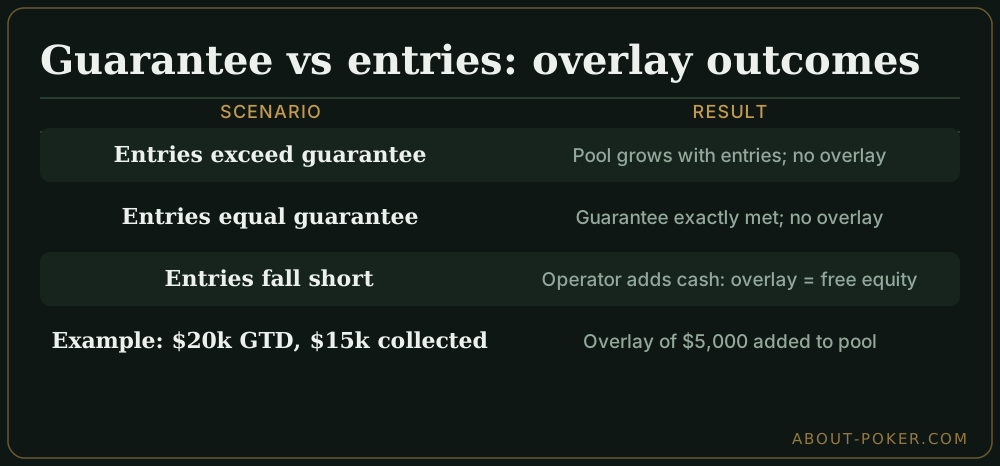
Here is a clean worked example. A $20,000 GTD event costs $50 to the prize pool per entry, and 300 players enter. Entries create 300 × $50 = $15,000, but the guarantee is $20,000, so the operator adds $5,000. That overlay is spread across 300 players, which is about $16.67 of extra equity per entry — on top of your own $50, you are effectively playing a pool that pays back more than was put in. The bigger the shortfall relative to the field, the larger your edge. Understanding payout structures tells you how that extra money is distributed across the finishers.
When a guarantee is just marketing
Most guarantees are set conservatively and are comfortably met or beaten. A “$1,000,000 GTD” flagship that draws double the required entries has no overlay at all — the guarantee was never in play. In those cases the GTD number is pure advertising: it signals the operator’s confidence and draws a crowd, but it adds nothing to your equity beyond the normal buy-ins. Do not assume a guarantee means added value; it only helps when the field misses.
How to find overlay spots
The best overlay opportunities tend to share a few traits. They run at odd hours or on holidays when turnout is thin, they carry ambitious guarantees relative to the site’s usual traffic, or they are new events without an established audience. Late registration is your friend here: you can watch the entry count climb and register only if the field is clearly short of the guarantee, locking in the overlay. Just weigh that against the chips you burn arriving late.
Guarantees and your bankroll
A guarantee does not change the variance of a tournament. A $100,000 GTD event with a huge field is still a high-variance, top-heavy tournament where you will cash infrequently. Treat the buy-in the same way you would any other event and follow sound bankroll and variance rules — a guarantee is a feature of the prize pool, not a reason to overextend your roll.
Bottom line
A guarantee (GTD) is the minimum prize pool an operator promises to pay. When entries fall short, the operator adds an overlay — free money that boosts your equity. When entries exceed the guarantee, the number is just marketing. Learn to spot events at risk of an overlay, and you will find some of the most profitable tournaments available.
Frequently asked
What does GTD mean in poker?
GTD stands for 'guaranteed.' It is the minimum total prize pool the operator promises to pay out, regardless of how many players enter. If a tournament is listed as $100,000 GTD, the winner's pool cannot be smaller than $100,000 even if entry fees collected fall short.
What is an overlay?
An overlay happens when the money collected from buy-ins is less than the guaranteed prize pool, so the operator has to add its own money to make up the difference. That added cash is dead money in the prize pool with no extra players attached, which makes the tournament more profitable to enter.
Are guaranteed tournaments better to play?
They can be. A guarantee sets a floor on the prize pool, and if the event misses its target you get an overlay, which is pure added value. But most guarantees are met or exceeded, so the guarantee mainly signals the operator's confidence rather than a bonus. Look for events at risk of an overlay for the best spots.