Bankroll for Mixed Games
How much bankroll for mixed games: why HORSE and 8-game need more buy-ins than hold'em, the swings involved, and worked buy-in counts by stake.
On this page · 6 sections
Mixed games — HORSE, 8-game, and their cousins — reward all-round skill, but they punish the bankroll differently from no-limit hold’em. Most rotations are limit games where you cannot fold your way out of variance, several are split-pot formats that add their own swings, and almost nobody is equally sharp in all of them. The result is a game type where the standard hold’em buy-in counts are simply too thin. Sizing your roll correctly is the difference between a fun, profitable rotation and a frustrating grind.
Why mixed games need a bigger roll
In no-limit hold’em you can end a hand instantly with a big bet, which caps some variance. Limit games strip that lever away: bets are fixed, more hands reach showdown, and a cold run in Razz or Stud bleeds bets steadily rather than in dramatic all-ins. Add split-pot games like Omaha Hi-Lo and Stud Hi-Lo, where getting quartered (winning a quarter of a pot you helped build) is a constant drag, and the swings widen further. Finally, you will be genuinely weaker in some games in the rotation — and playing a −EV discipline every few orbits inflates variance on top of everything else. The general buy-in framework in how much bankroll for poker is the floor; mixed games sit above it.
Buy-in guidelines by format
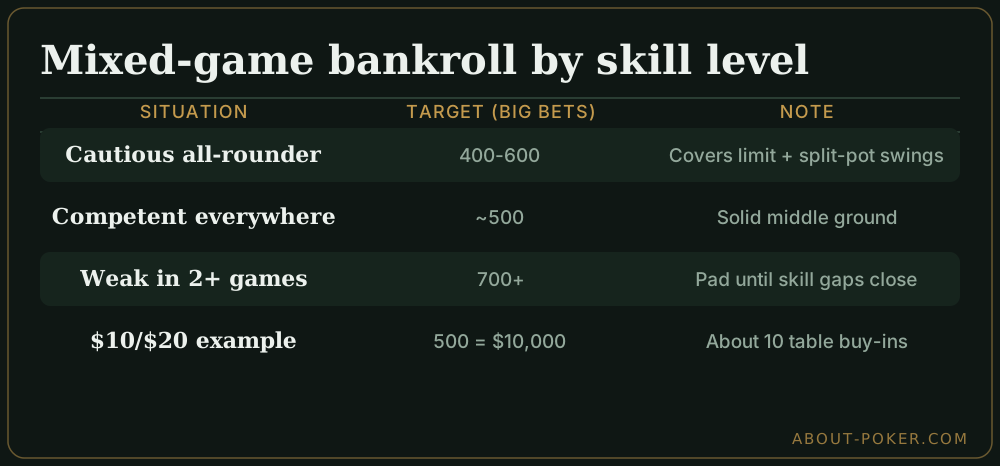
Because most mixed games are limit, bankroll is usually counted in big bets rather than buy-ins. A workable set of targets:
- Cautious mixed-cash roll: 400-600 big bets, or about 40-60 “buy-ins” if you treat 100 big bets as a session bankroll.
- Comfortable roll: 500 big bets is a reasonable middle for a competent all-rounder.
- Weak in several games: push toward 700+ big bets until your skill gaps close.
Compare this to PLO, another high-variance format covered in PLO cash bankroll, where deep buy-in counts are also the norm. Mixed games and big-bet Omaha sit at the swingy end of the spectrum for the same reason: reduced ability to control variance.
A worked mixed-game bankroll
Say you want to play $10/$20 limit mixed cash, where a big bet is $20 and a typical buy-in for the table is around $1,000 (about 50 big bets).
- Target roll at 500 big bets: 500 × $20 = $10,000.
- Expressed in table buy-ins ($1,000 each): 10 buy-ins — which sounds thin, but 500 big bets is a lot of limit poker.
- If you are shaky in Razz and 2-7, add a 40% pad: $14,000 before you sit comfortably.
The big-bet count is the honest measure here; counting “buy-ins” understates how much cushion limit variance actually requires. This is why the buy-in counting guide is worth reading alongside this one — the unit you count in changes the answer.
Managing skill gaps
The cheapest way to shrink your mixed-game bankroll requirement is to close your weakest game. Every discipline you play at a loss both costs EV and adds variance, so a rotation where you are −EV in Razz and Stud-8 needs a far bigger cushion than one where you are at least breakeven everywhere. Study your weakest games first, not your strongest — improving from bad to average in Razz saves you more money than going from good to great in hold’em. Track results by game if your rotation allows, so you know exactly where the leaks are.
Moving up in mixed games
The same discipline that governs shot-taking in hold’em applies here, only with a wider margin. Because a single downswing in a limit rotation can run long and shallow — a slow bleed rather than a sharp crash — you want to be more comfortably rolled before moving up, not less. A good rule: do not move to the next mixed stake until you have 500+ big bets for it and you are at least competent in every game in the rotation. Rushing up while carrying two weak games is how skilled hold’em players go broke in mixed games despite “playing fine” in their best discipline.
Bankroll checklist for mixed games
Before you commit to a mixed-game stake, confirm the essentials: you hold at least 400-500 big bets for the level, you have padded for any game you are weak in, you count your roll in big bets rather than optimistic buy-ins, and you have a plan to study your worst discipline. Mixed games are among the most rewarding formats in poker to master, but they demand respect for variance that a hold’em-sized roll simply does not provide.
Frequently asked
How much bankroll do I need for mixed games?
Plan for more than hold'em — roughly 40-60 buy-ins for cash mixed games rather than the 20-30 many use for no-limit hold'em. The extra cushion covers higher variance in split-pot and limit games, and the fact that you are usually weaker in at least some of the disciplines.
Why are mixed games higher variance?
Many mixed rotations are limit games where you cannot end a hand early, so more hands go to showdown and swings compound across streets. Split-pot games like Omaha Hi-Lo add quartering and scooping variance, and playing games you are less skilled at widens your results further.
What games are in HORSE and 8-game?
HORSE is Hold'em, Omaha Hi-Lo, Razz, Stud, and Stud Hi-Lo (Eight-or-better). 8-game adds No-Limit Hold'em, Pot-Limit Omaha, and 2-7 Triple Draw to a similar limit rotation. Both rotate the game every orbit or by time.
Should beginners play mixed games for bankroll?
Only at low stakes and with a padded roll. Mixed games are excellent for learning and often softer than hold'em, but your edge is uneven across disciplines, so the variance is real. Keep stakes small until you are competent in every game in the rotation.