Bankroll for Multi-Tabling
How multi-tabling changes your bankroll needs: why more tables means more buy-ins, the right table count for your roll, and a worked variance example.
On this page · 6 sections
Multi-tabling is the engine of online poker profit: instead of grinding one table at a time, you play four, eight, or a dozen at once and multiply your hands per hour. But volume cuts both ways. More tables means more decisions, more simultaneous swings, and a bankroll that has to absorb bigger short-term drops. If you carry a single-table roll onto a twelve-table grind, you are under-rolled without realizing it.
Why more tables demands more buy-ins
Bankroll requirements are really about surviving variance long enough for your edge to show. When you play one table, you might see 80 hands an hour. Across eight tables you might see 600. That is not just faster earning — it is faster losing during a downswing. Your results still trend toward your true win rate over time, but the swings you experience in any given session grow with volume.
There is a second, subtler effect. On multiple tables you often have several big pots live at the same moment. A single cold streak can hit five tables in the same ten minutes, stacking losses that a single-tabler would have spread across an afternoon. Correlated bad runs feel — and drain — much harder. That is why the standard advice is to hold a deeper roll as you scale up: not because your edge changes, but because the size of the normal swing does.
A practical table count for your bankroll
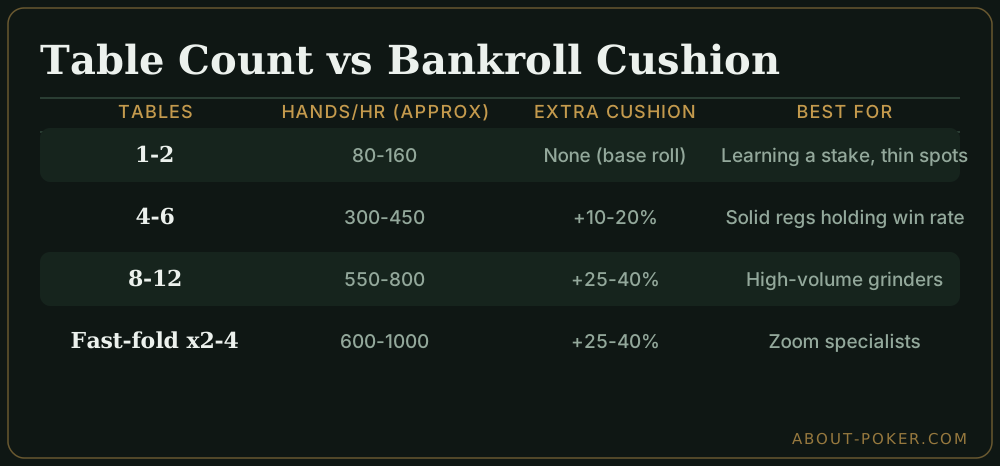
The healthy way to think about it is: add tables until your win rate stops holding, then back off one. Most players find their quality holds up to a point and then falls off a cliff. Track your bb/100 by table count and let the data decide. As a starting frame for online cash, many grinders use the buy-in guidance below, layered on top of the core cash-game bankroll numbers.
The key idea is that the extra buy-ins are not per table in a linear way — they cover the compounded variance of many tables running together. A disciplined 6-tabler beating 5bb/100 needs a meaningfully deeper roll than a single-tabler beating the same 5bb/100, even at the same stake.
Worked example: variance across table counts
Say you play NL50 (a $50 buy-in) and win 5bb/100 with a standard deviation around 90bb/100 — a realistic pairing for a solid, aggressive cash player. Standard deviation is the honest measure of how bumpy the ride is; it is the same statistic covered in variance and standard deviation.
Now compare volume. In a month, a single-tabler grinding 15 hours might log 18,000 hands. An 8-tabler doing the same hours logs closer to 100,000. Both have the same true edge, but the 8-tabler’s monthly swing — the range where results plausibly land — is far wider in dollar terms simply because they played five times the hands. A 6-buy-in downswing that takes the single-tabler weeks to hit can land on the 8-tabler inside a bad week. Same math, compressed time. That compression is exactly why you carry more cushion.
Common mistakes multi-tablers make
- Scaling tables faster than skill. Jumping from 2 to 8 tables overnight tanks your win rate and hides leaks you cannot see through the blur. Add one or two at a time.
- Treating fast-fold like normal tables. Zoom and similar formats deal you a new hand the instant you fold, so hands per hour explode. Follow dedicated Zoom bankroll management and count two fast-fold tables like six regular ones.
- Ignoring time-out and misclick losses. Spread too thin, you fold winners, misclick raises, and time out of pots. These are pure leaks that no bankroll can outrun.
- Not tracking win rate by table count. Without the data, you are guessing at your ceiling. Filter your database by number of tables and look at the bb/100 for each.
How stakes and format change the number
At micro stakes where the games are soft and swings smaller in dollars, you can run more tables and a leaner buy-in cushion. As you climb, opponents get tougher, your win rate compresses, and the same swing costs more money — so hold more buy-ins and often fewer tables. Deep-stacked and pot-limit formats have higher variance still and deserve extra cushion. Live players reading this: multi-tabling does not apply, but the underlying lesson does — anything that raises your hands-per-hour or your variance should push your buy-in count up, not down.
A quick pre-grind checklist
- Am I beating this stake single-tabling first? If not, do not add tables.
- Does my win rate hold at this table count? Check the database, not your gut.
- Do I have the extra buy-in cushion the volume demands, on top of the base stake requirement?
- Is my layout clean enough to act without misclicking or timing out?
- Have I set a stop-loss so a correlated cold streak does not turn into a session I regret?
Multi-tabling rewards discipline over ego. Keep the roll deep, add tables slowly, and let volume do the compounding.
Frequently asked
Do I need a bigger bankroll to multi-table?
Yes. Playing more tables at once means more hands per hour and more simultaneous action, which raises your hourly variance. A bankroll that feels safe on one table can feel thin across eight, so most grinders add buy-ins as they add tables.
How many tables should I play?
Play the most tables at which your win rate stays roughly flat. If adding a table drops your bb/100 more than a few points, you're spread too thin. Most solid online players settle between 4 and 12 tables depending on their reading speed and software.
Does multi-tabling lower my win rate?
Usually a little. You make faster, more default decisions and miss thin spots. The trade is more volume: a slightly lower win rate over far more hands often earns more per hour, up to the point where quality collapses.
How does Zoom or fast-fold poker affect this?
Fast-fold formats pack in even more hands per hour, so treat 2-4 fast-fold tables like 6-8 regular ones for bankroll purposes. The variance is compressed into less time, so keep a deeper roll.