How Much Can You Make Playing Poker
How much can you make playing poker: realistic hourly and yearly earnings by stake, how win rate and volume set your income, with worked numbers.
On this page · 6 sections
How much you can make playing poker has one honest answer: it depends on your win rate, the stake you beat, and how many hours or hands you put in. There is no salary — your income is the product of edge and volume, and both are hard-won. Plenty of strong players make a comfortable living; plenty of capable ones never turn a reliable profit. This page replaces the fantasy with the actual arithmetic so you can estimate your own realistic ceiling.
The formula behind poker income
Cash-game income is simply win rate multiplied by volume. Online, win rate is measured in big blinds per 100 hands (bb/100), so hourly profit is roughly: win rate in bb/100 × hands per hour ÷ 100 × the big-blind size. Live, where you see far fewer hands, players quote big blinds per hour instead. Everything about your earnings flows from those inputs, which is why serious players obsess over tracking them — the process laid out in win rate and ROI. A tiny edge over huge volume can be a living; a big edge over trivial volume is pocket money.
A worked online example
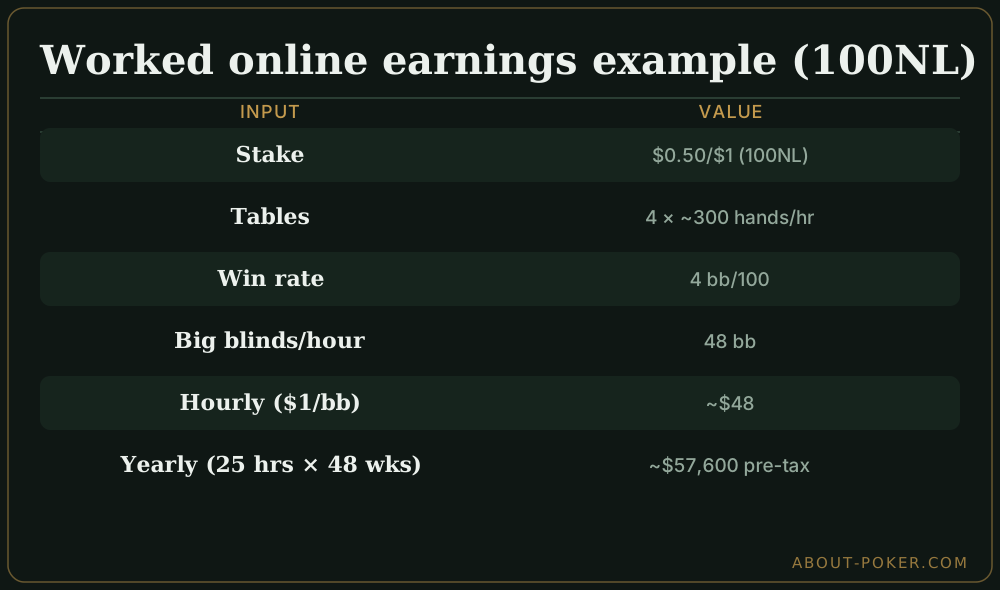
Say you play $0.50/$1 (100NL) online, four tables, at a genuine 4 bb/100 win rate, seeing about 300 hands per hour per table.
- Total hands per hour: 4 tables × 300 = 1,200 hands.
- Big blinds won per hour: 4 bb/100 × 1,200 ÷ 100 = 48 bb.
- At $1 per big blind: $48 per hour before rake-adjusted variance.
- Over 25 hours a week, 48 weeks a year: roughly $57,600 a year, pre-tax.
That is a real living at a modest stake — but it assumes a sustained 4 bb/100 over a full year, which is harder than it sounds. Drop to 2 bb/100 and the same schedule earns about half. This sensitivity to win rate is the single most important thing to understand about poker income.
A worked live example
Live cash is slower but bigger per big blind. Say you play $2/$5 live at a 5 bb/hour win rate.
- Win rate: 5 bb/hour × $5 = $25 per hour.
- Over 30 hours a week, 48 weeks: about $36,000 a year, pre-tax.
Fewer hands mean higher variance and a lumpier result, but live games are often softer, so a strong player’s per-hour edge can be excellent. The trade-off is volume: you physically cannot play as many hands live, which caps the top end unless you move up in stakes.
Realistic earnings by stake
Rough, honest ranges for a competent winning player, per hour, understanding that variance makes any single month wild:
- Micro stakes (2NL-25NL): a few dollars an hour — a supplement, not a living.
- Low stakes (50NL-200NL / $1/$2-$2/$5 live): roughly $15-$50 an hour for a solid reg.
- Mid stakes (500NL+ / $5/$10 live): a genuine professional income for the skilled.
- High stakes: large potential and large swings, reached by very few.
Most players never clear the micro/low band as a true winner. The pyramid is steep, and the players earning headline sums are a tiny minority.
What limits your income
Three ceilings cap earnings. Skill sets your win rate; bankroll sets the stake you can safely play, because you cannot earn $5/$10 money on a $1/$2 roll without risking ruin — the constraint in how much bankroll for poker. Volume sets how far your edge scales, and it is limited by focus, tilt, and the number of good games available. Raising income means pushing on whichever ceiling is lowest for you: usually skill for beginners, bankroll for improving players, and game selection for strong ones.
Turning poker into a living
Making a living is less about hero moments and more about grinding a proven edge with a bankroll that survives the swings and a lifestyle that supports the hours. Before going full-time you want a documented win rate over tens of thousands of hands, a roll large enough that a downswing does not force you down in stakes, and a withdrawal-and-salary plan like the one in professional poker bankroll. Do the math on your real numbers, not the dream ones. If your honest win rate and available volume add up to a living, poker can pay one — and if they do not, that same math tells you exactly what to improve first.
Frequently asked
How much can you realistically make playing poker?
It depends entirely on stake, win rate, and volume. A solid low-stakes online grinder might earn a few dollars an hour, while strong mid-stakes cash and tournament players can make a living. Very few reach high six figures, and most players break even or lose over time.
What is a good win rate in cash games?
Online win rate is measured in big blinds per 100 hands (bb/100). A 2-5 bb/100 win rate is solid at low stakes; 5+ bb/100 is strong. Live cash games run higher per hour but far fewer hands, so live win rates are quoted in big blinds per hour instead.
How long before poker pays a living?
Longer than most expect. You need a proven win rate over tens of thousands of hands, a bankroll to survive variance, and enough volume to turn a small edge into real income. Many capable players take years to build the roll and skill to go full-time, if they ever do.
Can you make more from cash games or tournaments?
Tournaments offer bigger top prizes but brutal variance and long dry spells, so income is lumpy. Cash games pay a steadier, more predictable hourly. Most professionals favour cash or a mix, using tournaments for upside rather than reliable income.