Part-Time vs Full-Time Bankroll
Part-time vs full-time bankroll: why a pro needs far deeper buy-ins than a hobbyist, plus the exact numbers, living-expense cushion, and a worked example.
On this page · 6 sections
The gap between a part-time and a full-time bankroll is not about ego or ambition — it is about who your bankroll has to survive. A hobbyist’s roll only has to survive variance. A professional’s roll has to survive variance and pay the rent every month, including the months you lose. That second job doubles the number of buy-ins you need and adds a separate cash cushion on top.
The core difference: who pays your bills
When you play part-time, your salary covers your life. Poker losses hurt, but they never threaten your housing or food. That means your only enemy is risk of ruin from variance, and a standard 20–30 buy-in cash roll handles it comfortably.
When you play full-time, poker is the salary. Now every downswing does two things at once: it shrinks your roll and it still demands a withdrawal for living costs. Those two forces compound. A stretch where you break even at the tables but withdraw $4,000 to live is, from the bankroll’s point of view, a $4,000 loss. This is why the full-time number is so much larger — the roll has to absorb both the swing and the burn.
The numbers, side by side
For online cash, the working figures are: part-time wants 20–30 buy-ins, full-time wants 40–60 buy-ins. For live cash, both go a little deeper because you can’t reload as easily and sessions are longer. For tournaments, both roughly quadruple because variance is brutal — part-time 100+ buy-ins, full-time 200+.
Then, for full-time only, add a living-expense fund: at least six months of your real monthly costs, held in a separate account that is not part of the roll. This fund is what lets you keep playing your normal stake during a downswing instead of moving up to “make it back” — the single most common way pros bust.
A worked example
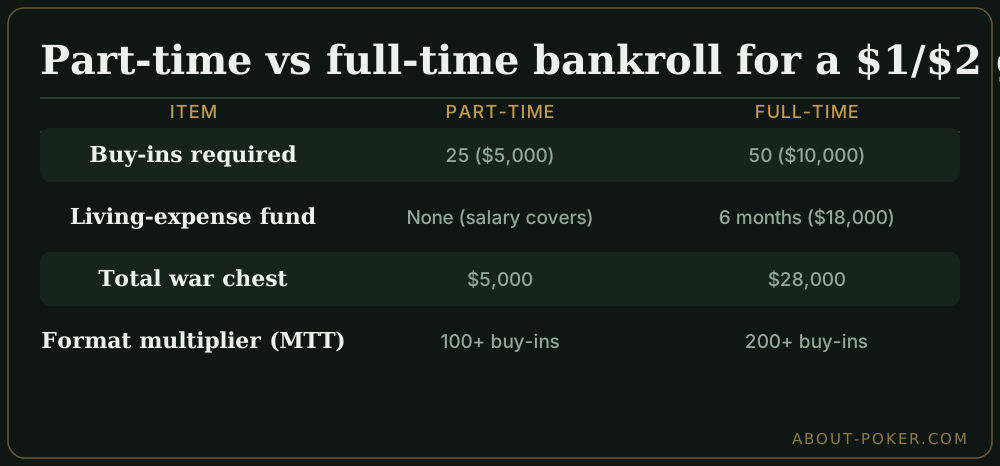
Say you play $1/$2 no-limit live, a $200 buy-in, and your monthly living costs are $3,000.
As a part-time player, 25 buy-ins is $5,000. That’s your whole bankroll requirement. Your day job pays the $3,000.
As a full-time player, the same $1/$2 game now needs 50 buy-ins to absorb both variance and withdrawals, which is $10,000. On top of that you want six months of expenses set aside: 6 × $3,000 = $18,000. So your total war chest is $28,000 — the $10,000 roll plus the $18,000 cushion. That is more than five times the part-time figure for the exact same game, and it is the honest cost of turning a hobby into an income.
Why the cushion matters more than the roll
New pros obsess over buy-ins and ignore the expense fund, but the fund is what actually keeps you alive. Imagine you go on a 15-buy-in downswing — completely normal over a few months. With a separate expense fund, you keep grinding $1/$2, wait out the variance, and recover. Without it, you’re pulling rent out of a shrinking roll, which means you’re effectively taking a shot at higher effective stakes every month whether you meant to or not. See our shot-taking guide for why forced shots are the dangerous kind.
Common mistakes going from part-time to full-time
- Quitting the job on a part-time roll. Hitting 30 buy-ins during an upswing feels like enough. It isn’t — that number has no room for the withdrawal burn.
- Blending expenses into the bankroll. If rent and roll are the same dollars, you can never tell whether you’re winning or just spending slower.
- Not counting variance in your win rate. A 5bb/100 win rate is real over a huge sample and invisible over a month. Full-time means living through the invisible months.
- Ignoring the swing in standard deviation. Live cash runs around 80–100bb/100 standard deviation; that spread is what your extra buy-ins are for.
A quick readiness checklist
Before you go full-time, you should be able to answer yes to all of the following:
- Do I have 40–60 cash buy-ins (or 200+ tournament buy-ins) for my target stake?
- Do I have six months of living expenses in a separate account?
- Have I beaten this stake over a large sample — tens of thousands of hands, not a hot month?
- Can I move down without emotional resistance if the roll drops?
If any answer is no, you are still a part-time player with a full-time dream — and that’s fine. Keep building. Our professional bankroll guide and the broader bankroll management framework walk through the transition step by step.
Frequently asked
How much bigger should a full-time bankroll be than a part-time one?
Roughly double, in buy-ins, and then add living expenses on top. A part-time cash player is fine on 20–30 buy-ins, while a full-time player wants 40–60 buy-ins plus 6 months of expenses held separately from the roll.
Can I go pro on a part-time bankroll?
Not safely. A part-time roll has no cushion for the months you run below expectation, and drawing living costs out of a thin roll accelerates risk of ruin. Build the deeper roll and the expense fund first, then quit the day job.
Should living expenses be part of my bankroll?
No. Keep living expenses in a separate account so a downswing doesn't force you to move up or play scared. Your poker bankroll and your rent money should never be the same dollars.
Does the format change the part-time vs full-time gap?
Yes. Tournament players need far more buy-ins in both cases (100+ part-time, 200+ full-time) because variance is much higher, so the absolute dollar gap between hobbyist and pro is largest in MTTs.