Selling Tournament Action
Selling tournament action explained: how markup works, a fair markup by ROI, tax and tracking basics, and a worked package a buyer would take.
On this page · 6 sections
Selling tournament action lets you spread the risk of a big buy-in across a group of investors while keeping the majority of your own upside. You sell pieces of your seat; buyers pay their share of the buy-in, usually plus a markup that rewards your edge, and they collect the same share of any cash. Done fairly it is a win-win — you cut variance, they get exposure to your skill. Done greedily, inflated markup quietly transfers your buyers’ money to you whether you cash or not.
How selling action works
The mechanics are straightforward percentages. If you enter a $1,000 event and sell 30%, investors together pay $300 of face value. In return they own 30% of your result: cash for $10,000 and they receive $3,000, leaving you $7,000 plus the 70% you always kept. You have effectively played a $1,000 tournament for $700 of your own money at risk. This one-off structure is the cousin of ongoing staking and backing; the difference is that action is sold per-event with no makeup carried forward.
Understanding markup
Markup is the price of your edge. A buyer paying 1.2x markup pays $120 for a $100 piece — the extra $20 compensates you for the fact that a share in a skilled player is worth more than face value. The logic: if your true ROI in the event is +20%, then $100 of your action is “worth” about $120, so 1.2x is fair. Charge less and you leave money on the table; charge more and, over time, your buyers lose even when you run normally. This is why markup must be honest.
Fair markup by ROI
A practical guide relating markup to your expected ROI:
- ROI ~0-5% (thin edge): 1.0x to 1.05x. Barely worth marking up.
- ROI ~10-15% (solid reg): 1.1x to 1.15x.
- ROI ~20% (strong record): ~1.2x.
- ROI 30%+ (elite, well-documented): up to ~1.3x, but expect scrutiny.
These assume you can actually prove the ROI. Buyers increasingly ask for graphs and databases. A tracked record — the sort of history described in tournament bankroll — is what separates justified markup from wishful pricing.
A worked action package
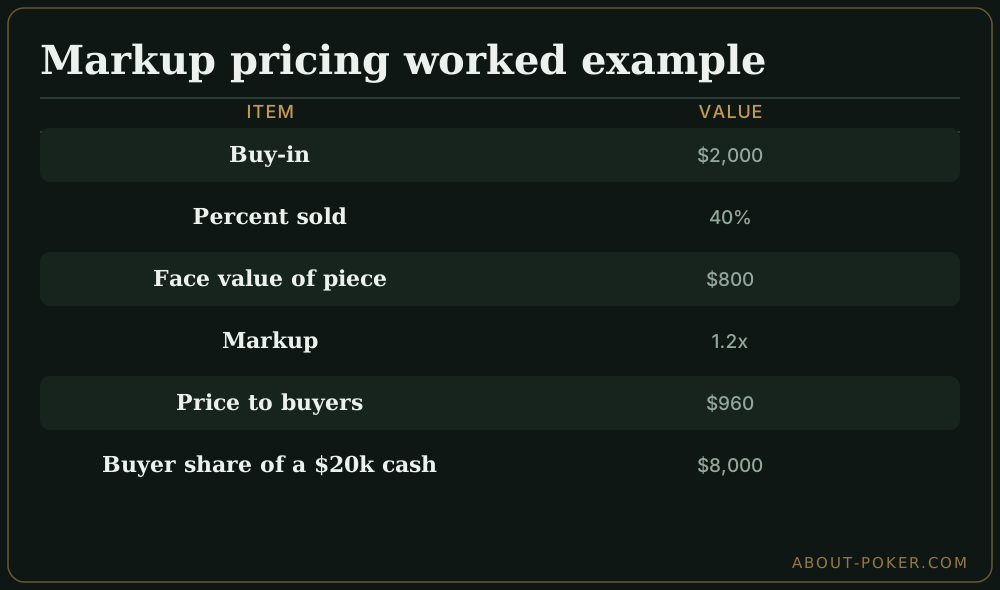
Suppose you are playing a $2,000 buy-in with a genuine 20% ROI, and you want to sell 40% of yourself at 1.2x markup.
- Face value of the 40% piece: 0.40 × $2,000 = $800.
- Price to buyers with 1.2x markup: $800 × 1.2 = $960.
- Your out-of-pocket after sales: $2,000 − $960 = $1,040 for 60% of the action.
- If you cash for $20,000: buyers get 40% = $8,000; you keep 60% = $12,000.
- If you bust: buyers lose their $960, you lose your $1,040.
The markup means you have already banked $160 of edge value the moment the package sells out — but only because your 20% ROI makes that $960 a fair price. Overprice it and that $160 becomes a hidden tax on your buyers.
Tracking, trust, and tax
Selling action is a reputation business. Pay out promptly, share your results transparently, and keep clean records of who bought what percentage. A simple spreadsheet listing buyer, percentage, amount paid, and payout owed prevents nearly every dispute. Be aware, too, that in many jurisdictions both the markup you collect and your share of cashes can be taxable income, and buyers may owe tax on their winnings — consult local rules rather than guessing. The comparison of how one-off action differs from an ongoing arrangement with makeup is covered in backing deals.
Common mistakes when selling
The cardinal sin is inflating markup beyond your real edge; it works once, then your buyers do the math and never buy again. Others sell so much action that they have almost no money in their own seat, which quietly removes the incentive to play their best. And plenty of players forget that markup only pays off if they run near expectation — a cold streak still costs buyers real money, so protecting your reputation means keeping markup honest and communication constant. Sell a fair piece at a fair price, pay fast, and a good buyer list becomes a durable asset that lets you play far above your solo bankroll.
Frequently asked
What does selling tournament action mean?
Selling action means letting others buy a percentage of your tournament for a share of any winnings. If someone buys 10% of your seat, they pay 10% of the buy-in (plus markup) and receive 10% of whatever you cash. It lets you play bigger events while reducing your own variance.
How does markup work?
Markup is a multiplier on the buy-in that pays you for your skill edge. At 1.2x markup, a buyer pays $120 for a piece that costs you $100 face value. The markup should reflect your genuine ROI in the event — reasonable markup is fair, inflated markup is a bad deal for buyers.
What markup is fair?
As a rough guide, fair markup roughly tracks 1 plus your expected ROI. A player with a 20% ROI edge can justify around 1.2x; a modest edge supports 1.05x to 1.1x. Charging 1.3x or more requires a strong, provable record or you will burn your buyers.
Do buyers get their share of every payout?
Yes. Investors receive their bought percentage of the total prize, after any markup they paid at purchase. If you sell 25% and cash for $8,000, buyers collectively receive $2,000, split by how much of that 25% each one owns.