Poker Backing Deals
How poker backing deals work: profit splits, makeup, staking agreements, and a worked example so backer and horse both know what they signed.
On this page · 6 sections
A poker backing deal is a partnership: one person puts up the money, the other puts up the skill, and they split the results. The backer funds buy-ins and absorbs the downside; the horse plays and keeps a share of the profit. It sounds simple, but the details — split percentage, makeup, and what counts as expenses — decide whether the arrangement is fair or a slow trap. Understanding those terms before you sign is the whole job.
How a backing deal is structured
At its core a deal has three moving parts. The split is the profit share, quoted horse-first, so “50/50” means the player keeps half. The makeup is the debt: every losing period the backer covers is added to a running tally the horse must repay from future wins before profit is divided. Expenses cover travel, buy-ins, and sometimes coaching, and whether they sit inside or outside makeup changes the economics sharply. Get all three in writing. The related mechanics of one-off action are in selling tournament action; backing is the ongoing, multi-session version.
Understanding makeup
Makeup is where most disputes start. Say a backer stakes you across cash sessions and you run bad for $3,000. That $3,000 becomes makeup. Now you win $5,000 in the next stretch. You do not split $5,000 — you first repay the $3,000, leaving $2,000 to divide. On a 50/50 deal you take home $1,000. Only once makeup is cleared do you split from the first dollar again. This protects the backer from funding a player who wins a little, cashes out their half, then loses it all back on the backer’s dime.
Choosing a fair split
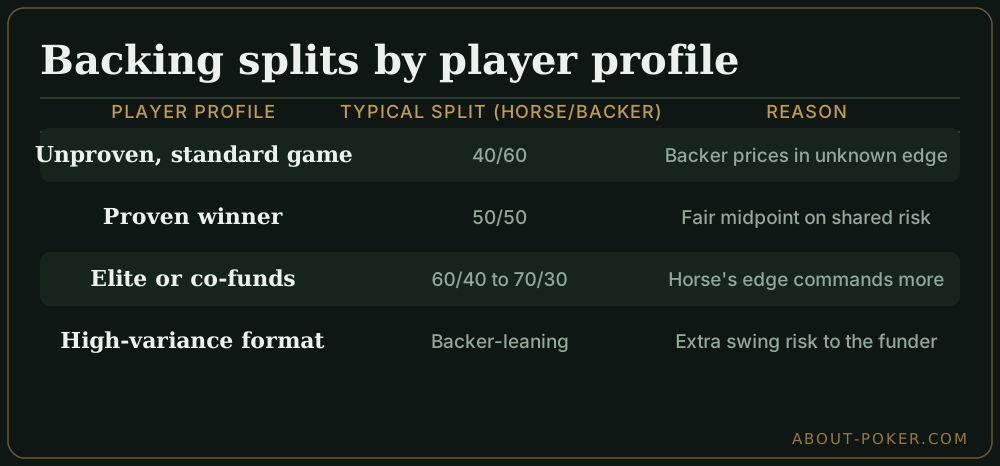
The right split reflects edge and variance. A rough guide:
- Unproven player, standard game: 40/60 to 50/50 in the backer’s favour — the backer is buying risk on an unknown.
- Proven winner, moderate variance: 50/50 is the fair midpoint.
- Elite horse or the horse contributes some funds: 60/40 to 70/30 favouring the player.
The split should track expected ROI. A player with a documented win rate — the kind of record built with a win rate and ROI tracker — has real leverage to negotiate. A player with no records has almost none.
A worked backing example
Consider a 50/50 deal with makeup, expenses outside makeup, over one month of tournament play.
- Buy-ins staked by backer: 20 events × $200 = $4,000.
- Cashes: three min-cashes and one final table totalling $6,500.
- Profit before split: $6,500 − $4,000 = $2,500.
- No prior makeup, so split is clean: horse $1,250, backer $1,250.
Now the losing-month version: the same $4,000 staked returns only $1,500 in cashes. The horse earns nothing that month, and $2,500 of makeup carries into next month. Until the horse wins that back, every future cash first pays down the debt. This asymmetry — you share the wins but the losses stack as debt — is the core trade-off of being backed.
Red flags before you sign
Watch for deals where expenses are vague (“reasonable costs” with no cap), where makeup never resets even after the deal formally ends, or where the backer can pull funding mid-downswing while still holding you to makeup. A clean contract names the stakes and games covered, the exact split, how makeup accrues and clears, an expense policy, and an exit clause for both sides. If the person offering the deal resists putting any of that in writing, that is your answer. The umbrella concepts and the difference between staking and backing are laid out in staking and backing.
Is being backed right for you?
Backing makes sense when you can beat a stake you cannot afford to fund solo, or when you want to smooth brutal variance in high-buy-in tournaments. It is the wrong tool if you already have the roll, because you are simply giving away half your long-run profit for risk reduction you do not need. Run the honest number: your expected profit unbacked versus your smaller share backed, weighed against the peace of mind of not risking your own money. For many mid-stakes grinders the answer is to stay self-funded and manage variance with a proper bankroll instead.
Frequently asked
What is a poker backing deal?
A backing deal is an agreement where a backer funds a player's buy-ins in exchange for a share of the profits. The player, called the horse, keeps the rest. Losses are usually carried as makeup that must be repaid from future winnings before profit is split.
What is a normal backing split?
50/50 is the classic starting point for a player with a proven edge. Backers may take a larger share (60/40 or 70/30) for unproven horses or higher-variance formats, while established winners can command 60/40 or better in their favour.
What is makeup in a backing deal?
Makeup is the running total of losses the backer has covered. Before the player earns any profit, they must first win back that debt. Makeup carries forward across sessions and only resets when the deal ends or both parties agree.
Are backing deals worth it for the player?
They can be, if you lack the roll to play a stake you genuinely beat, or want to cut your variance. The trade-off is giving up a large share of long-run profit and, often, being stuck in makeup during downswings.