Shot-Taking Rules
Clear shot-taking rules for poker: how many buy-ins to risk, the stop-loss that keeps a shot safe, and a worked shot plan you can copy today.
On this page · 6 sections
Shot-taking rules exist to answer one question before emotion can: exactly how much am I willing to lose to test a bigger game, and when do I quit? A shot is a short, pre-planned attempt at a stake your bankroll does not yet fully support. Follow the rules and it is the safest on-ramp to higher stakes there is. Break them and it is the fastest route to rebuilding from scratch.
The four rules that make a shot safe
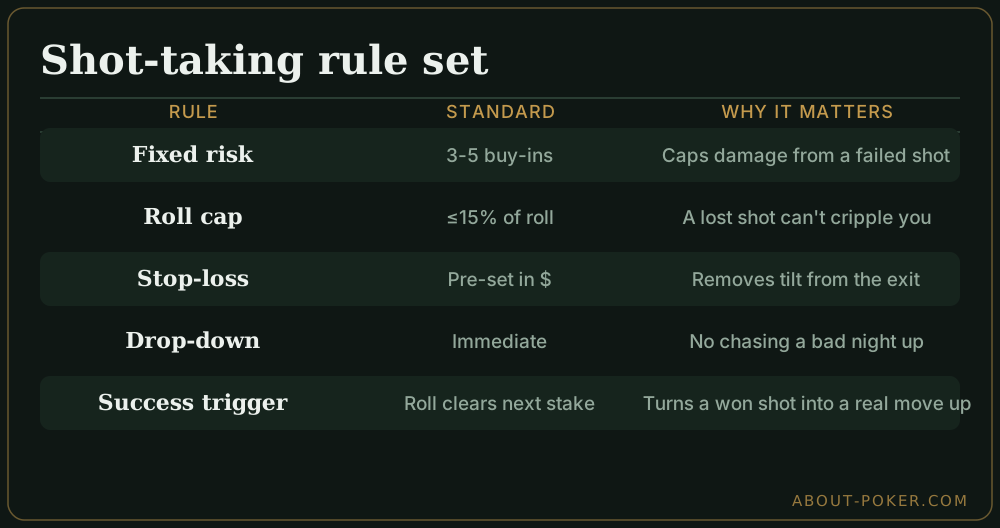
Every disciplined shot obeys the same four conditions. Miss one and you are no longer taking a shot — you are just moving up under-rolled.
- Fixed risk. Decide the exact number of buy-ins before you play. Three to five is standard.
- Pre-set stop-loss. Write down the point at which the shot ends, in dollars, before the first hand.
- Automatic drop-down. If you hit the stop-loss you return to your regular stake immediately — same session, no debate.
- Earned entry. You already beat your current stake and your roll is close to the next threshold.
If you cannot state all four out loud before sitting, you are not ready.
How much to risk
The standard is 3-5 buy-ins of the target stake, capped at about 10-15% of your total bankroll. Suppose you play $1/$2 with a $6,000 roll and want to test $2/$5 (a $500 buy-in). Five buy-ins would be $2,500 — over 40% of your roll, far too much. Fifteen percent of $6,000 is $900, which is under two buy-ins and too small a sample. The honest read: your roll is not yet close enough for a proper shot at $2/$5. This is why the “earned entry” rule matters — the math only works when you are genuinely near the threshold, a topic covered in when to move up stakes.
Setting the stop-loss
The stop-loss is the whole game. A clean rule is: lose your allotted buy-ins and the shot is over, full stop. Some players prefer a session-based version — for example, “any single session down two buy-ins, I quit for the day” — layered on top of the total shot budget. Both work. What kills bankrolls is the floating stop-loss that quietly moves from three buy-ins to four to “just one more re-buy.” Once the number is negotiable it is not a stop-loss, and the shot has become an ordinary under-rolled gamble.
A worked shot plan
Here is a complete plan you can copy. Say you have a $10,000 roll beating $1/$2 comfortably and want to test $2/$5.
- Shot fund: 4 buy-ins × $500 = $2,000 (20% of roll — slightly rich, so you accept a tighter stop).
- Stop-loss: down $1,500 (3 buy-ins) ends the shot, no exceptions.
- Session cap: down 2 buy-ins in one sitting, quit that day.
- Success trigger: up 3 buy-ins and total roll clears $12,500 — then move up for good.
- If neither trigger hits: play the shot out, bank results, reassess next month.
Notice every branch is decided in advance. When you are actually at the table, there are no decisions left to make about the shot itself — only about the poker.
Common shot-taking mistakes
The classic error is shooting on tilt to recover a bad night; you are guaranteed to be playing your worst poker against tougher opposition. A close second is failing to bank a winning shot — the roll spikes, ego takes over, and you stay at the higher stake without the buy-ins to survive normal variance. Others under-fund the shot so badly that a standard downswing ends it before the sample means anything, then conclude “I can’t beat that game” on 200 hands of noise. Treat a shot like an experiment: a fair sample, a fixed budget, and an honest reading of the result. The broader framework for how buy-in counts scale sits in how much bankroll for poker, and the mindset side is expanded in the main shot-taking guide.
Quick pre-shot checklist
Before you sit in the bigger game, tick every box: I beat my current stake over a real sample; my roll is near the next threshold; my shot fund is 3-5 buy-ins and under ~15% of my roll; my stop-loss is written down; I know exactly what “success” looks like; and I am not shooting to chase losses. Six yeses, and the shot is disciplined. Any no, and you wait.
Frequently asked
How many buy-ins should a shot be?
Set aside 3-5 buy-ins of the higher stake, or roughly 10-15% of your total bankroll — whichever is smaller. That is enough to give the shot a fair sample without threatening the rest of your roll if it fails.
What is the single most important shot-taking rule?
Decide your stop-loss before you sit down. A shot with a pre-set exit is discipline; a shot you extend on tilt is just playing under-rolled and hoping. The number must be written down before the first hand.
When am I allowed to take a shot?
When you already beat your current stake over a real sample, your roll is close to the threshold for the next stake, and the higher game looks beatable. Never shot to win back a losing session.
What happens if my shot succeeds?
Bank the profit, then decide whether the extra winnings push your total roll over the full requirement for the new stake. A won shot funds a permanent move up; it is not a licence to stay up under-rolled.