When to Move Down Stakes
Moving down stakes protects your bankroll when the roll shrinks or the games get tough. Here are clear buy-in triggers, the ego traps, and a decision checklist.
On this page · 7 sections
Everyone talks about moving up in stakes — it’s the exciting direction. But knowing when to move down is the more important skill, because it’s the habit that keeps you in the game when things go wrong. Dropping down protects your bankroll during a downswing, gets you into games you can actually beat, and takes the pressure off when you’re playing scared. It is not a demotion. It is risk management, and the players who do it without ego are the ones who never go broke.
Moving down is the mirror image of moving up, so it helps to read them together — see when to move up stakes for the other half of the picture.
Why moving down is a strength, not a failure
The single most protective habit in all of bankroll management is a willingness to drop stakes. Here’s why: your risk of ruin is calculated assuming you keep playing the same stake with the same roll forever. In reality, if you drop down when your bankroll shrinks, your real-world risk of going broke falls far below the raw formula — because you’re always adjusting the size of your bets to the size of your roll.
That’s the whole trick. A player who moves down mechanically as their roll declines is playing with a kind of built-in stop-loss. A player who refuses to drop is the one who busts. Ego, not variance, is what empties most bankrolls.
The buy-in triggers
The cleanest way to remove emotion from the decision is to set numeric triggers in advance. Common defaults:
- Cash games: carry 30–40 buy-ins for a stake; drop down when you hit ~20 buy-ins of the current game.
- Tournaments: carry 100+ buy-ins; drop down around 40–50 for your current buy-in level.
- Move back up once you rebuild to your original threshold (e.g., 30–40 buy-ins for cash).
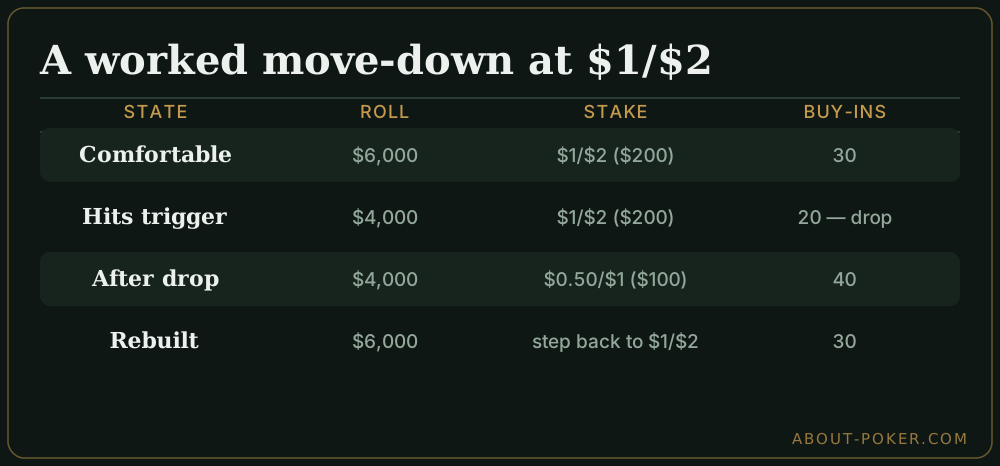
A worked example. You’ve got a $6,000 roll grinding $1/$2 with a $200 buy-in — that’s 30 buy-ins, a comfortable position. A cold stretch drags you down to $4,000, which is 20 buy-ins. That’s your trigger. You drop to $0.50/$1 ($100 buy-in), where $4,000 is a healthy 40 buy-ins. You grind there until the roll climbs back to $6,000, then you step back up to $1/$2. No agonizing, no hero stands — just numbers.
Reasons to move down beyond the roll
Bankroll size is the main trigger, but it’s not the only one. Consider dropping down when:
- The games got tougher. If regulars have flooded your stake and the fish have dried up, your win rate has quietly fallen. A softer, lower game can pay better per hour than a tough higher one.
- You’re playing scared. If the money at your stake now feels too big to lose — after a downswing, a life change, or a bad month — you’ll play tight and passive and leave EV on the table. Dropping to where the stakes feel trivial restores good decisions.
- You’re genuinely losing. If a large sample shows a real, negative win rate (not just variance — see understanding poker downswings to tell the difference), drop to a game you can beat, rebuild both roll and confidence, and fix the leaks before returning.
The ego trap
The hardest part of moving down is never the math — it’s the identity. Players attach their self-image to “being a $2/$5 reg,” and dropping to $1/$2 feels like going backward in public. This is exactly the wrong frame. The stake you play is not who you are; it’s a tool matched to your current bankroll and edge.
Watch for the classic ego spiral: a player takes a hit, refuses to drop, plays scared at a stake they can no longer afford, tightens up, loses more, and finally busts — all to avoid the mild embarrassment of a temporary move down. The player who’d dropped one level at the first trigger would still be grinding, still winning, still building back. Swallow the ego early and it costs you nothing; swallow it late and it costs you the roll.
Distinguishing variance from a real problem
Before you move down for skill reasons (as opposed to hitting a bankroll trigger), make sure you’re diagnosing correctly. A losing month at a beatable stake is almost always variance. A losing 50,000-hand sample with clear technical leaks is a real problem. Move down mechanically on bankroll triggers regardless — but only move down as a strategic retreat once the sample is large enough to trust.
Common mistakes when moving down
- Setting no triggers, so every drop becomes an emotional argument you usually lose.
- Moving down but playing too small to take it seriously, then punting out of boredom.
- Refusing to drop after a life change that shrank the roll’s real-world importance.
- Treating a move down as permanent — it’s a temporary adjustment, not a verdict.
- Confusing variance with a leak, and dropping (or refusing to) for the wrong reason.
A move-down checklist
When you’re unsure whether to drop, run through this:
- Has my roll hit my pre-set buy-in trigger for this stake?
- Have the games gotten tougher, cutting my real win rate?
- Am I playing scared because the money now feels too big?
- Over a large sample, am I genuinely losing, or just running below EV?
- Am I hesitating purely because of ego rather than any real reason?
If any of the first four is a clear yes — or the last one is the only thing holding you back — move down. It’s the cheapest insurance policy in poker, and the habit that lets winning players stay winning players for good.
Frequently asked
When should you move down in poker stakes?
Move down when your bankroll drops below the minimum buy-in count you set for your current stake — commonly 20 buy-ins for cash or 100 for tournaments. It is a discipline rule, not an admission of failure: dropping down preserves your ability to keep playing and rebuild.
How many buy-ins before you drop down?
A common rule is to drop a stake once your roll falls to about 20 buy-ins for the current cash game (or 100 buy-ins for MTTs), then move back up when you rebuild to roughly 30–40. The exact numbers depend on your win rate and the game's variance.
Is moving down stakes bad?
No — it is one of the most protective habits in bankroll management. Refusing to move down is what turns a normal downswing into going broke. The best players treat dropping down as a routine, ego-free tool for controlling risk of ruin.
Should I move down if I keep losing at my stake?
If a large sample shows you are genuinely losing — not just running below expectation — then yes, move down to a beatable game to rebuild both your bankroll and your confidence. Distinguish a real skill gap from ordinary variance before deciding.