Why Is It Called a Full House in Poker?
A full house is named for its 'full' five cards — three of one rank plus a pair, no gaps. Here's the history, nicknames, and a worked example.
On this page · 6 sections
A full house is called “full” because every one of its five cards is matched — three of one rank plus two of another, with nothing left over. Unlike most hands, there’s no dangling kicker; the hand is completely “filled up,” so old card players described it as being full. Over time “full house” stuck as the name for three of a kind and a pair together.
The short answer
The name traces back to 19th-century American poker, when the hand was often described simply as “full” — the three-plus-two combination fills every slot, so three cards form one group, two form another, and none are idle. Exactly when and how “full house” became the standard term isn’t documented with any certainty; the phrase appears to have settled in alongside the rest of poker’s vocabulary as the game spread. The “house” part simply extended “full” into a more colorful phrase — much like calling a good hand a “boat.”
What the record actually shows
Be wary of confident etymology stories online — the honest answer is that no single origin is proven. What we can pin down is roughly when the terms appear in print:
| Term | Earliest attested in print (approx.) | What it suggests |
|---|---|---|
| ”full hand” | 1860s American poker guides | The hand was first named for being complete — every card working. |
| ”full house” | Turn of the 20th century | ”House” is a later flourish on the older “full hand." |
| "full boat” / “boat” | 20th-century table slang | Casual shorthand, never a rulebook term. |
Two theories compete for the “house” part. The completeness reading is the one most sources favor: the hand is “full up,” with no empty slots. A second, weaker guess links “house” to gambling houses or to the hand “filling the house” (the table) — but there’s no documentary support for it, so treat it as folk etymology rather than fact.
Why “full” and not something else
Walk up the hand ladder and watch the leftover cards disappear:
- One pair — two matched, three kickers doing nothing.
- Two pair — four matched, one kicker left over.
- Three of a kind — three matched, two kickers left over.
- Full house — all five matched. Nothing left over.
A full house is the point where the hand becomes complete. That’s the intuition behind “full.” It’s not about being the strongest hand — a flush, quads, and straight flushes all beat it — but about the shape of the hand itself. Everything fits.
The nicknames: boat, full boat, and how to say it
At the table you’ll rarely hear “full house” alone. The common slang:
- “Boat” or “full boat” — the most popular nickname. Origin is uncertain, but it likely rhymes off “full” (full → boat) and evokes something loaded to capacity.
- “Full up” — an older phrasing, as in “I’m full up with kings.”
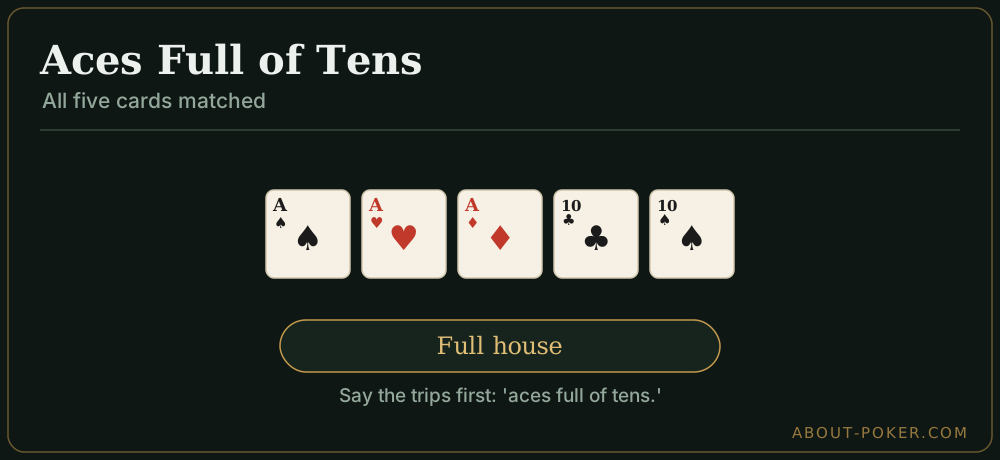
When you announce a full house, you name the trips first, then the pair, joined by “full of”:
A♠ A♥ A♦ 10♣ 10♠= “aces full of tens”7♥ 7♦ 7♠ 2♣ 2♥= “sevens full of deuces”
This ordering matters, because the trips decide the winner when two players both have a boat.
Why the name decides who wins: a two-boat example
The “trips first” way of saying a full house isn’t just style — it mirrors how the hand is ranked. Here’s a quick showdown that shows the naming and the winner are the same thing.
You hold Q♠ Q♥. The board runs out Q♦ 9♣ 4♥ 4♦ 2♠.
- Your best five cards:
Q♠ Q♥ Q♦(trips) plus4♥ 4♦(the board’s pair) = queens full of fours. - Your opponent holds
9♥ 9♦. Their best five:9♥ 9♦ 9♣(trips) plus4♥ 4♦(the same board pair) = nines full of fours.
Both players read the trips first, and queens beat nines — so your queens full of fours wins, even though the pair is identical. The attached pair only becomes a tie-breaker when both players share the same trips.
Why the completeness matters beyond the name
The “full” nature isn’t only trivia — it’s why the hand is so strong and so dangerous. Because it uses all five cards, a full house has no weakness a kicker can expose; you never lose to a “better kicker” the way you can with one pair or three of a kind. The only ways to lose are to a bigger full house or to one of the three hands above it. And note the classic trap: a full house does beat a flush, so if you’re wondering whether that big flush is ahead, our does a flush beat a full house guide settles it — it doesn’t.
Bottom line
“Full house” comes from the hand being full — three of a kind plus a pair, with all five cards matched and no leftover kicker. It’s also called a “boat” or “full boat,” and you say it trips-first (“aces full of tens”). The completeness that gives it the name also makes it one of poker’s most reliable big hands. Lock in where it sits on the hand rankings hub, then take it to the Texas Hold’em felt.
Frequently asked
Why is it called a full house in poker?
The name comes from the hand being 'full' — all five cards are working together as three of a kind plus a pair, with no unmatched kicker. Every card belongs to a group, so the hand is 'full up.'
What is a full house also called?
A 'full boat' or just a 'boat.' The three-of-a-kind portion is sometimes read first, as in 'kings full of fours' for K-K-K-4-4.
Does a full house use all five cards?
Yes. Three cards share one rank and the other two share a different rank, so all five are matched. That completeness — no leftover kicker — is exactly why it's called 'full.'
How do you say a full house out loud?
Name the trips first, then the pair: 'aces full of tens' for A-A-A-10-10. The rank of the trips decides which full house wins in a showdown.