Beating a Losing Streak Mentally
A losing streak is mostly variance, not a broken game. Here's the mental system — bankroll rules, volume control, and study — to beat it without going broke.
On this page · 7 sections
Beating a losing streak mentally comes down to one reframe: most of a downswing is variance, and variance is not feedback about your ability. Your job during a streak is not to win the next hand — it’s to keep playing your best while the math corrects itself. That means protecting your bankroll, controlling your volume, and refusing to let short-term results rewrite how you feel about your game.
Why losing streaks feel worse than they are
Human brains are pattern-matchers. When you lose four sessions in a row, your mind builds a story: “I’ve lost it,” “the games got tougher,” “I’m cursed.” None of that is true, but the story feels true because losing hurts roughly twice as much as winning feels good. That asymmetry is loss aversion, and it’s why a normal statistical dip can feel like the sky falling.
The reality is that even a strong winner spends a large chunk of their career not making money. If you win at 5bb/100 with typical cash-game variance, you can run below break-even for tens of thousands of hands and still be a genuine winner. The streak is real; the conclusion your brain draws from it usually isn’t.
Separate the money from the decisions
The single most useful mental habit during a streak is to grade yourself on decisions, not dollars. A session where you lost three buy-ins but made no clear mistakes was a good session — you just got the wrong side of variance. A session where you won two buy-ins by calling off light and running hot was a warning sign, not a triumph.
To do this you need a way to review objectively. Keep a short log of the hands that cost you the most and revisit them the next morning, calm. Ask: was I ahead when the money went in? Was this a spot that works most of the time? This is the core idea behind dealing with downswings — you audit the process and let the results be whatever they are.
Protect the bankroll first
You cannot beat a losing streak if you go broke in the middle of it. Bankroll rules exist precisely for the streaks, not the good times. A common cash-game guideline is 30 to 50 buy-ins for the stake you’re playing; for tournaments, 100+ buy-ins because the variance is far higher.
Here’s a worked example. Say you have a $2,000 bankroll and you play $0.50/$1 with a $100 buy-in — that’s 20 buy-ins, already thin. A rough streak drops you to $1,200. You are now at 12 buy-ins, deep into danger. The correct move is not to “win it back” at $1 — it’s to drop to $0.25/$0.50 ($50 buy-ins), where $1,200 is 24 buy-ins. You keep playing, the pressure drops, and one normal upswing rebuilds you. Moving down is how winners survive; refusing to move down is how good players go broke.
Control volume and intensity
Streaks are the worst time to grind long sessions. Fatigue lowers decision quality, and low decision quality during variance turns a downswing into a real leak stacked on top of bad luck. Cut your session length. If you normally play four hours, play two. If you multi-table eight tables, drop to four so every decision gets full attention.
Some players do the opposite and try to “run good volume” through the streak to speed up the correction. That works only if your A-game holds — and during a painful streak, it rarely does. Better to play fewer, cleaner hands. Quality of decisions beats quantity of hands when your emotions are raw.
Use the streak as a study window
A losing stretch is dead time emotionally, so convert it into learning time. This is when off-table work pays the most, because you’re motivated to fix things and you have fresh, painful examples to study. Pull your biggest losing pots and look for patterns. Are you overcalling rivers? Bluffing stations? Getting stacked in blind-vs-blind wars?
Understanding why variance exists also helps here — when you internalize that a break-even stretch of 40,000 hands is statistically normal, the streak stops feeling like a verdict and starts feeling like weather. You can’t stop the weather; you can dress for it.
Common mistakes that turn a streak into a spiral
- Chasing losses by moving up. Playing higher to win back money faster is the fastest route to broke.
- Grading yourself on the scoreboard. If you feel good only when you win, variance controls your emotions completely.
- Playing tired or emotional. Streaks tempt marathon sessions; those are where the real leaks live. See running bad in poker for the behavioral traps.
- Quitting the game entirely. A short break is healthy; abandoning poker because of normal variance means the streak won.
A simple losing-streak checklist
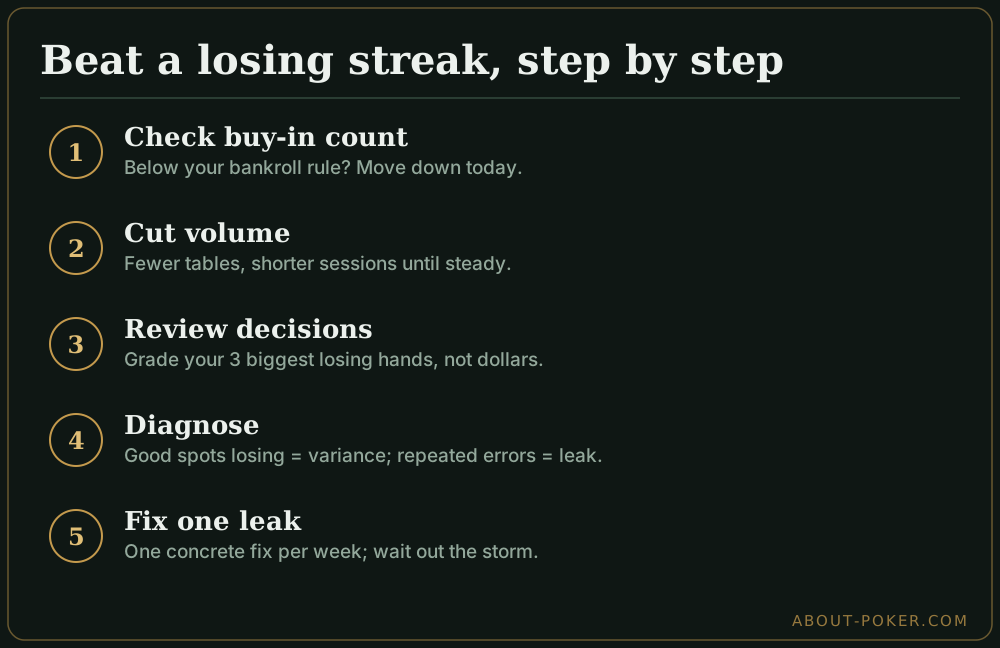
- Confirm your buy-in count. Below your rule? Move down today.
- Cut session length and table count until you feel steady.
- Review your three biggest losing hands each morning — decisions, not dollars.
- Log whether losses came from good spots or repeated errors.
- Fix one concrete leak per week; ignore the scoreboard.
Do this and the streak becomes survivable — and once variance turns, as it always does, you come out the other side with a tighter game and a calmer head.
Frequently asked
How long can a poker losing streak last?
Longer than most players expect. A solid winner can run below break-even for 20,000 to 100,000 hands purely from variance. The lower your win rate and the higher your variance format (tournaments, heads-up), the longer bad stretches can run.
Should I move down in stakes during a losing streak?
Yes, if the losses have shrunk your bankroll below your buy-in rules. Moving down is not an admission of failure — it reduces pressure, protects your roll, and lets you rebuild confidence at a level where the money matters less.
How do I know if it's variance or a real leak?
Variance shows up as good decisions losing; leaks show up as repeated bad decisions. Review your losing hands away from the table. If your all-ins were mostly ahead and your bluffs were spots that normally work, it's variance. If you keep spewing in the same spot, it's a leak.