Detachment From Results
Judging your poker by wins and losses teaches you the wrong lessons because variance owns the short run. Learn to detach from results and grade decisions instead.
On this page · 6 sections
Ask a losing player why they made a play and they’ll often say “because it worked” or “because it didn’t work last time.” That’s results-oriented thinking, and it’s one of the most expensive habits in poker. Over any short stretch, variance — not skill — decides who wins the pot, so grading yourself by the scoreboard teaches you the wrong lessons at the wrong moments. Detachment from results is the discipline of judging your play by the quality of your decision, independent of whether it won.
Why the outcome lies to you
Consider a simple truth: if you get all-in with aces against kings preflop, you’re about an 82% favorite. You should take that spot every single time. But 18% of the time you lose — and a results-oriented player who just lost with aces starts wondering if they should have folded. That’s the lie. The play was correct; the outcome was noise.
The reverse is just as dangerous. Call a river with bottom pair against a range that has you crushed, spike two pair, and win — a results-oriented brain files that away as a good call. It wasn’t. You got lucky, and you just trained yourself to make a losing play again. This is outcome bias, and it quietly corrupts your strategy every time you let the result grade the decision.
Separate the decision from the outcome
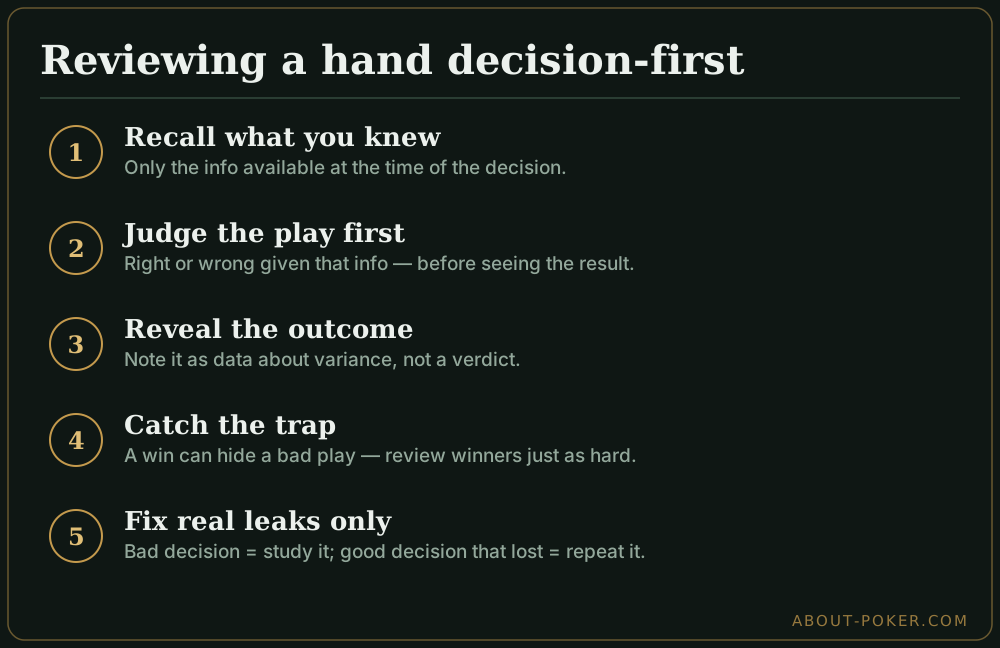
The core skill is a two-step review. Before you ever look at whether a hand won, ask: given only what I knew at the time, was this the right decision? Then, and only then, note the result — but treat the result as data about variance, not a verdict on your play.
- Good decision, good result → correct, and it paid off. Fine.
- Good decision, bad result → still correct. This is variance. Do it again.
- Bad decision, bad result → a real leak. Fix it.
- Bad decision, good result → the trap. This is the one to catch, because the win disguises the leak.
Most improving players only interrogate the losing hands. The hidden edge is scrutinizing the winning ones just as hard, because that fourth quadrant is where bad habits hide. This mindset is the analytical half of goal setting for poker, where you build targets around process rather than outcomes.
A worked example
You raise, get called, and barrel a bluff on the river with king-high. Villain tanks and folds a better hand — you win a big pot. Feels great, feels like a read.
Now detach and review the decision. Did the board and villain’s range actually support a bluff there? If villain’s range was full of pairs that call, the bluff was −EV and you simply ran into the one holding they’d fold. The pot you won is irrelevant to that judgment. If you let the win convince you the bluff was good, you’ll fire that same spot into calling ranges for months and bleed chips — while remembering the one time it worked. Detachment is what lets you say, “won the pot, wrong bluff,” and correct it.
Detachment defuses tilt
Results-oriented thinking is also the fuel for tilt. When you believe outcomes reflect your skill, a losing session feels like a personal failure and a bad beat feels like an injustice — both prime triggers for spew. When you genuinely understand that short-run results are mostly variance, the sting drains out of them. You lost a flip; the sun also rose. This is why understanding variance is so tied to emotional control, and why detachment is one of the most effective tools in how to stop tilting.
How to build the habit
Detachment is a muscle, not a switch. A few practices that build it:
- Review process-first. In every hand review, state your reasoning before revealing the result.
- Track process goals. Judge sessions by whether you executed your plan and respected your stop-loss, not by the number at the bottom.
- Widen your sample mentally. When a good play loses, remind yourself it wins the other 82% (or whatever the real number is) of the time. One trial is meaningless.
- Treat wins and losses identically in review. Same questions, same rigor. The result shouldn’t change how hard you examine the decision.
Where detachment ends
One caveat: detachment applies to individual outcomes and short samples, not to long-run results. Over tens or hundreds of thousands of hands, your results do reflect your skill, and you should absolutely pay attention to a persistent downward graph — that’s a signal to study, not variance to ignore. The skill is knowing the difference: shrug off the single bad beat, but take the sustained losing winrate seriously.
Get this balance right and poker becomes far less emotionally exhausting. You stop riding the scoreboard up and down, you learn the correct lesson from every hand, and you make the same +EV plays whether the last five won or lost. That consistency — playing your best regardless of recent results — is exactly what separates long-term winners from everyone else. For the full picture, start at the mental game hub.
Frequently asked
What does detachment from results mean in poker?
It means judging your play by the quality of your decisions rather than whether the hand won or lost. Because variance controls short-run outcomes, a good decision can lose and a bad one can win. Detachment lets you learn from the process instead of being misled by the scoreboard.
How do I stop being results-oriented in poker?
Separate the decision from the outcome every time you review a hand. Ask 'was this the right play given what I knew?' before you look at whether it won. Track process goals, expect variance in the short run, and treat winning and losing sessions with the same analytical eye.
Why is being results-oriented bad for poker?
Because outcomes over small samples are mostly noise, so grading yourself on them teaches false lessons — you punish good plays that lost and reward bad plays that won. That corrupts your strategy over time and feeds tilt when the results don't match your effort.