Focus and Attention at the Table
Attention is a finite resource and most players waste it. How to protect focus at the poker table, manage energy over long sessions, and stop autopiloting.
On this page · 6 sections
Poker rewards attention more than almost any other skill, and yet attention is the resource players guard least. You will study ranges for hours and then throw away a session because you were half-watching a show and missed that the tight player suddenly opened three hands in a row. Focus and attention at the table is not about grinding harder; it is about spending a finite resource wisely across the length of a session.
Attention is a battery, not a switch
The most useful mental model is that your attention is a battery that starts full and drains through the session. Every decision, every distraction, every hour of sitting depletes it. This is why the mistakes cluster late: hour four is not where the tough spots are, it is where your battery is nearly dead. Accepting this changes how you plan. Instead of asking “how long can I play?” you ask “how long can I play well?” — and those are very different numbers. Quitting a winning session because your focus is fading is not weakness; it is protecting your edge from the version of you that plays on empty.
Remove the obvious drains first
Before any advanced technique, plug the leaks. Put the phone out of reach — not face-down on the table, actually away. Close the extra browser tabs. If you play online, kill the second monitor’s distractions during a session. These sound trivial, but attention does not multitask; it switches, and each switch costs you re-focus time and a real chance of missing information. A player who simply removes their phone for a session often gains more than one who studies a new bluff-catching spot. Your pre-session routine is the natural place to build these removals into a habit.
Give yourself a job on folded hands
You are folding most hands. Those minutes are where focus quietly dies and autopilot takes over. The fix is to give yourself an active assignment every time you are not in a pot: narrow one specific opponent’s range as the hand develops, watch for a bet-sizing pattern, or predict who wins at showdown and check yourself. This turns dead time into data collection and keeps the battery engaged rather than idling toward boredom. It is also the antidote to the trap covered in patience and boredom at the table — boredom is what makes players open bad hands just to feel involved.
A worked example of energy management
Imagine two players in the same eight-hour live session. Player A plays straight through, phone on the rail, grabbing food at the table. By hour six he is calling down out of position with second pair “just to see,” bleeding a buy-in in slow drips. Player B plans it differently: three roughly two-hour blocks with a ten-minute walk between each, water instead of a fourth coffee, and a hard rule to reassess focus at every break. Player B plays maybe six hours of sharp poker instead of eight hours of decaying poker. Over a year, Player B’s win rate is dramatically higher — not because she knows more, but because she was actually present for the hands that mattered.
Match table count to game difficulty
Online, the fastest way to overspend attention is to open too many tables. Table count should track game difficulty and your current state. In easy games where most spots are standard, more tables is fine. In tough games, in three-bet pots, or while recovering from a downswing, fewer tables means each close decision gets the attention it deserves. The right number is not fixed — it is the most tables at which you still make your best decision in a marginal spot. Discipline about this is the practical side of poker focus and discipline.
The focus checklist
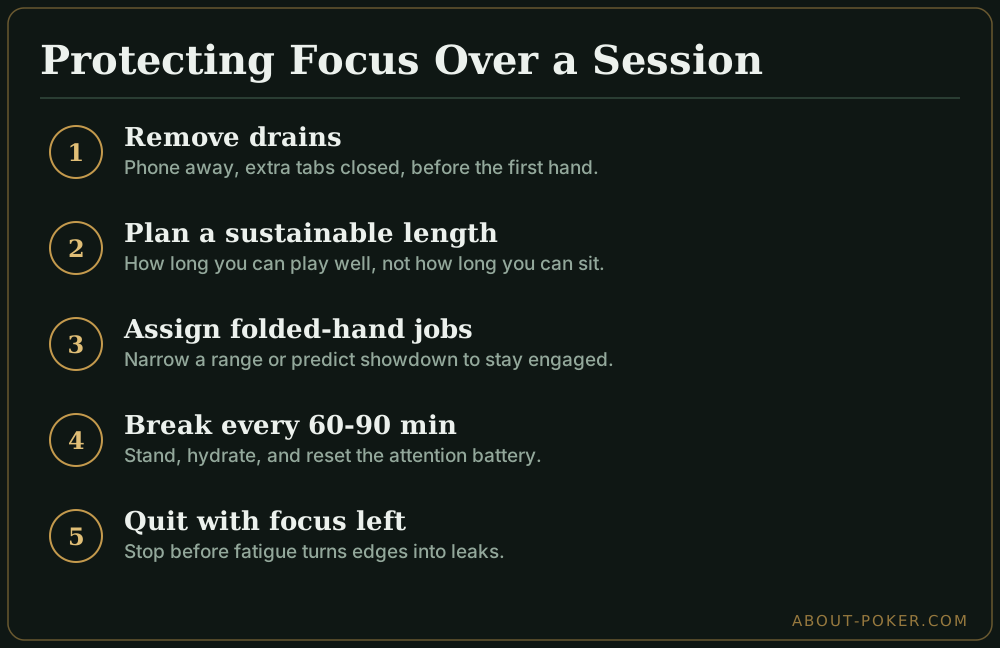
- Plan a sustainable length — how long you can play well, not just how long you can sit.
- Remove the phone and extra tabs before the first hand, not during.
- Break every 60–90 minutes: stand, hydrate, reset the battery.
- Assign a job on folded hands so idle time becomes information.
- Scale table count to difficulty; fewer tables when spots get close.
- Quit while you still have focus left, especially when winning.
Attention is the input that makes every other skill work. Protect it deliberately, and your existing knowledge finally gets to show up in the pots that decide your session.
Frequently asked
How do I stay focused at the poker table?
Treat attention as a battery that drains over time. Remove distractions, take short breaks every hour, keep sessions to a length you can actually sustain, and give yourself a job during folded hands — reading opponents — so your mind stays engaged instead of wandering to your phone.
Why do I lose focus late in sessions?
Focus is a finite resource that depletes with time, hunger, and repeated decisions. Late-session mistakes are usually mental fatigue, not skill gaps. The fix is shorter sessions, scheduled breaks, hydration, and quitting while you can still play your A-game.
Does multi-tabling hurt focus?
It splits attention, which is fine when you are running well and playing standard spots but costly in close decisions. During downswings or in tough games, drop table count so each decision gets full attention. Match your table load to the difficulty of the games.
How can I stop autopiloting in poker?
Give yourself an active task on every hand you are not in — narrow one opponent's range, note a bet-sizing tell, predict the winner at showdown. Engagement during folded hands is what keeps you out of autopilot and ready when a big spot arrives.